Bookmaker Football: The Complete Guide to Football Betting in 2026


Updated October 2026
Licensed
usAvailable in US
Fast payouts
18+ Only

Master football betting: odds, markets, strategies, and how to choose the best football betting sites in 2026.

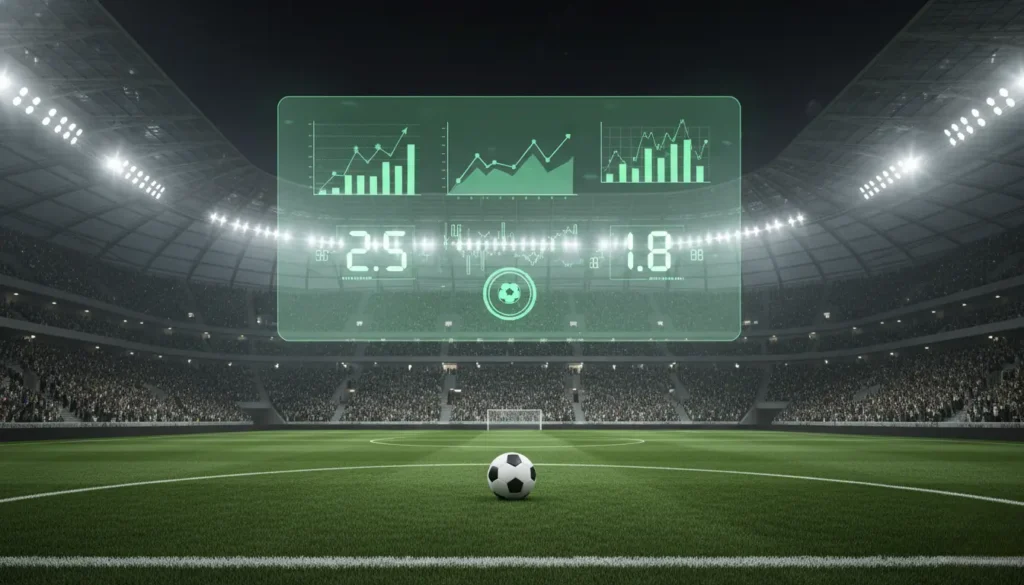
Professional football betting guide showing stadium with digital odds overlay and betting statistics

Introduction: What is Bookmaker Football?

Bookmaker football is the practice of wagering money on football matches through licensed betting operators who set odds and manage markets. These bookmakers act as intermediaries between bettors, offering standardized betting products across leagues worldwide while building profit margins into every market they offer.

The term “bookmaker” originates from the traditional practice of recording bets in a physical book. Modern bookmakers operate sophisticated digital platforms, but the fundamental business model remains unchanged: they accept wagers on both sides of an outcome, set odds that guarantee mathematical advantage regardless of result, and profit from the volume of bets rather than gambling on match outcomes themselves.

Football dominates global sports betting, with major bookmakers processing billions in wagers annually across competitions from the Premier League to lower-division matches. The accessibility of online betting platforms, mobile apps, and live in-game wagering has transformed bookmaker football from a specialized activity into a mainstream form of sports engagement.

Understanding how bookmakers operate, what differentiates betting sites, which markets offer value, and how to approach football betting systematically separates informed participants from those gambling blindly on instinct. This guide explains the mechanics, strategies, and realities of bookmaker football in practical terms.

How Football Bookmakers Actually Work

Bookmakers function as market makers for football betting, setting odds that allow them to profit regardless of which team wins. The business model depends on balancing their book—accepting roughly equal liability on both sides of a bet while building in a margin that guarantees profit over thousands of transactions.

The overround explained

Every football betting market includes an overround, also called the vig, juice, or margin. This is the bookmaker’s commission built into odds. For a match between two evenly matched teams, true fair odds might be 2.0 (even money) for each side. But a bookmaker might offer 1.90 for Team A and 1.90 for Team B. Converting these odds to probabilities: 1/1.90 = 52.63% for each team, totaling 105.26%. The 5.26% above 100% is the overround—the bookmaker’s edge. Over many bets, this mathematical advantage generates consistent profit regardless of individual results.

Different bookmakers impose different overrounds. Sharp bookmakers targeting professional bettors might work with 2-3% margins, offering better odds but lower limits. Recreational bookmakers might use 8-10% overrounds, offering worse prices but higher bet limits and extensive markets. The overround varies by league popularity—Premier League matches have tighter margins due to competition and liquidity, while lower-division or obscure league matches carry larger margins due to less efficient pricing.

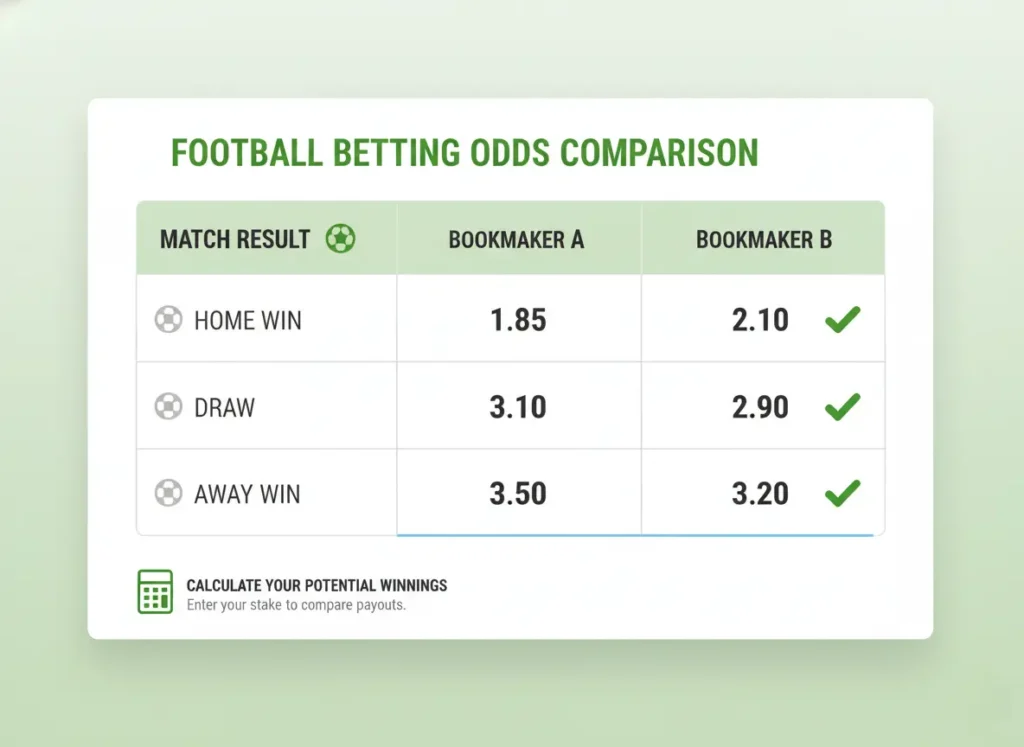
Football betting odds comparison dashboard showing different bookmaker prices and best value indicators
Comparing odds across multiple bookmakers helps identify the best value for your bets

How bookmakers set football odds

Odds compilation combines quantitative modeling, market monitoring, and trader judgment. Bookmakers use statistical models processing historical results, team form, injuries, weather conditions, and countless variables to generate opening odds. These opening odds represent the bookmaker’s assessment of true probabilities plus their margin. Once markets open, odds adjust dynamically based on incoming money. If one side receives disproportionate betting, odds shorten on that side and drift on the opposite outcome to encourage balancing action. The goal is managing liability rather than predicting results.

Major bookmakers employ professional traders monitoring markets continuously, adjusting prices in response to betting patterns, news events, team announcements, and odds movement at competing bookmakers. This creates an ecosystem where inefficiencies correct quickly. If one bookmaker’s odds are significantly out of line with the market, arbitrage bettors exploit the difference until prices converge. Understanding this mechanism explains why shopping for best odds matters—the same bet can return significantly different payouts depending on which bookmaker you use.

The hold percentage concept

Hold percentage describes the actual profit bookmakers retain from total betting handle. While the overround represents theoretical edge, hold percentage measures realized profit after accounting for sharp bettors, promotional costs, and market inefficiencies. A bookmaker with 5% overround might only hold 2-3% in practice because winning bettors extract value from less efficient markets and promotional offers reduce effective margin. Hold percentage varies significantly—recreational bookmakers might hold 8-10% on popular markets where casual bettors accept worse prices, while sharp bookmakers accept 1-2% hold from professional bettors betting large amounts at efficient prices.

Choosing the Right Football Betting Site

Selecting bookmakers involves evaluating multiple factors beyond just comparing odds. The right bookmaker depends on your betting style, stake sizes, geographic location, and priorities regarding markets, features, or customer service.

Licensing and regulation

Legitimate bookmakers hold licenses from recognized gambling authorities. The UK Gambling Commission provides the gold standard for regulation—bookmakers serving UK customers require UKGC licenses, subjecting them to strict operational standards, segregated customer funds, responsible gambling requirements, and dispute resolution procedures. Other reputable jurisdictions include Malta Gaming Authority, Gibraltar Gambling Commission, and Isle of Man Gambling Supervision Commission. Curacao licenses are common but offer less consumer protection. Unlicensed bookmakers operating without proper authority should be avoided entirely regardless of promotional offers or odds—you have no legal recourse if they refuse withdrawals or close your account arbitrarily.

Odds comparison and value

Odds quality varies dramatically between bookmakers. A bet at odds of 2.0 versus 1.90 on the same outcome represents 5.26% better value—over hundreds of bets, this difference compounds significantly. Sharp bookmakers targeting professional bettors offer consistently better odds with smaller margins but impose lower betting limits and might restrict accounts showing long-term profit. Recreational bookmakers accept larger stakes but charge higher margins through worse odds. Most serious bettors maintain accounts at multiple bookmakers, placing each bet with whoever offers best available price. This line shopping approach is fundamental to profitable betting.

Market variety and depth

Some bookmakers specialize in broad market offerings across hundreds of leagues worldwide, while others focus deeply on major competitions. If you bet Premier League weekend matches, any major bookmaker provides extensive markets. If you bet Albanian second division or South American youth football, you need bookmakers with deep market coverage in those specific areas. In-play betting markets have become crucial—bookmakers offering live betting with fast updates and extensive in-game markets provide more betting opportunities than those with limited live offerings. Bet builder features allowing custom combinations of markets appeal to recreational bettors but typically carry poor value due to correlation between selections not being properly reflected in pricing.

Betting limits and account restrictions

Bookmakers handle winning accounts differently. Some immediately restrict or close accounts showing consistent profit—these bookmakers want only recreational losing customers. Others tolerate winning players longer or accept professional action at sharp prices with high limits. If you bet seriously and develop an edge, you’ll eventually face restrictions. Sharp bookmakers might start you with £50 max bets and increase limits if your action appears professional and informed. Recreational bookmakers might offer £5,000 limits initially but slash them to £10 if you show consistent profit. Understanding each bookmaker’s policy toward winning accounts matters if you’re betting with serious intent rather than casual entertainment.

Payment methods and processing speed

Deposits should be instant, withdrawals should process within 24-48 hours. Bookmakers delaying withdrawals for “verification” lasting weeks raise red flags. E-wallets like PayPal, Skrill, and Neteller typically process fastest. Bank transfers work but take longer. Credit cards can fund accounts but many banks block gambling transactions. Cryptocurrency options provide privacy but aren’t universally available. Some bookmakers charge withdrawal fees or restrict certain methods for withdrawals despite accepting them for deposits. Read the fine print on banking policies before depositing.

Customer service quality

You’ll eventually need support—wrong settlement, technical issues, account verification problems, or withdrawal questions. Live chat with knowledgeable agents resolves issues fastest. Email support taking 48+ hours indicates understaffed operations. Phone support suggests serious customer service investment but is becoming rarer. Test customer service before depositing significant money—ask a simple question and evaluate response quality and speed.

Understanding Football Betting Odds

Odds communicate two things simultaneously: the probability of an outcome according to the bookmaker, and the payout you’ll receive if your bet wins. Understanding odds formats, implied probability, and value identification is fundamental to intelligent betting.

Decimal odds (European format)

Decimal odds represent total return per unit staked, including your stake. Odds of 2.5 mean betting £10 returns £25 if you win—£10 stake plus £15 profit. Calculating profit is simple: multiply stake by decimal odds, subtract original stake. Decimal odds are intuitive because they directly show total return, making quick value comparison easy. Converting decimal odds to implied probability: divide 1 by the decimal odds. Odds of 2.0 = 50% probability (1/2.0), odds of 3.0 = 33.33% probability (1/3.0), odds of 1.5 = 66.67% probability (1/1.5). This conversion reveals the bookmaker’s assessment of outcome likelihood including their margin.

Fractional odds (UK format)

Fractional odds like 5/2 or 11/4 show profit relative to stake, excluding the returned stake. Odds of 5/2 mean you profit £5 for every £2 staked—bet £10, win £25 profit plus your £10 stake back for £35 total return. Converting to decimal: divide the fraction and add 1. So 5/2 = 2.5 + 1 = 3.5 decimal odds. Fractional odds feel traditional but decimal odds are simpler for calculations and comparisons.

American odds (moneyline)

American odds use positive and negative numbers. Negative odds show how much you must stake to profit £100. Odds of -150 mean betting £150 wins £100 profit plus your £150 stake back. Positive odds show profit from £100 stake. Odds of +200 mean betting £100 wins £200 profit plus your £100 stake back. Converting American odds to decimal: for negative odds, divide 100 by the absolute value and add 1. For -150: (100/150) + 1 = 1.67 decimal. For positive odds, divide the number by 100 and add 1. For +200: (200/100) + 1 = 3.0 decimal. American odds are common in US sports betting but less intuitive than decimal format.

Implied probability vs true probability

The gap between implied probability (what odds suggest) and true probability (actual likelihood of outcome) determines value. Bookmaker odds of 2.0 imply 50% probability. If you calculate the team actually has 55% chance of winning, the bet offers positive expected value—you’re getting better odds than warranted by true likelihood. Finding these discrepancies systematically is how professional bettors profit. The bookmaker’s overround means implied probabilities always sum to more than 100%, so not every bet can be value. You need analysis superior to the market’s assessment to identify genuinely valuable opportunities.

Fair odds calculation

Removing the overround reveals “fair odds” representing market probability without bookmaker margin. For a match with odds of 1.90 on both teams, implied probabilities are 52.63% each, totaling 105.26%. To get fair odds, divide each implied probability by total probability: 52.63/105.26 = 50% fair probability for each team, converting to fair odds of 2.0. Comparing bookmaker odds to fair odds shows how much margin you’re paying. Some bettors only bet when they find odds better than calculated fair odds, using this as their value threshold.

Popular Football Betting Markets Explained

Bookmakers offer dozens of betting markets for major matches, each with different characteristics regarding variance, analysis requirements, and bookmaker edge. Understanding market mechanics helps you identify where your edge might exist.

Match result (1X2)

The foundational market offering three outcomes: home win (1), draw (X), away win (2). This market is the most liquid and efficiently priced because it attracts the highest betting volumes. Typical overrounds on Premier League 1X2 markets range from 3-6% at competitive bookmakers. The three-way nature means backing underdogs carries higher variance than two-way markets—your selection must win, not just avoid losing. Many recreational bettors focus exclusively on 1X2 because it’s simple and familiar, but this market often offers least value precisely because it’s most heavily bet and analyzed.

Double chance

This market combines two of the three 1X2 outcomes into one bet. Home win or draw, home win or away win, draw or away win. It provides insurance against the draw but at significantly shorter odds than backing the straight win. Mathematically, double chance pricing derives from 1X2 odds—bookmakers calculate it by combining the probabilities of the two outcomes you’re covering. The overround on double chance markets is typically higher than 1X2, making it generally poor value. It appeals to recreational bettors wanting safety, but the price for that safety makes it rarely worth the reduced variance.

Both teams to score (BTTS)

Simple binary market: will both teams score at least one goal each? Yes or no. This market has grown extremely popular because it’s uncorrelated with match result—both teams can score in a draw, home win, or away win. Analysis focuses on team offensive and defensive statistics, styles of play, and historical scoring patterns. Clean sheets dramatically affect BTTS—teams with strong defensive records keep more clean sheets, making BTTS less likely. Attacking teams in matches against defensive opponents might win comfortably but fail to concede, losing BTTS bets. The market is reasonably efficient at major books but can offer value in lower leagues where odds setting relies more on algorithms than detailed analysis.

Over/under goals

Betting whether total goals scored by both teams will be over or under a specified line, typically 2.5 goals. Over 2.5 goals wins if three or more goals are scored, loses if two or fewer. The .5 ensures binary outcomes without push. Some bookmakers offer 1.5, 3.5, 4.5 lines or even more granular options. Analysis involves team scoring rates, defensive quality, tactical approaches, and match context. High-scoring leagues like Bundesliga see higher goal lines than defensive leagues like Serie A. The correlation between goals and possession, shots, or expected goals provides analytical angles. Over/under markets can be more efficient than 1X2 because they’re less influenced by casual betting based on team reputation.

Asian handicap

This market eliminates the draw by giving one team a virtual goal advantage or deficit. A match at level odds becomes -0.5 favorite versus +0.5 underdog. Betting the -0.5 favorite means they must win the match for your bet to succeed—draw or loss means you lose. Betting +0.5 underdog wins if that team wins or draws. Asian handicaps range from 0.0 (draw no bet) through 0.25, 0.5, 0.75, 1.0, 1.5 and higher depending on team quality difference. Quarter-ball and half-ball handicaps provide more nuanced betting on mismatches. The format is popular in Asian betting markets and with professional bettors because it offers better odds than double chance while maintaining some draw insurance. Understanding the precise mechanics of different handicap levels is essential—a -0.75 handicap is actually two bets split between -0.5 and -1.0.

Correct score

Predicting the exact final score offers long odds but extremely low probability of success. A Premier League match might offer 1-0 at 7.0, 2-1 at 8.0, 0-0 at 9.0, with dozens of score options ranging to 5-5 at 100+ odds. Bookmaker overround on correct score markets often exceeds 20-30% because recreational bettors are drawn to long-odds outcomes despite terrible value. The high variance means even making correct analytical predictions doesn’t guarantee profit over reasonable sample sizes. Most professional bettors avoid correct score markets entirely—the high margins and variance make consistent profit nearly impossible. These markets exist primarily to attract recreational betting on low-probability outcomes at bad prices.

First/last/anytime goalscorer

Betting on which player scores first, last, or anytime during the match. Anytime goalscorer offers shortest odds because it includes any goal scored by your selection. First goalscorer pays longer odds but requires your player scores the opening goal specifically. Last goalscorer is similar but focuses on the final goal. Analysis involves player form, minutes played, penalty-taking duties, and opposing defensive quality. Strikers offer shorter odds than midfielders, who offer shorter odds than defenders. The bookmaker edge on goalscorer markets is substantial—often 15-25% overround because recreational bettors love backing specific players without properly calculating probabilities. The variance is extreme: even prolific strikers blank in most matches, and predicting exactly which player scores first among twenty-two requires substantial luck.

Halftime/fulltime

Betting on the result at both halftime and fulltime—nine possible combinations like Home/Home (leading at half, winning at full time) or Draw/Away (level at half, away team winning at full time). This combination market offers long odds on unlikely outcomes but carries massive overrounds, often 30%+ because bookmakers know casual bettors are attracted to the long odds without understanding how poor the value is. The correlation between halftime and fulltime results makes some combinations extremely unlikely—Home/Away (home team leading at half, away team winning at full time) rarely occurs because teams protecting leads tend to maintain them. These markets are primarily recreational betting vehicles.

Corners, cards, and specials

Bookmakers offer markets on corners (over/under corners, first corner, corner handicaps), cards (total bookings, player to be carded, red card yes/no), and countless specials (shot on target totals, offside counts, specific score in each half). These markets typically carry larger bookmaker margins than mainstream markets because they’re lower liquidity, harder to model accurately, and attract recreational betting. Some niche markets offer value opportunities when bookmaker pricing is inefficient, but most are designed to extract money from casual bettors betting on anything available rather than focusing on finding value. The further you drift from core markets like 1X2 and over/under goals, the larger the bookmaker edge typically becomes.


Football Bookmaker Toolkit
Three calculators built around this guide's own mechanics: whether a stake-capped odds boost is actually worth it, how much margin different market types really cost you, and how quarter-ball Asian handicaps settle.
This guide's own example: a favourite boosted from 1.5 to 2.0 but capped at £10 is worse for a serious bettor than plain 1.9 odds with no cap where you can stake your full planned amount. The boost only wins when your intended stake is at or below the cap — otherwise the volume you lose outweighs the better price.
Educational calculator, not betting advice. Always check the exact terms of any boosted or enhanced odds offer.
Based on the overround ranges this guide cites for each market. Core markets like 1X2 are priced tightly because they attract the most betting volume and scrutiny; niche markets like correct score or half-time/full-time carry much larger built-in margins because bookmakers know casual bettors chase long odds without checking the real cost.
These are typical ranges cited in the guide, not the exact margin of any specific bookmaker or match — always check the actual odds on both sides of a market to judge real value.
This guide notes that a quarter-ball handicap like -0.75 is really two separate half-stakes settled at the two neighbouring whole/half lines (here, -0.5 and -1.0). Each half settles independently — sometimes one wins while the other pushes or loses — which is why quarter handicaps can produce a partial win or partial loss instead of an all-or-nothing result.
Educational calculator illustrating standard Asian handicap settlement rules, not a prediction of any match outcome.
These tools are for education only and do not constitute betting advice or a guarantee of any outcome. Betting involves real risk of losing money. Please gamble responsibly, 18+ only. If you're struggling with gambling, contact GamCare or BeGambleAware.

Winning Strategies for Football Betting

Profitable football betting requires systematic approaches combining analytical edge, disciplined bankroll management, and emotional control. Casual betting based on supporting your favorite team or following tips rarely succeeds long-term.

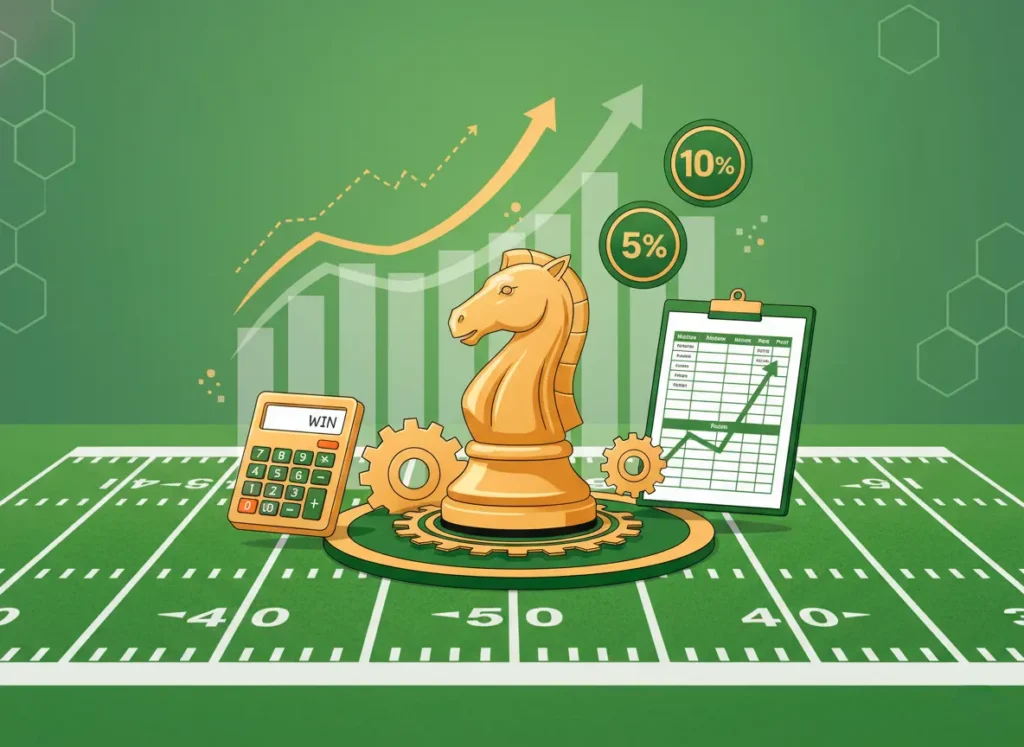
Strategic betting approach illustration with chess pieces, financial charts and bankroll management concepts
Successful betting requires strategic thinking and disciplined bankroll management

Value betting fundamentals

The core concept separating winning from losing bettors is value betting—wagering only when your assessed probability of outcome exceeds the implied probability from bookmaker odds. If you calculate a team has 60% chance of winning and the bookmaker offers odds implying 50% probability (2.0 decimal odds), you have a value bet. Over large samples, consistently betting at positive expected value produces profit regardless of short-term variance. The challenge is developing analysis superior to the market’s assessment. This requires specialized knowledge in specific leagues or markets, statistical modeling, or identifying information the market hasn’t fully priced in. Most bettors skip this work and bet based on instinct, then wonder why they lose consistently despite “knowing football.”

Specialization and edges

Profitable bettors typically specialize rather than betting everything available. You might focus on Championship home underdogs, Bundesliga over goals, or specific teams whose true quality you understand better than market prices suggest. Specialization builds expertise and helps identify patterns the broader market misses. Generalists betting Premier League, La Liga, Serie A, Ligue 1, and Bundesliga simultaneously compete against sharp money and informed opinions across all those leagues. Specialists focusing deeply on Norwegian second division or League One gain information advantages over bookmakers using algorithmic pricing without detailed knowledge of those leagues. Your edge comes from knowing something the market doesn’t, analyzing something better than consensus, or acting faster than other bettors when information emerges.

Bankroll management systems

Even profitable bettors with genuine edges lose 45-48% of bets due to variance inherent in probability. Bankroll management ensures you survive inevitable downswings without going broke before your edge plays out. The Kelly Criterion provides mathematical optimal staking based on edge and bankroll—bet percentage of bankroll equal to your edge. With 10% edge, bet 10% of bankroll. This maximizes long-term growth but requires accurate probability assessment and accepts high variance. Most professional bettors use fractional Kelly (half Kelly or quarter Kelly) sacrificing maximum growth for reduced variance and psychological comfort. A common amateur approach is flat staking—betting the same amount regardless of confidence. This works fine if you’re only betting value opportunities, but wastes potential on your strongest bets while over-allocating to marginal edges.

Units and stake sizing

Professional bettors think in units rather than currency amounts. One unit represents a standard bet size, typically 1-2% of bankroll. Betting 1 unit on decent value, 2 units on strong value, 3 units on rare maximum confidence bets creates hierarchy based on edge size. This prevents emotional betting—you’re following a system rather than deciding stakes based on how confident you “feel.” Recreational bettors often do the opposite, betting small on research-based picks and large on impulse bets based on nothing beyond wanting action on a televised match. Consistent unit sizing aligned with value assessment is fundamental discipline.

Line shopping across bookmakers

Having accounts at multiple bookmakers and always taking the best available odds dramatically impacts profitability. The difference between 1.90 and 2.0 on the same bet represents 5% better value—over hundreds of bets annually, this compounds to substantial profit increase. Serious bettors maintain accounts at 5-10 bookmakers, checking odds across all of them for every bet. Odds comparison sites automate this process, but don’t rely solely on them because they sometimes display outdated odds or miss bookmakers offering best prices. The extra work of checking multiple sites adds meaningful edge without requiring better analysis or prediction ability.

Live betting and in-play opportunities

In-play betting markets move rapidly based on match events, creating potential value opportunities when odds over-react to short-term developments or fail to properly update based on score, timing, or match flow. A team dominating possession but trailing 1-0 might offer value on the comeback as panic sellers take pessimistic odds. A red card dramatically changes match dynamics, but bookmaker’s automated adjustment might over- or under-correct immediately after the card. The challenge is you’re trading off analytical preparation time for execution speed—you must assess value in real-time while the match is evolving. Many bettors lose money live betting because they bet impulsively on matches they’re watching for entertainment rather than waiting for genuine value spots. Live betting demands even stricter discipline than pre-match betting because the constant available action tempts undisciplined wagering.

Statistical models and expected goals

Advanced statistical approaches like expected goals (xG) modeling provide objective metrics for team quality beyond results. A team winning 2-0 from two shots against opponents creating 15 high-quality chances might be overvalued by market focused on results rather than underlying performance. Teams consistently outperforming their xG might be due for regression, while teams underperforming xG might offer value if prices reflect recent poor results rather than quality of chances created. Building predictive models using historical data, team statistics, and contextual factors can identify inefficiencies in bookmaker pricing. The key is your model must be better than what bookmakers use—they employ professional analysts and sophisticated algorithms, so beating them requires serious statistical work rather than basic spreadsheet analysis.

Record keeping and tracking

Record keeping separates serious bettors from casual punters. Track every bet—date, match, market, odds, stake, result, and profit/loss. Spreadsheets work fine; specialized betting trackers work better. The data reveals patterns you’d never notice subjectively: which markets you’re profitable in, which leagues you should avoid, whether home favorites or away underdogs suit your analysis, if your live betting actually performs better than pre-match. Most bettors avoid this work because confronting actual results hurts—you’d rather believe you’re basically breaking even than see you’re down £800 over six months betting League Cup matches you know nothing about. The data provides objective feedback for improving rather than repeating mistakes indefinitely.

Bookmaker Bonuses and Promotions: Worth It or Not?

Bookmaker bonuses sound fantastic until you read the terms and conditions. The marketing screams “£50 FREE BET” while the small print explains you need to bet £300 at minimum odds of 1.5 within seven days or the bonus expires worthless. Understanding bonus mechanics prevents wasting time on offers that benefit the bookmaker more than you.

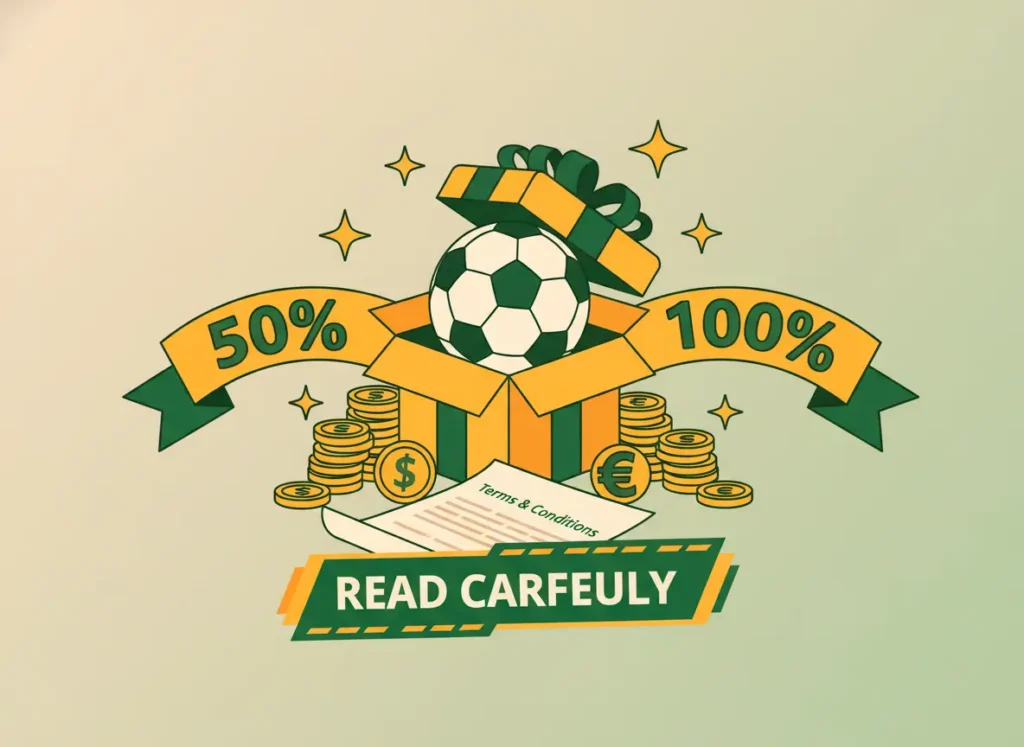
Bookmaker bonuses and promotions illustration showing gift rewards with warning symbols and terms documentation
Always read bonus terms carefully – not all promotions offer genuine value

Welcome bonuses

Welcome bonuses are the most aggressive promotions used to attract new customers. Common formats include deposit matches (bookmaker matches your first deposit up to a specified amount), free bet stakes (deposit and bet £10, get £40 in free bets), and risk-free first bets (get your stake refunded as a free bet if your first bet loses). The devil lives in the implementation details. Wagering requirements force you to bet through the bonus amount multiple times before withdrawing anything. Minimum odds requirements push you toward longer-priced bets than you’d choose naturally. Time limits create artificial urgency to bet quickly rather than waiting for good opportunities. Some bonuses are genuinely valuable—deposit £100, get a £100 free bet with reasonable terms creates extra bankroll for finding value. Other bonuses are mathematical traps dressed as generosity—deposit £100, get £100 locked bonus requiring £600 of betting at minimum odds 2.0 within 48 hours is basically a scam.

Evaluate bonuses by calculating expected value

Evaluate bonuses by calculating expected value rather than getting seduced by headline numbers. A £50 bonus requiring £300 of betting at bookmaker margins of 6% costs you £18 in expected losses to unlock the bonus—your £50 bonus actually costs you £18, making it worth £32 in real value. If you were planning to bet anyway and the bonus adds value without forcing bad bets, grab it. If the requirements push you into betting you wouldn’t otherwise make, skip it entirely and just bet your own money at better odds elsewhere. The promotional-focused bookmaker with the massive bonus might be worse value overall than the sharp bookmaker with no bonus but 2% better odds on every bet.

Free bet mechanics

Free bet mechanics confuse many bettors because “free” doesn’t mean what it intuitively should. Most free bets return only the profit, not the stake. Winning a £10 free bet at odds of 3.0 pays you £20 (2.0 × £10 in profit), not £30 (3.0 × £10 total return). This stake-not-returned structure means free bets are worth roughly 70-80% of their face value, not 100%. Use free bets on longer-priced selections to maximize value—the stake not being returned hurts less at odds of 5.0 than odds of 1.5. Some bettors use free bets for matched betting strategies, placing opposite bets at exchanges to guarantee profit regardless of outcome. This works but bookmakers have gotten sophisticated about detecting and restricting matched bettors.

Enhanced odds promotions

Enhanced odds promotions look attractive but come with catches. Bookmaker boosts Premier League favorite from 1.5 to 2.0 and restricts maximum stake to £10—you’re getting extra value but limited to small bets. The economics work because bookmakers lose £5 on your £10 bet but gain massive customer acquisition or reactivation worth far more than that small loss. Take enhanced odds when they appear on bets you’d make anyway, but don’t let them dictate your betting strategy. A boosted price of 2.0 restricted to £10 is worse than unboosted odds of 1.9 where you can bet £500 if that’s your planned stake anyway.

The fundamental question with any bonus is whether it makes you a profitable customer for the bookmaker or actually provides value to you. Bookmakers offer bonuses because they work as customer acquisition tools—the average player deposits, claims the bonus, loses their money betting poorly, and never withdraws anything. Be the exception who extracts genuine value from bonuses while betting smartly enough to profit overall. That means reading terms carefully, calculating expected value honestly, and walking away from bonuses with terrible conditions rather than convincing yourself they’re good deals.

Live Football Betting at Online Bookmakers

Note: This section was listed in the Table of Contents but no content was provided in the original document for this section.

Mobile Football Betting: Apps vs Browser

Mobile betting dominates football betting in 2026 — over 70% of bets are placed via smartphones rather than desktop computers. The convenience of betting anywhere combined with push notifications about matches, odds changes, and bet settlements makes mobile the primary betting interface for most people. Quality varies enormously between platforms.

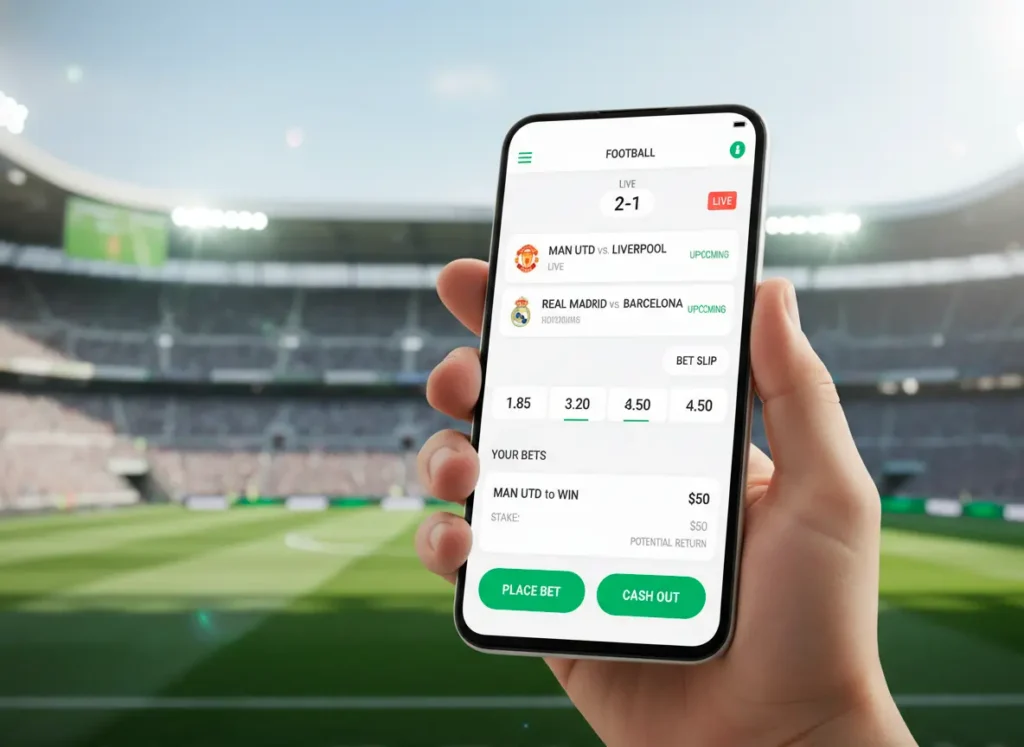
Modern smartphone displaying football betting app interface with live matches, odds and bet slip
Mobile betting apps offer convenience and instant access to live football markets

Native mobile apps generally provide better experiences than mobile browser versions—faster load times, smoother navigation, offline functionality for checking bet history, and push notifications for important updates. iOS and Android apps from major bookmakers are typically well-designed with intuitive interfaces optimized for touchscreens. The disadvantage is apps take up phone storage and you need separate apps for each bookmaker you use. Serious bettors with accounts at 5-7 bookmakers end up with folders full of betting apps cluttering their home screens.

Essential mobile features include one-tap bet placement from home screens to matches, simplified bet slips that don’t require multiple confirmation steps, Face ID or fingerprint authentication for quick login, and reliable performance during high-traffic periods when major matches are live. Nothing is more frustrating than finding value in a live betting situation, opening your app, and watching it crash or freeze while odds move past the opportunity.

Responsible Gambling with Football Bookmakers

Responsible gambling concept showing balanced approach to betting with protective elements and limit controls
Practice responsible gambling by setting limits and maintaining healthy betting habits

Note: This section was listed in the Table of Contents but no content was provided in the original document for this section.

The Future of Football Bookmakers

Note: This section was listed in the Table of Contents but no content was provided in the original document for this section.

Conclusion

Football bookmakers are tools—neither inherently good nor bad, just mechanisms for wagering on matches with odds and terms dictated by profit-seeking businesses. Your success depends on understanding how these tools work, choosing bookmakers aligned with your betting style, and approaching betting with discipline and realistic expectations.

The fundamentals don’t change regardless of technological advances or market evolution: find value by identifying odds higher than true probabilities, manage your bankroll to survive inevitable downswings, shop lines across multiple bookmakers to get best available prices, specialize in areas where you can develop genuine information edges, and track results honestly to learn from data rather than selective memory.

The bookmaker wants your money and built mathematical advantages into every market. You can still profit, but it requires respect for the competition and commitment to doing the work most bettors avoid. Welcome to football betting—now you know how the game actually works.

FAQ

What’s the difference between a bookmaker and a betting exchange for football?

Traditional bookmakers set their own odds and take the opposite side of your bet—when you back Arsenal, the bookmaker is laying Arsenal against you. Betting exchanges like Betfair match bettors against each other, with the platform taking commission on winnings instead of building margin into odds. Exchanges let you both back and lay outcomes, essentially acting as your own bookmaker. They typically offer better odds because they operate without traditional overround, though they require more sophisticated understanding of betting mechanics.

How do I know if a football bookmaker is legitimate and safe?

Check for valid licensing from recognized authorities like the UK Gambling Commission, Malta Gaming Authority, or Curacao eGaming—license information should be displayed prominently on the website and verifiable with the regulator directly. Research the bookmaker’s operational history and reputation through reviews on sites like Trustpilot and specialized betting forums, looking for patterns of payment issues or unfair practices. Test customer service responsiveness before depositing serious money. Avoid bookmakers with unclear licensing, numerous unresolved complaints, or terms giving them unlimited discretion to void bets.

Can I consistently make money betting on football with bookmakers?

Professional bettors prove it’s possible, but the vast majority of people lose money long-term. Success requires systematic value betting—identifying odds higher than true probabilities through superior analysis—combined with strict bankroll management, line shopping across multiple bookmakers, specialization in specific leagues or markets, and disciplined record-keeping. It’s a business requiring work, patience, and emotional control rather than gambling for entertainment. Most people can’t maintain the discipline required, which is why bookmakers profit consistently. If you’re betting for fun, set limits and accept losses as entertainment costs rather than expecting profit.

Skip to toolbar