
How Bookmakers Set Football Odds: Behind the Numbers
 Available in US
bettors treat bookmaker odds like weather—something that just appears fully formed, beyond understanding or influence. You check the app, see Manchester City at 1.5 to beat Brighton, and either bet it or don’t based on whether that price feels right. But odds don’t materialize from thin air. Behind every number sits a complex process involving mathematical models, human traders, market dynamics, and behavioral psychology. Understanding how bookmakers actually set odds transforms you from someone reacting to prices into someone evaluating whether those prices make sense.
I’ve spent years on both sides of this equation—placing bets as a punter and consulting for a mid-sized European bookmaker during a brief career detour that taught me more about odds compilation than a decade of betting ever could. The gap between what bettors think happens and what actually happens is enormous. Most people assume bookmakers have some mystical insight into match outcomes. Reality is far more interesting and exploitable.
Bookmakers aren’t trying to predict results accurately. That might sound counterintuitive, but it’s fundamental to understanding odds. Their goal is creating prices that attract roughly balanced action on both sides of a market, locking in profit regardless of outcome through the margin built into odds. When that balance fails and they end up exposed to one side, that’s when human judgment and risk management become critical. The process combines automated systems, statistical modeling, trader expertise, and constant adjustment based on how money moves through markets.
Understanding this process reveals opportunities most bettors never see. You stop asking “who will win this match?” and start asking “where has the bookmaker mispriced the probability?” That shift in perspective separates long-term winners from people who occasionally get lucky before giving everything back.
The Foundation: Mathematical Models and Statistical Analysis

Every bookmaker starts with quantitative models attempting to predict match outcomes based on measurable factors. These models evolved dramatically over the past two decades from relatively simple systems into sophisticated algorithms processing massive datasets. The fundamental approach remains consistent even as technical sophistication increases—convert available information about teams, players, and match circumstances into probability estimates for different outcomes.
Historical performance data forms the bedrock. Models analyze results over multiple seasons, weighting recent matches more heavily than distant history. A team’s record from three seasons ago matters less than their last ten matches, but both factor into the calculation. The weighting formulas vary between bookmakers—some emphasize recent form heavily, others prefer larger sample sizes spanning longer periods. Neither approach is objectively correct; they represent different philosophies about what drives future performance.
Expected goals models revolutionized football analytics and odds setting over the past decade. Rather than treating all wins equally, expected goals frameworks evaluate chance quality. A team winning 1-0 while being outshot 20-3 and surviving through goalkeeper heroics gets assessed differently than a team winning 1-0 while dominating possession and creating numerous quality chances. This distinction matters enormously for predicting future performance—the first team was probably lucky, the second was probably unlucky despite identical results.
Bookmakers incorporate expected goals data extensively now, though implementation varies. Sharp bookmakers like Pinnacle integrate it deeply into their models, adjusting prices based on underlying metrics rather than just results. Recreational bookmakers sometimes lag behind, creating exploitable situations where their odds haven’t fully adjusted to reflect expected goals analysis that sharp bettors are using.
Team strength ratings update continuously based on performance, with different systems for calculating relative strength. Elo rating systems adapted from chess provide one framework—teams gain or lose points based on results against opponents of varying quality. Beating a strong team adds more points than beating a weak team. Losing to a weak team costs more points than losing to a strong team. These ratings create baseline expectations for any potential matchup.
More sophisticated models incorporate dozens of variables beyond simple results and expected goals. Possession statistics, passing accuracy, pressing intensity, defensive organization, set piece efficiency—modern tracking data provides granular information about team capabilities. The challenge is determining which variables actually predict future performance versus which just describe past matches without predictive power. Models constantly get refined as analysts identify which factors matter and which are noise.
Player-level data adds another analytical layer. Team strength isn’t static—it fluctuates based on which players are available. A team missing their starting striker and two midfielders isn’t the same team the model analyzed over the previous season. More advanced models adjust team ratings based on lineup information, though this requires accurate data about player availability and impact that isn’t always reliable until lineups are confirmed hours before kickoff.
Home advantage remains one of the most consistent factors in football. Teams win more matches at home across all leagues and levels, though the magnitude varies. Premier League home advantage averages around 0.3-0.4 goals per match, while some leagues show stronger effects. Models apply home advantage adjustments automatically, though the 2020-2021 pandemic period with empty stadiums demonstrated that crowd presence drives meaningful portion of that advantage.
The models spit out probability estimates for different outcomes—home win, draw, away win, plus probabilities for various score lines, goal totals, and other markets. These probabilities represent the starting point for odds, not the final prices. Multiple steps remain before those probabilities become the odds you see on screen.
Converting Probabilities into Odds: The Margin Question
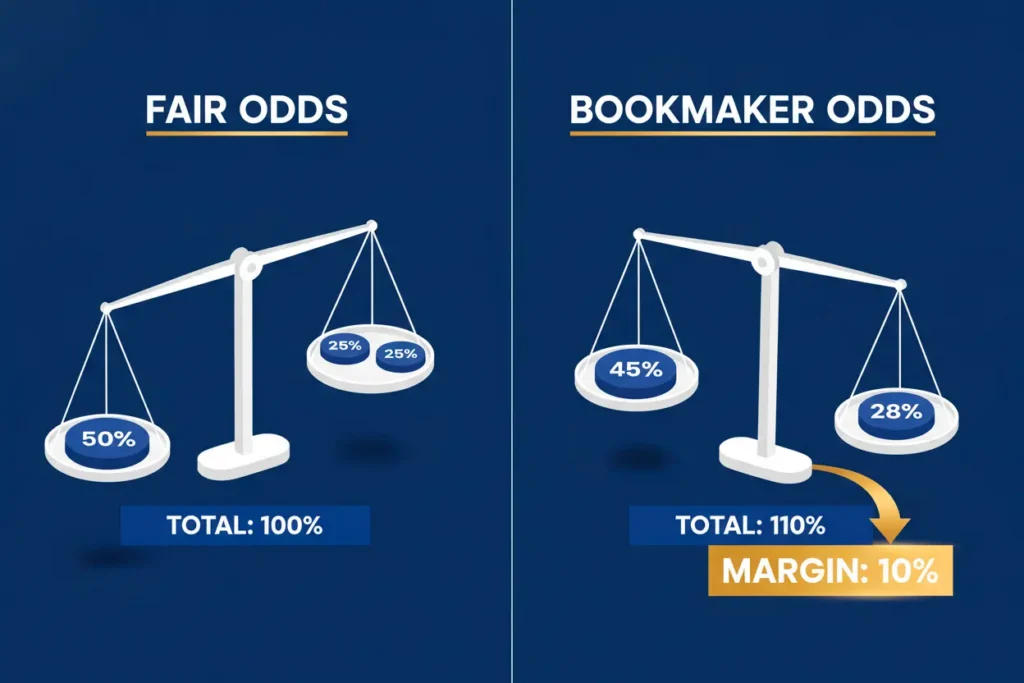
Raw probability estimates from models need converting into odds that ensure bookmaker profit. This is where the overround or margin enters—the difference between a fair market totaling 100% probability and the inflated total bookmakers create that guarantees profit.
Imagine a match where the model estimates 50% home win probability, 25% draw probability, and 25% away win probability. Fair odds would be 2.0 for home, 4.0 for draw, and 4.0 for away. Add those implied probabilities and you get exactly 100%. If bookmakers offered these odds, they’d break even long-term before operating costs—every pound wagered gets returned to bettors as winnings on average.
Bookmakers add margin by reducing all odds proportionally. That same match might become 1.85 home, 3.50 draw, and 3.50 away. Now the implied probabilities total approximately 110%—the extra 10% is bookmaker margin ensuring long-term profit regardless of which outcome occurs. If they take £1000 on each outcome (£3000 total wagered), they’ll pay out roughly £2700 to winners, keeping £300 as profit from the margin.
Margin size varies strategically. High-profile matches with efficient markets carry tighter margins, sometimes as low as 2-3% with sharp bookmakers. Small matches in obscure leagues might have 8-12% margins because bookmakers are less confident in their pricing and face lower competition. The bookmaker can charge higher margins on matches where bettors have fewer alternatives and less information to challenge pricing accuracy.
Different bookmaker types apply different margin philosophies. Exchange models like Betfair operate with minimal direct margin because they’re facilitating peer-to-peer betting rather than taking positions themselves. They profit from commission on winnings instead. Sharp bookmakers like Pinnacle use low margins but aggressive bet limiting—they’ll take large bets at tight prices from anyone, trusting their models to break even on individual bets while profiting from aggregate volume.
Recreational bookmakers build higher margins but offer promotions, enhanced odds, and loyalty incentives. Their business model assumes most customers are losing bettors who value convenience and entertainment over optimal pricing. The margin enables funding those promotional costs while still generating profit. These bookmakers actively limit or ban winning bettors because their model requires maintaining a customer base that loses consistently.
The margin doesn’t get applied uniformly across outcomes. Bookmakers often shade odds based on expected betting patterns. If they anticipate heavy public backing for the favorite, they might artificially lower favorite odds beyond what the margin alone would suggest, creating extra value on the underdog side to encourage balancing action. This shading creates exploitable situations—the true value often lies betting against heavily backed favorites that have been over-shortened.
The Role of Traders: Human Judgment in Odds Setting
Automated models generate starting prices, but human traders make final decisions about what odds actually get offered. This human element matters more than most bettors realize. Traders aren’t just monitoring systems—they’re making constant judgment calls about when to trust the model versus when to override it based on information the model can’t process.
Breaking team news exemplifies trader importance. Lineups get confirmed typically 60-75 minutes before kickoff. An automated model might have set odds assuming a team’s star striker would play, but when team sheets reveal he’s benched, those odds need immediate adjustment. Traders must quickly evaluate the impact—not just that the striker isn’t playing, but who replaces him, how significant the drop-off is, and what this means for team tactics and expected goals.
Injury news, managerial changes, weather conditions, motivational factors—dozens of variables emerge between initial odds publication and kickoff that models struggle to quantify. An experienced trader knows that a manager facing potential dismissal might produce anomalous short-term results either through desperate tactical innovation or through complete team morale collapse. The model treats that match like any other between those two teams. The trader applies judgment about which narrative is more likely.
Market monitoring forms a major trader responsibility. Odds at one bookmaker don’t exist in isolation—they’re constantly compared against competitor prices and betting exchange markets. If your odds are significantly out of line with the broader market, something is wrong. Either your model has identified genuine value that others missed, or you’ve made a mistake. Traders must quickly determine which scenario applies.
Sharp betting patterns trigger trader alerts. When known professional bettors or betting syndicates place large wagers, that’s a signal that the odds might be mispriced. Traders might tighten odds immediately, increase the margin, or reduce betting limits while they reassess whether the sharp money indicates a pricing error. Recreational betting patterns get ignored—the trader doesn’t care that thousands of casual bettors are backing Manchester United because they’re Manchester United fans. Sharp money commands attention because it usually reflects informed analysis.
Traders manage liability exposure across all markets. It’s not enough for individual match odds to be accurate if the bookmaker ends up heavily exposed on one side. A trader might adjust odds not because they’ve changed their view on match outcome probability, but because they need to attract balancing action to reduce risk. This is why odds movements don’t always reflect new information about the match—often they reflect liability management.
Risk appetite varies between bookmakers and influences trader behavior. Risk-averse operations want balanced books on every match. Risk-tolerant operations might deliberately take positions when confident their odds are accurate and public opinion creates value on the opposite side. A trader at a risk-tolerant bookmaker might see heavy backing for the favorite, recognize that public sentiment is creating value on the underdog, and actually widen odds on the favorite further rather than shorten them, welcoming the unbalanced book because they believe the underdog has more chance than the public thinks.
Live Betting: Odds Setting in Real-Time

Live betting transformed the industry over the past 15 years and represents the most challenging odds setting environment. Pre-match odds can be calculated carefully with time for analysis. In-play odds must adjust second-by-second as match situations evolve, requiring a combination of algorithmic speed and human judgment operating under time pressure.
Automated live pricing models track match state continuously. The model knows the current score, time elapsed, which team has possession, field position, recent shot attempts, and various other real-time metrics depending on data feed sophistication. It recalculates win/draw/loss probabilities constantly based on these changing inputs. A team trailing 1-0 at 30 minutes has different comeback probability than the same deficit at 85 minutes. The model quantifies these differences.
Live betting markets get suspended frequently around significant events—goals, penalties, red cards, substitutions. The instant a goal gets scored, the market suspends while the model recalculates new odds based on the changed score. This suspension prevents sophisticated bettors with faster data feeds from exploiting latency—betting on outcomes they already know occurred before the bookmaker’s feed updates. Even a two-second information advantage creates massive edge in live betting.
Traders monitor live markets more actively than pre-match because things change rapidly. A red card at 25 minutes fundamentally alters match dynamics in ways the pre-match model never contemplated. The trader must quickly decide how much to adjust odds, considering factors the algorithm struggles with—which player was sent off, whether this helps or hurts the team’s tactical approach, how the opposition might exploit the advantage.
Live betting attracts sharp action from bettors with sophisticated real-time analysis. Some professional betting operations employ people watching matches with statistical models that calculate value faster than bookmaker models update. The moment they identify mispricing, they bet heavily before the bookmaker corrects. This creates an adversarial dynamic where traders know that aggressive live betting might signal their odds are wrong, triggering faster and more conservative adjustments.
Live odds margins are typically wider than pre-match because of uncertainty and risk. The bookmaker is more exposed to both modeling errors and information asymmetry in live markets. They compensate by building larger margins and reacting more aggressively to betting patterns. A bet that would be accepted pre-match might trigger immediate odds adjustment or rejection when placed live because the bookmaker is more sensitive to the possibility that the bettor has information or analytical edge.
Cash-out functionality ties into live odds because cash-out offers are calculated using current in-play prices plus bookmaker margin. The more accurately a bookmaker prices live markets, the tighter they can make cash-out spreads while still protecting themselves. Bookmakers with sophisticated live trading operations offer better cash-out value than those with crude in-play pricing.
Different Markets, Different Approaches
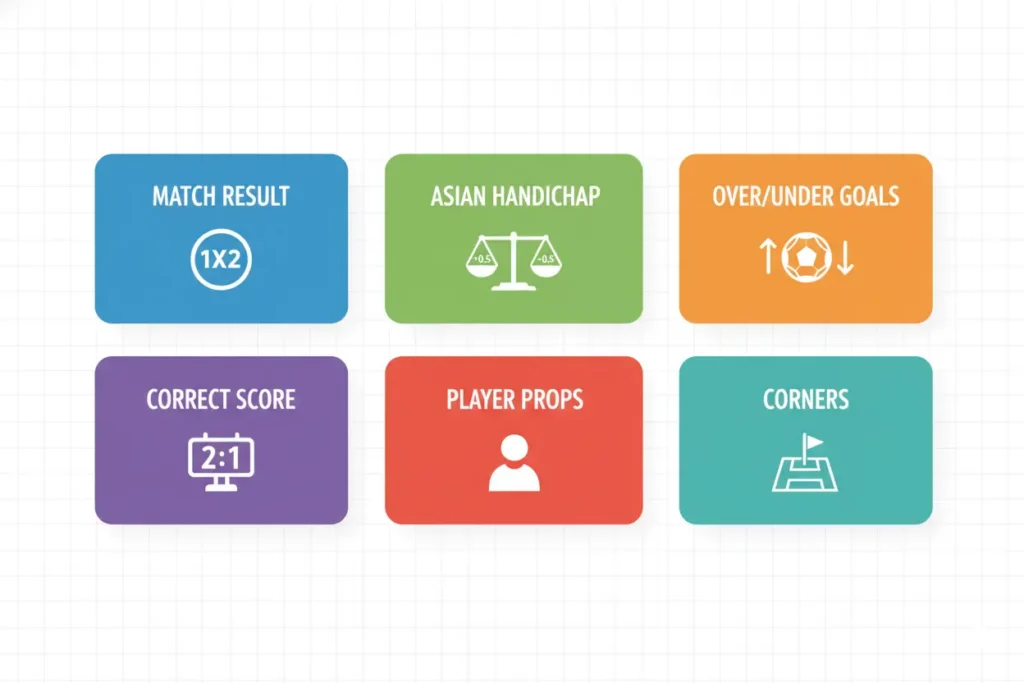
Bookmakers don’t apply uniform methodology across all market types. Match result markets get the most analytical attention and tightest margins because they generate most volume. Niche markets get less sophisticated pricing, creating opportunities for specialists who develop expertise in specific market types.
Asian handicap markets require different modeling than traditional three-way markets. The elimination of draw outcomes and use of quarter-goal and half-goal lines creates unique pricing challenges. Bookmakers focusing on Asian handicaps, particularly those serving Asian market customers, develop specialized expertise. European bookmakers sometimes treat Asian handicaps as secondary markets with wider margins because they lack in-house expertise.
Over/under markets seem straightforward but involve subtleties around correlation with match result. Goals aren’t distributed randomly—teams trailing late score fewer goals on average than teams drawing or leading because they’re facing opponents defending leads. Models must account for these correlations rather than treating over/under as independent from result markets.
Player prop markets like anytime goalscorer or player shots on target are exploding in popularity but remain less efficiently priced than main markets. The analytical challenge is enormous—modeling individual player performance requires understanding playing time probability, position, team tactics, opposition defensive attention, and current form. Many bookmakers essentially guess at these prices, building large margins as protection against uncertainty.
Correct score markets carry high margins because precise score prediction is extremely difficult. A match might have clear favorite, but whether they win 1-0, 2-0, 2-1, or 3-1 is much harder to model accurately. Bookmakers protect themselves with 15-20% margins on correct score markets, knowing that even with inflated margins these markets remain popular because of the high odds available.
Corner markets illustrate how bookmakers price secondary markets opportunistically. Corner counts show some correlation with possession and attacking play but also significant randomness. Rather than building sophisticated corner prediction models, most bookmakers set wide margins and adjust primarily based on betting patterns rather than rigorous analysis. This makes corner markets potentially exploitable for bettors who do develop systematic corner prediction approaches.
Common Misconceptions About Odds Setting
The biggest misconception is that bookmakers have inside information or superior predictive ability making their odds inherently accurate. Reality is bookmaker odds represent starting points that get refined through market forces. On major matches, market efficiency drives odds toward accuracy. On smaller matches, odds might be substantially wrong if sharp money doesn’t flow in to force corrections.
Bookmakers aren’t trying to predict results correctly—they’re trying to create prices that balance their risk exposure while building in profit margin. An efficiently priced market might give a team 50% win probability, but the bookmaker doesn’t care if that team actually wins. They care that roughly equal money comes in on both sides, locking in profit from the margin regardless of outcome.
People assume odds movements mean bookmakers are changing their predictions about match outcomes. Usually odds movement reflects risk management responding to betting patterns, not new analytical insights about the match. If odds on Barcelona shorten from 1.5 to 1.3, it probably means heavy betting on Barcelona forced the bookmaker to adjust for liability management rather than the bookmaker deciding Barcelona is more likely to win.
The idea that bookmakers always want balanced books is oversimplified. Risk-averse bookmakers prefer balanced exposure, but sophisticated operations sometimes take positions when they believe their odds are accurate and public money is creating value on the opposite side. If confident their model is right and the public is wrong, bookmakers occasionally welcome unbalanced books to exploit bettor bias.
Betting limits aren’t arbitrary—they reflect bookmaker confidence in their odds. Lower limits on obscure markets or smaller matches signal less confidence in pricing accuracy. Higher limits on major matches reflect confidence that odds are defensible even against sharp bettors. When bookmakers adjust limits for specific bettors, it signals they view that bettor as informed and dangerous rather than recreational.
Exploiting Odds Setting Knowledge
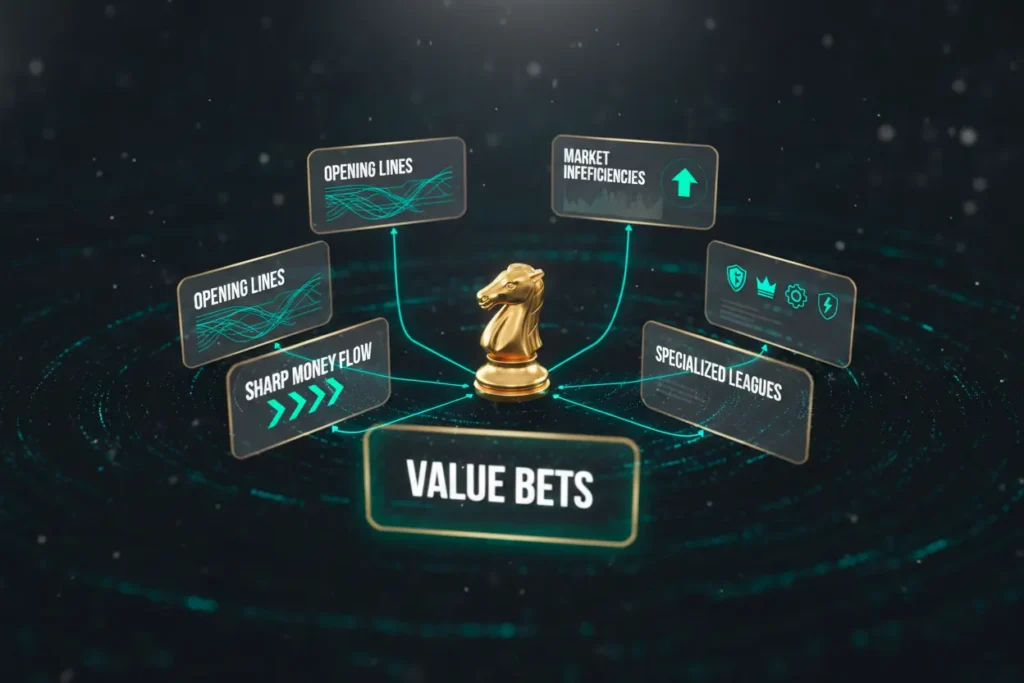
Understanding odds compilation reveals exploitable inefficiencies. Bookmakers are good at their jobs but not perfect. Structural biases, analytical limitations, and risk management priorities create opportunities for informed bettors.
Beat the opening price in inefficient markets. Odds on major matches move toward efficiency quickly as professional money flows in. But smaller matches might open with significant mispricing that persists longer. If you can analyze these matches faster than the bookmaker adjusts their odds, opening lines offer value.
Focus on markets where bookmakers build high margins as protection against uncertainty. Those wide margins signal analytical weakness. If you can model those markets more accurately than the bookmaker, the value opportunities are substantial. This requires genuine expertise rather than casual opinions, but the payoff makes it worthwhile.
Exploit situations where bookmaker risk management creates predictable bias. Fading heavily bet favorites in high-profile matches often provides value because bookmaker shading creates artificially short odds. Backing unpopular sides that media and public undervalue offers edge that compounds over time.
Monitor odds movements to identify where sharp money flows. Rapid odds movements on lower-profile matches often signal informed betting rather than public action. Following sharp money doesn’t guarantee profit—professional bettors also lose—but it indicates where sophisticated analysis suggests value exists.
Specialize in specific leagues or markets where you can develop expertise exceeding bookmaker models. Bookmakers spread analytical resources across hundreds of competitions. Deep knowledge of one league creates information advantages that bookmakers can’t match without similar specialization. This is how professional bettors operate—finding niches where they know more than the market.
Understanding how bookmakers set odds doesn’t make beating them easy, but it transforms betting from gambling based on hunches into strategic analysis of whether offered prices make mathematical sense. The bookmaker has advantages through bankroll, information resources, and market position. Your advantage comes from focus, specialization, and exploiting the structural inefficiencies that odds setting inevitably creates. Welcome to the real game behind the game—now you know how the prices you see actually get made.
Discover professional insights on Top Bookmaker Football.
To truly beat the market, you must learn how to calculate Expected Value (EV) in football bets.
