
Football Betting Markets Explained: Complete Bookmaker Guide
 Available in US
Walk into any conversation about football betting and someone inevitably asks “who do you fancy for the match?” As if betting on football begins and ends with picking match winners. That narrow view ignores the reality that modern bookmakers offer dozens—sometimes hundreds—of different ways to bet on any given match. Understanding the full range of markets available and which ones suit your knowledge and strategy transforms betting from a binary win-or-lose proposition into a nuanced landscape with multiple paths to profitability.
The explosion of betting markets over the past two decades changed football betting fundamentally. Twenty years ago, you could bet on the result, maybe back a correct score if you were feeling ambitious, and that was essentially it. Now a Premier League match might have two hundred separate betting opportunities covering everything from total goals to individual player statistics to obscure propositions like throw-in counts. This proliferation creates both opportunity and confusion. More markets mean more chances to find value, but also more ways to make poorly considered bets on outcomes you don’t actually understand.
I’ve bet on football markets ranging from straightforward match results to absurdly specific player props that took genuine research to evaluate properly. Some markets are elegant in their simplicity—either a thing happens or it doesn’t. Others involve multiple correlated outcomes that require understanding conditional probabilities most bettors never consider. The markets you choose to bet should align with your knowledge base and analytical approach rather than just whatever looks interesting when scrolling through a betting app.
This guide breaks down major betting markets bookmakers offer, explaining mechanics, strategic considerations, and where each market type fits in a complete betting approach. The goal isn’t encouraging you to bet every market available—that’s a recipe for spreading yourself thin and betting on outcomes you can’t properly evaluate. The goal is understanding options so you can focus on markets where your knowledge creates genuine edge.
Match Result Markets: The Foundation
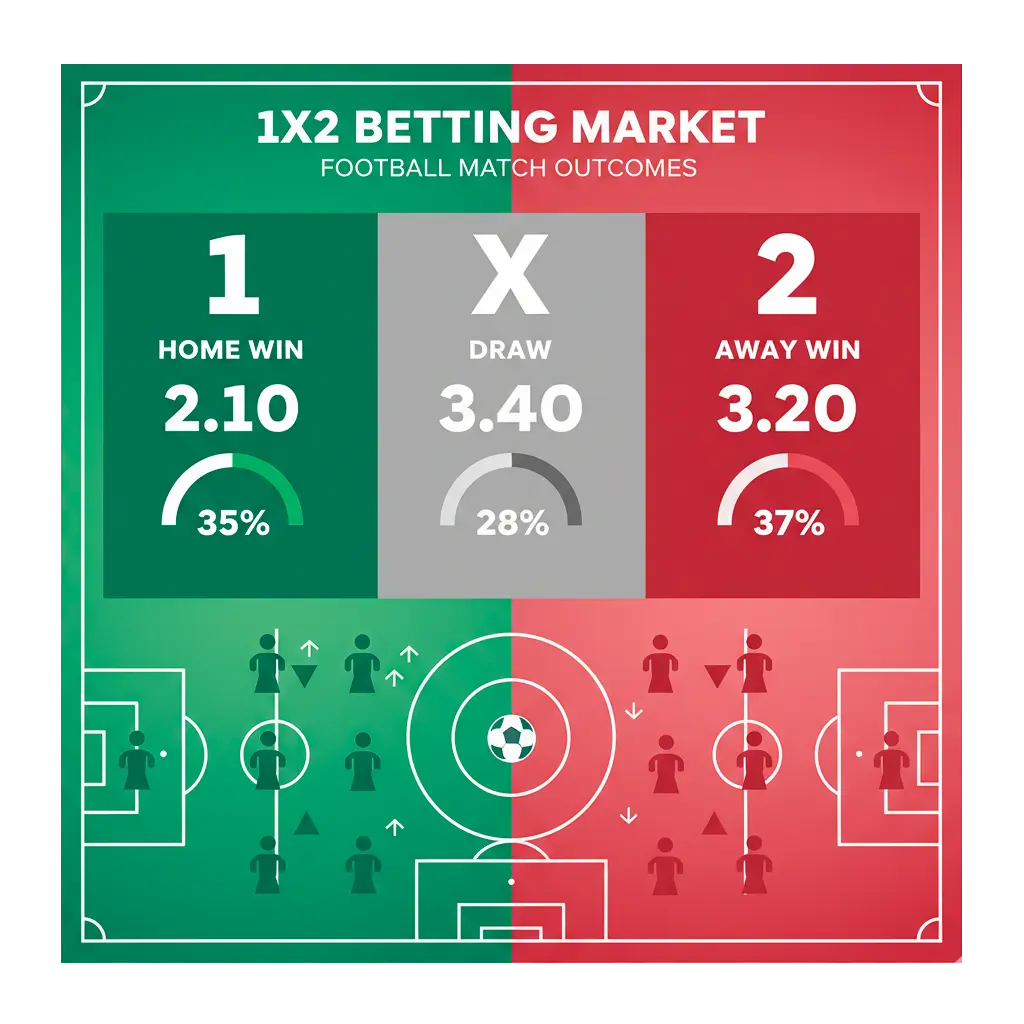
Match result betting—often called 1X2 for home win, draw, away win—represents the purest form of football betting. You’re predicting which team wins or whether the match ends level. The simplicity is both strength and weakness. Anyone can understand the market, but that accessibility means bookmakers price it with enormous efficiency. Finding value requires genuine analytical edge rather than casual opinions.
The three-way nature of football results creates interesting dynamics compared to sports with two possible outcomes. Draws happen roughly 25-30% of the time across major leagues, varying by competition and style. This third outcome increases bookmaker margins since they’re building edge into three prices instead of two. The combined implied probability of home win, draw, and away win odds typically totals 105-108% at mainstream bookmakers—that extra 5-8% is their margin.
Match result markets favor teams playing at home, though home advantage varies by league and has decreased slightly over recent years. Premier League home advantage averages around 0.3-0.4 goals per match currently. Championship and lower divisions often show stronger home effects. Understanding typical home advantage in the specific league you’re betting helps evaluate whether offered odds properly reflect the impact of venue.
The efficiency of match result markets on major matches makes them challenging for consistent profitability. Bookmakers dedicate most analytical resources to pricing these markets accurately, and professional bettors hammer any mispricing quickly. Your edge in Premier League match result betting likely comes from superior information about lineup news, tactical matchups, or motivational factors rather than raw statistical analysis everyone else has access to.
Lower-profile matches offer more opportunity for match result value. A Tuesday afternoon League Two match receives less analytical attention from bookmakers and less betting volume to drive market efficiency. If you develop expertise in lower leagues through watching matches and tracking team dynamics, you can identify situations where bookmakers have mispriced results based on superficial analysis or outdated information.
Backing draws deliberately seems counterintuitive to many bettors, but draw betting offers strategic value in specific situations. Matches between evenly matched defensive teams often produce draws more frequently than bookmaker odds suggest. The public undervalues draws because backing a draw feels like actively hoping for boring football. This bias creates situations where draw odds offer mathematical value even though you’re betting on what most people consider the unexciting outcome.
Understanding how different result markets interact helps with hedging strategies. If you’ve backed a team to win pre-match but they concede first, draw odds lengthen significantly. Backing the draw at inflated odds while holding your original bet creates profit potential across multiple outcomes. These hedging opportunities appear constantly in live betting when score changes create temporary market inefficiencies.
Over/Under Goals: Tempo and Style

Total goals markets remove the question of which team wins and focus purely on match tempo and quality. The most common lines are over/under 2.5 goals, though bookmakers increasingly offer multiple lines including 1.5, 3.5, and 4.5 goals. The half-goal framing eliminates push outcomes—the match either goes over or under with no ambiguity.
Analyzing over/under effectively requires different thinking than result betting. Team strength matters less than playing style and tactical approach. Two elite attacking teams meeting in a must-win situation creates over potential even if you can’t confidently predict which side wins. Conversely, two defensive teams playing cautiously might produce under conditions regardless of which team ultimately prevails.
Expected goals data revolutionized over/under analysis by providing better measures of team attacking and defensive quality than raw goal tallies. A team scoring two goals per match through sustained quality chance creation differs fundamentally from a team scoring two goals per match through occasional moments of individual brilliance or defensive mistakes. Expected goals helps distinguish between sustainable scoring patterns and results driven by variance.
Situational factors dramatically impact goal totals in ways casual bettors often miss. Teams needing wins to avoid relegation or secure European qualification play more open football, increasing goal probability. Teams comfortable mid-table with nothing to play for often produce turgid low-scoring affairs. Weather conditions matter—heavy rain or strong winds generally reduce scoring slightly though less than recreational bettors assume.
The correlation between match result and total goals creates strategic betting considerations. Favorites winning convincingly tend toward overs, while underdogs grinding out draws or narrow wins tend toward unders. Understanding these correlations helps avoid contradictory positions like backing an underdog while also backing over—these outcomes work against each other mathematically even though both technically could happen.
Live betting on totals offers unique advantages because you’re watching the match tempo develop in real time. A match might close at over/under 2.5 goals at even money, but if it reaches halftime 0-0 after limited chances, under odds drop significantly while over odds increase. If you’re watching and see the match playing more open than the scoreline suggests, betting over at inflated odds creates value.
Different leagues show different typical goal distributions worth understanding. Bundesliga historically shows higher scoring than Serie A. Championship matches average more goals than Premier League matches despite lower quality because tactical approaches differ. These baseline expectations inform whether bookmaker totals lines on specific matches represent value or just reflect the league-wide norm.
First half goals markets and team totals create variations on the basic concept. You might bet first half over/under 1.5 goals rather than match total, focusing on whether teams start aggressively. Or bet team totals like Manchester City over 2.5 goals scored rather than match total, isolating one team’s attacking performance. These derivative markets often show less efficient pricing than main totals lines.
Asian Handicap Markets: Eliminating the Draw
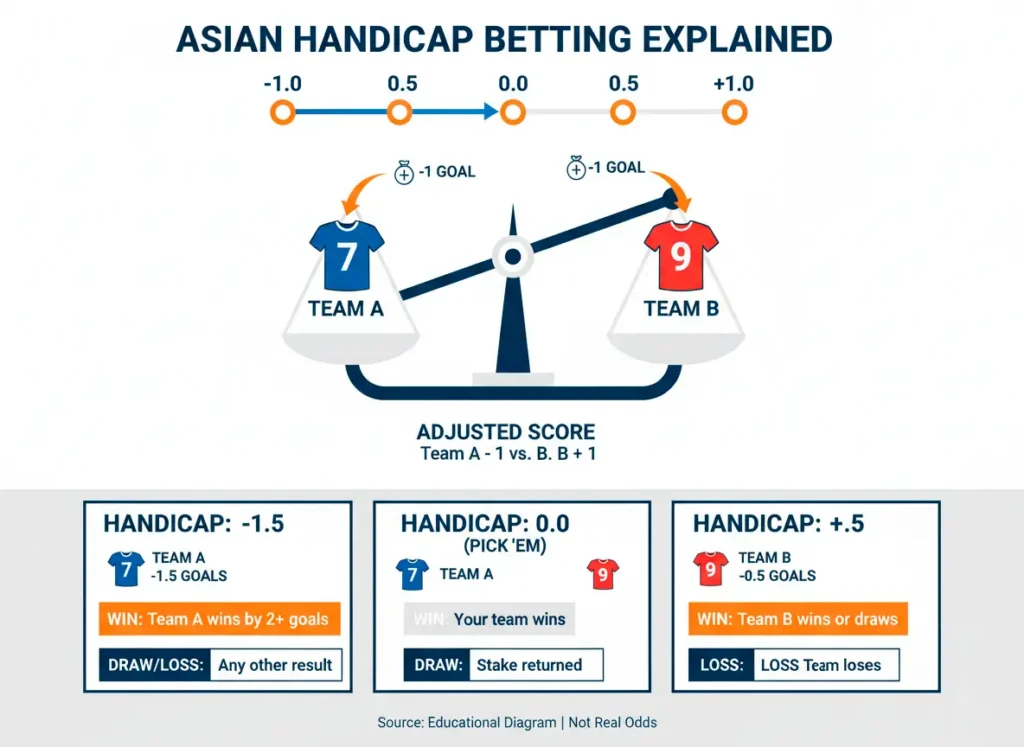
Asian handicaps revolutionized football betting by removing the draw outcome and creating two-way markets. One team receives a goal handicap—might be -1.5 goals or +0.5 goals—that’s applied to the final score for betting purposes. The handicap structure means your bet either wins or loses with no draw settlement, fundamentally changing the mathematics and strategic considerations.
The mechanics require understanding but make sense with examples. Manchester City -1.5 handicap means City must win by at least two goals for the bet to win. They win 2-0, you win. They win 1-0, you lose because applying the -1.5 handicap makes the adjusted score 0-1.5 against City. The team receiving the handicap essentially starts with a goal advantage for betting purposes.
Bookmakers offer Asian handicaps in quarter-goal and half-goal increments creating nuanced lines. A -0.75 handicap splits your stake between -0.5 and -1.0, creating partial win/loss scenarios. The team wins 1-0, half your stake wins on the -0.5 handicap while half pushes on the -1.0 handicap and returns. These split handicaps reduce variance compared to full-goal handicaps while maintaining the two-way nature.
The advantage of Asian handicaps is eliminating bookmaker edge on the draw outcome. Traditional 1X2 markets have three outcomes the bookmaker builds margin into. Asian handicaps have two outcomes, typically with 103-104% combined implied probability compared to 106-108% on 1X2 markets. This 2-4% difference becomes significant over hundreds of bets, making Asian handicaps more attractive from a pure mathematical edge perspective.
Strategic use of Asian handicaps involves identifying matches where one team should win comfortably but backing them straight at low odds isn’t attractive. Manchester City might be 1.30 to beat a relegation candidate. City -1.5 handicap might offer 1.80 odds—much better value if you believe City wins by multiple goals. You’re essentially expressing a view on margin of victory rather than binary win/lose.
The handicap market moves fluidly based on team news and betting patterns. If a star striker misses the match for the favorite, handicap lines tighten—maybe -1.5 becomes -1.0 as the bookmaker adjusts expectations for comfortable victory. Understanding these movements and what drives them helps identify value when handicaps haven’t adjusted properly to new information.
Asian handicaps work particularly well for live betting because the handicap adjusts continuously as the match develops. A team ahead 1-0 might be offered at +1.5 handicap for the remainder of the match, essentially giving them a 2.5 goal buffer for betting purposes. These live handicaps create hedging opportunities and arbitrage potential between pre-match and in-play markets.
The mental framing of Asian handicaps differs from traditional betting and requires adjustment. You’re not backing teams to win—you’re backing adjusted outcomes after applying goal advantages. A team might win the actual match but lose on the handicap, or lose the actual match but win on the handicap. This disconnect between real result and betting result trips up bettors who don’t fully internalize how handicaps work.
Both Teams to Score: Simplicity with Edge
Both teams to score (BTTS) markets offer elegant simplicity—either both teams score at least once or they don’t. This binary outcome removes complexity around which team wins or total goals while focusing on a specific event with reasonably predictable probabilities based on team attacking and defensive metrics.
The mathematical independence of BTTS from match result creates interesting strategic possibilities. You can back BTTS while staying neutral on which team wins, creating profit potential across multiple final scores. You can combine BTTS with specific result predictions—backing BTTS and home win creates positively correlated positions where both bets likely succeed together or fail together.
Analyzing BTTS probability requires evaluating both teams’ attacking threat and defensive vulnerability. A match between two strong attacking teams who both concede regularly shows high BTTS probability. A match between a strong attacking team and a defensive team that rarely scores shows low BTTS probability regardless of the expected result. The question isn’t “who wins?” but rather “will both teams score at least once?”
Clean sheet statistics inform BTTS analysis more directly than attacking metrics alone. A team that keeps clean sheets frequently makes BTTS unlikely in their matches. A team that rarely keeps clean sheets increases BTTS probability. The percentage of matches where teams fail to score provides clear guidance on BTTS likelihood that betting markets sometimes misprice.
Situational factors affect BTTS probability in ways casual analysis misses. Teams already relegated or safely mid-table might play more open football that increases scoring from both sides. Cup matches where teams take risks create BTTS conditions even between mismatched opponents. Weather rarely matters as much as people think—heavy rain affects passing quality but rarely prevents all goals completely.
The correlation between BTTS and total goals needs consideration when combining bets. BTTS yes naturally correlates with overs—if both teams score, you’re already at 2+ goals. Backing both BTTS and over 2.5 goals creates significant overlap where one bet succeeds, the other likely succeeds too. This isn’t necessarily wrong but means you’re concentrating risk rather than diversifying across independent outcomes.
Live BTTS betting offers value when one team scores early. If the favorite leads 1-0 after fifteen minutes, BTTS odds lengthen significantly even though substantial time remains. If you were considering BTTS pre-match, the value often improves after early goals as odds temporarily overshoot. The key is evaluating whether the trailing team maintains reasonable scoring threat despite falling behind.
The “BTTS and win” market combining both outcomes into single bets appeals to recreational bettors but typically shows poor value. You’re accepting lower odds for convenience rather than placing separate bets that might offer better combined returns. Occasionally the combination bet shows mathematical value but usually you’re better served backing BTTS and result separately if you want both positions.
Correct Score and Player Props: High-Risk, High-Reward

Correct score betting represents football betting’s lottery ticket—huge odds for predicting exact scorelines but low probability of success. The most common scores like 1-0, 2-1, and 1-1 typically offer 6-9/1 odds while more unusual scorelines like 3-3 or 4-2 might be 50/1 or higher. The mathematics work against you severely—bookmaker margins on correct scores often reach 130-150%, meaning you’re fighting massive built-in disadvantage.
Despite poor expected value, correct score betting appeals to people who want the chance at significant returns from small stakes. Correctly predicting 3-2 at 28/1 turns a modest bet into memorable profit. The strategy isn’t betting correct scores regularly but rather using them occasionally in specific situations where you have strong conviction about the likely flow and outcome of a match.
Analyzing correct scores requires different thinking than other markets. Instead of asking “will there be goals?” or “who wins?” you’re asking “what’s the exact goal distribution most likely?” This involves understanding both teams’ attacking patterns and defensive vulnerabilities at granular level. A team that scores frequently but also concedes changes the score distribution compared to teams that grind out low-scoring victories.
The “score draw” category lumping all draws like 1-1, 2-2, 3-3 together often shows better value than backing individual draws. You’re still predicting a draw but accepting any scoring draw rather than the exact score. The odds might be 4-5/1 rather than 6-7/1 for individual scores, but you’ve massively increased your probability of winning by accepting multiple outcomes.
Correct score betting has strategic application for accumulator final legs. You might have four selections already successful with strong conviction about a fifth match. Rather than adding another 1.50 favorite that barely increases returns, you add a correct score at 8/1 that substantially increases potential profit while still having reasonable chance of success based on your analysis.
Player props—betting on individual player performances like goalscorers, assists, shots on target, completed passes—create markets where specialized knowledge about individual players creates genuine edge. Bookmakers price these markets less efficiently than main markets because the analytical work tracking individual player data exceeds what most recreational bettors do.
Anytime goalscorer markets represent the most popular player prop. You’re betting that a player scores at least one goal regardless of timing or final result. Odds reflect perceived scoring probability based on player position, recent form, opponent quality, and other factors. Forwards might be 2-4/1 while defenders might be 10-15/1 or higher.
First goalscorer props offer higher odds than anytime but require more luck. You need the player not just to score but to score first. Even prolific strikers score first in only 30-40% of matches where they score. The increased odds compensate somewhat but the additional variance makes first goalscorer betting less attractive from pure expected value perspective.
Last goalscorer betting shows even more variance but occasionally offers value late in matches. If a striker hasn’t scored and their team trails needing goals, substitution patterns and desperation attacking make them stronger last goalscorer candidates than odds suggest. Live betting on last goalscorer in specific situations creates opportunities casual pre-match betting doesn’t.
Player card markets—betting on specific players to receive yellow or red cards—require understanding refereeing tendencies, player discipline records, and tactical matchups. Certain players accumulate cards consistently through aggressive defending or poor discipline. Certain referees issue cards more freely than others. Certain tactical matchups produce more physical battles where cards become likely.
Minutes played props and player performance specials appear at some bookmakers for major matches. You might bet on whether a player completes 90 minutes, makes a certain number of passes, or achieves multiple statistical categories. These markets remain thinly traded with high margins, creating opportunity for bettors who track detailed player statistics and understand tactical contexts affecting individual performance.
The analytical challenge with player props is incorporating lineup uncertainty and playing time risk. A player might offer value to score based on recent form, but if there’s 30% chance they don’t start or get substituted after 60 minutes, that significantly changes expected value. Understanding manager rotation patterns and monitoring team news becomes essential for player prop betting.
Correlation between player props and team performance creates interesting betting combinations. You might back a striker to score anytime while also backing their team to win, creating positively correlated positions where both bets likely succeed or fail together. Or back opposition players to score while staying neutral on match result, creating decorrelated positions where you profit in multiple scenarios.
Corner and Card Markets: Alternative Angles
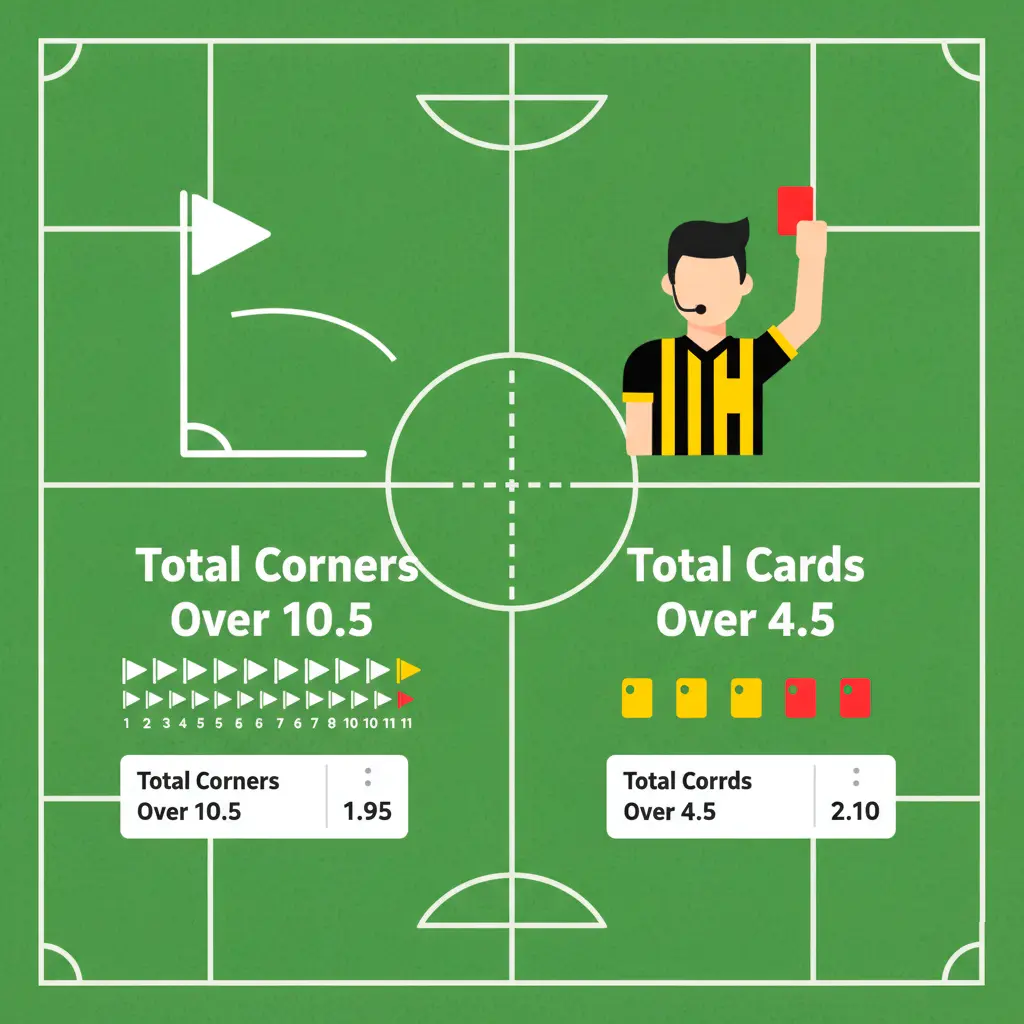
Bookmakers increasingly offer markets on match events beyond goals and results. Corners, cards, and other statistics create betting opportunities for bettors who track these metrics and understand what drives variation in these counts.
Total corners markets work similarly to goal totals—you’re betting over or under a specified number. Typical lines fall around 9.5 or 10.5 total corners for major matches. Corner counts correlate moderately with team possession and attacking play but show substantial randomness. A team dominating possession might generate twelve corners or six corners depending on how defending team channels attacks and luck around deflections.
Team corners markets let you bet on specific teams rather than match totals. Dominant home teams against defensive opposition might generate ten corners while conceding two. Betting on their team corners over rather than match total over provides better odds if you’re confident about one-sided corner distribution. Understanding defensive tactics and how teams defend corners helps evaluate likely corner distributions.
Corner handicaps apply Asian handicap principles to corners, eliminating draw outcomes and potentially reducing margins. These work identically to goal handicaps but for corner counts instead. A team might be -3.5 corners, meaning they must win the corner count by at least four to cover.
Card markets betting on yellow and red cards attract bettors who understand refereeing tendencies and disciplinary patterns. Total cards over/under lines typically sit around 3.5 or 4.5 cards for major matches. Certain leagues are more physical and generate more cards—Championship matches average more cards than Premier League matches despite lower quality.
Player-specific card markets offer value when certain players face opponents they struggle against stylistically or have historical disciplinary issues with specific referees. A defender known for tactical fouling facing rapid attackers creates higher card probability than generic player card odds suggest. These situations require detailed knowledge about player tendencies and matchups that casual bettors don’t consider.
Booking points markets assign point values to cards—typically ten points for yellow cards, twenty-five points for red cards. This creates different distribution than simple card counts because one red card dramatically impacts totals. The volatility makes booking points challenging but potentially exploitable if you identify matches with elevated red card probability.
The margins on corner and card markets typically exceed margins on main markets because bookmakers have less confidence in their pricing. This creates opportunity for bettors who specialize in these areas and develop superior models. The analytical work required deters most bettors, reducing competition and allowing inefficiencies to persist.
Building Market-Specific Expertise
The proliferation of betting markets creates choice overload where bettors jump between markets randomly rather than developing genuine expertise. The profitable approach is identifying markets where your knowledge and analytical approach creates edge, then focusing effort there rather than spreading attention across everything available.
Market selection should align with your information sources and analytical strengths. If you watch matches extensively and can evaluate tactical matchups, result markets and Asian handicaps let you leverage that knowledge. If you prefer statistical analysis using databases and expected goals models, total goals and BTTS markets reward that approach. If you track individual players obsessively, player props become your focus.
Specializing in overlooked markets where bookmaker pricing is less sophisticated offers advantages over competing in efficient markets like Premier League match results. Corner markets, lower-league results, player props in less prominent matches—these areas receive less analytical attention and less sharp betting volume, creating more persistent inefficiencies to exploit.
Understanding correlations between markets prevents contradictory positions. Betting a team to win while also betting under totals creates opposing forces—the team probably needs to score multiple goals to win, working against the under. Some correlations work positively—backing a striker to score while backing their team to win creates synergy. Think through these relationships before placing multiple bets on same matches.
Tracking performance by market type reveals where you actually make money versus where you think you make money. You might believe you’re good at picking match winners but discover your profit comes entirely from BTTS bets. The data provides objective feedback for focusing effort on markets where you demonstrate actual rather than imagined edge.
Market depth and liquidity matter for bet sizing. Main markets like results and totals handle large bets with minimal impact on odds. Niche markets like corners or player props often have tight limits because bookmakers aren’t confident accepting large liability on those markets. Scale your bets appropriately based on market liquidity rather than betting identical amounts across different market types.
The betting landscape continues evolving with new markets appearing regularly. Micro-betting on events resolving in seconds, increasingly granular player props, live betting markets updating continuously—staying current with what’s available and where value emerges requires ongoing attention. The markets that offered best value five years ago might be efficient now while new markets have emerged creating fresh opportunities.
Understanding betting markets deeply transforms you from someone reacting to whatever options appear into someone strategically selecting markets where you have genuine advantages. The bookmaker wants you betting randomly across markets you don’t understand because that’s how they extract maximum edge. Your path to profitability lies in specialization, expertise, and disciplined focus on markets where your knowledge creates quantifiable value. Welcome to strategic market selection—now you understand what you’re actually betting on.
Master the fundamentals on our main portal.
One of the most popular professional markets is explained in our Asian Handicap betting guide.
