
Asian Handicap Betting Explained: The Complete Football Guide
 Available in US
Asian handicap betting eliminates the draw from football wagering, leaving only two possible outcomes: one team wins or the other does. This fundamental shift changes everything about how you approach a match. Instead of three-way markets where draws drain value and complicate calculations, Asian handicaps create a binary choice with near-50/50 implied probabilities. The format originated in Indonesia, spread throughout Asia, and has become the preferred market for professional football bettors worldwide. Understanding it properly opens doors to tighter margins, better value, and more sophisticated betting strategies than traditional 1X2 markets allow.
The genius of Asian handicaps lies in how they level the playing field. When Manchester City faces a relegation-threatened side, the 1X2 odds on City might be 1.15 — terrible value requiring City to win about 87% of the time just to break even. Asian handicaps solve this by giving the underdog a virtual head start. City might need to win by two or more goals to cover a -1.5 handicap, suddenly making the bet interesting again. The handicap transforms a lopsided mismatch into a genuine contest between two betting options.
How Asian Handicaps Work: The Basic Principle
Every Asian handicap assigns a goal advantage or disadvantage to each team before kick-off. The favourite receives a negative handicap (they start behind); the underdog receives a positive handicap (they start ahead). When the match ends, you apply the handicap to the actual scoreline to determine your bet result.
If Liverpool are -1.0 against Bournemouth, they start the match at a virtual 0-1 deficit. Liverpool must win by more than one goal for a bet on them to succeed. A 2-0 Liverpool win becomes 2-1 after the handicap — Liverpool still ahead, bet wins. A 1-0 Liverpool win becomes 1-1 after the handicap — a draw, and your stake is refunded (this is called a “push”). A 1-1 actual draw becomes 1-2 after the handicap — Bournemouth ahead, bet loses.
Conversely, Bournemouth at +1.0 starts with a virtual goal advantage. They win your bet if they win, draw, or lose by exactly one goal (push). Only losing by two or more means your bet loses. This asymmetry explains why Asian handicaps appeal to bettors seeking downside protection on underdogs or enhanced odds on favourites.
The elimination of draws as a losing outcome is crucial. In traditional 1X2, backing an underdog means losing when they draw — roughly 25-30% of Premier League matches. With Asian handicaps, draws either become wins (with positive handicaps like +0.5 or higher) or pushes (with whole number handicaps). This fundamentally changes the risk-reward calculation.
Half-Goal Handicaps: No Pushes, Clean Results
Half-goal handicaps (0.5, 1.5, 2.5, etc.) guarantee a definitive result because no team can score half a goal. There’s no push possibility — your bet either wins or loses.
A -0.5 handicap on the favourite is functionally identical to backing them on the 1X2 market. They must win; draws and losses mean you lose your bet. The odds should be nearly identical to the 1X2 win price, though Asian handicap markets often have tighter margins.
A +0.5 handicap on the underdog means they win your bet if they win or draw. Only an outright loss fails. This is equivalent to a “double chance” bet (Draw or Away) but typically offered at better odds due to lower Asian market margins.
A -1.5 handicap requires the favourite to win by two or more goals. Scorelines like 2-0, 3-1, 3-0, 4-2 all succeed. Winning by exactly one goal (1-0, 2-1) loses your bet, as does any draw or defeat.
A +1.5 handicap means the underdog can lose by one goal and your bet still wins. They’re effectively starting 1-0 up with an extra half-goal cushion. Only losing by two or more goals loses your bet.
The pattern continues: -2.5 requires a three-goal winning margin, +2.5 allows losing by up to two goals, and so on. The larger the handicap number, the more extreme the required result.
Whole-Goal Handicaps: The Push Possibility
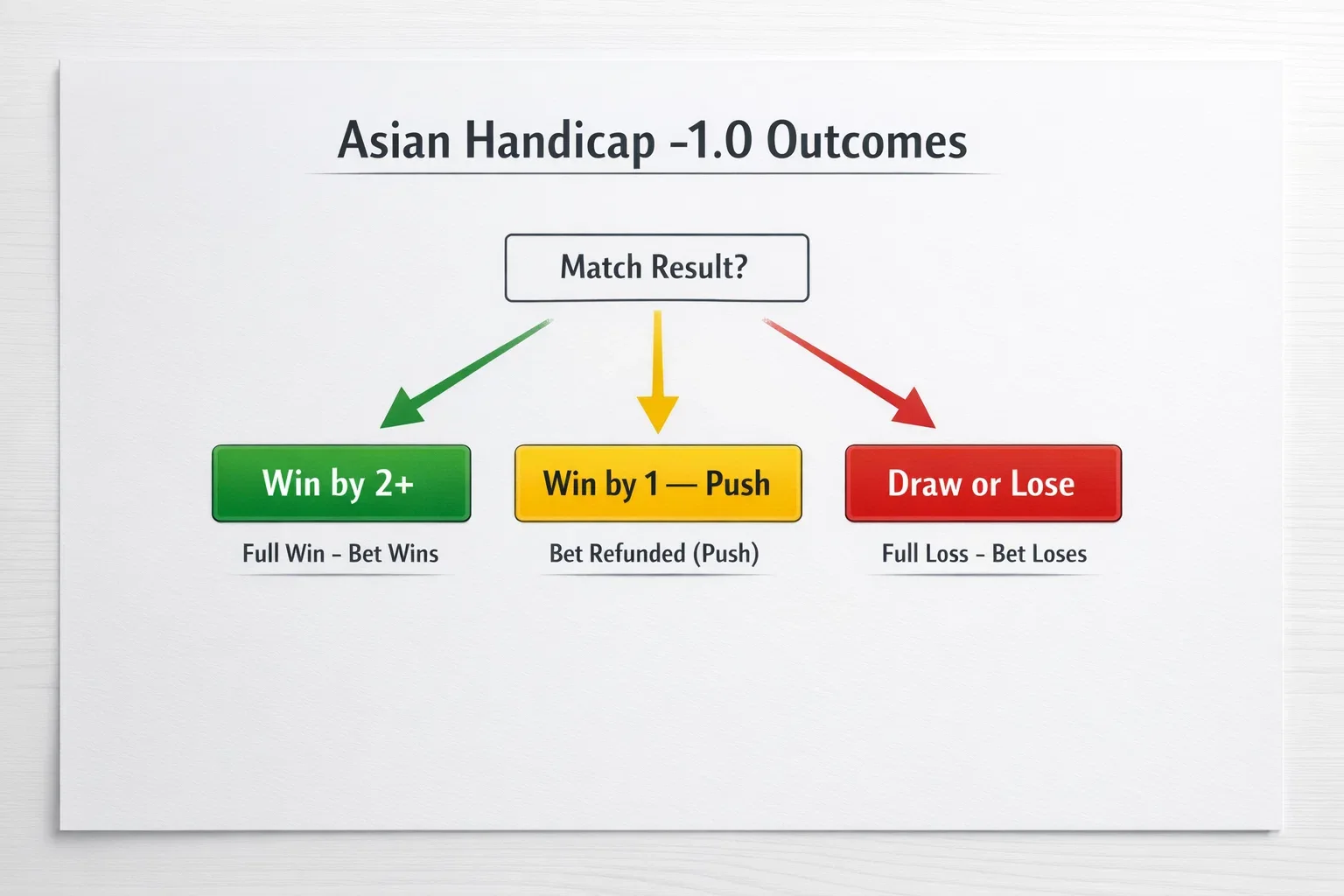
Whole-number handicaps (0, 1, 2, etc.) introduce pushes — situations where neither side wins and stakes are refunded. This happens when the handicap exactly neutralises the actual goal difference.
A 0.0 handicap (also called “level ball” or “draw no bet”) refunds your stake on a draw. If you back the favourite at 0.0 and they win, you win. If they lose, you lose. If the match draws, push — money back. This provides insurance against the draw without sacrificing much in odds compared to the 1X2 price.
A -1.0 handicap means winning by exactly one goal results in a push. Win by two or more, you win the bet. Win by one, stake returned. Draw or lose, bet lost.
A +1.0 handicap means losing by exactly one goal is a push. Winning, drawing, or losing by one returns your stake. Only losing by two or more loses the bet.
Whole-goal handicaps offer a middle ground — more protection than half-goal lines but less certainty about outcomes. Many bettors prefer them for the psychological comfort of getting money back on marginal results rather than suffering outright losses.
Quarter-Goal Handicaps: Split Bets
Quarter-goal handicaps (0.25, 0.75, 1.25, 1.75, etc.) are where Asian handicaps become uniquely powerful — and initially confusing. These split your stake automatically between the two nearest half-goal lines.
A -0.25 handicap splits your bet equally between -0.0 and -0.5. Half your stake goes on draw-no-bet; half goes on needing to win outright. This creates four possible outcomes based on a single match result.
If the favourite wins: Both halves win. Full payout.
If the match draws: The -0.0 half pushes (stake returned); the -0.5 half loses. You lose half your stake.
If the favourite loses: Both halves lose. Full loss.
A +0.25 handicap is the mirror image. Half your bet is on +0.0 (push on draw), half on +0.5 (win on draw). If the underdog wins, both halves win. If they draw, one half pushes and one wins — you profit but not fully. If they lose, both halves lose.
A -0.75 handicap splits between -0.5 and -1.0. The favourite needs to win by at least one goal, with winning by exactly one resulting in half-win, half-push. Winning by two or more means full victory.
A +0.75 handicap splits between +0.5 and +1.0. Losing by exactly one goal means one half wins, one half pushes — you still profit. Losing by two or more loses everything.
The pattern extends to all quarter-goal lines. A -1.25 handicap splits between -1.0 and -1.5. A +2.75 splits between +2.5 and +3.0. The calculations follow the same logic: identify the two adjacent lines, apply outcomes to each, combine results.
Calculating Quarter-Handicap Outcomes
Let’s work through a concrete example. You bet £100 on Liverpool -0.75 at odds of 1.90 against Newcastle.
Your £100 splits into £50 on Liverpool -0.5 and £50 on Liverpool -1.0.
Scenario 1: Liverpool win 3-1 (by two goals)
- Liverpool -0.5: Win. £50 × 1.90 = £95 return (£45 profit)
- Liverpool -1.0: Win. £50 × 1.90 = £95 return (£45 profit)
- Total: £190 return on £100 stake. Profit: £90.
Scenario 2: Liverpool win 2-1 (by one goal)
- Liverpool -0.5: Win. £50 × 1.90 = £95 return (£45 profit)
- Liverpool -1.0: Push. £50 returned.
- Total: £145 return on £100 stake. Profit: £45.
Scenario 3: Match draws 1-1
- Liverpool -0.5: Lose. £50 lost.
- Liverpool -1.0: Lose. £50 lost.
- Total: £0 return. Loss: £100.
Scenario 4: Newcastle win 1-0
- Both halves lose. Loss: £100.
Notice how the quarter-goal handicap provides a partial safety net compared to taking -1.0 alone (where a one-goal win would only push) while requiring a smaller margin than -0.5 alone (where only outright victory matters). The intermediate risk-reward profile suits many betting situations.
When to Use Each Handicap Type
Different handicap lines serve different strategic purposes. Choosing correctly depends on your probability assessment and risk tolerance.
Use half-goal handicaps (-0.5, -1.5, +0.5, +1.5) when you want clean, binary outcomes. These force decisive results and avoid the ambiguity of pushes. They’re ideal when you have strong conviction about the margin of victory and don’t want capital tied up in pushed bets earning nothing.
Use whole-goal handicaps (-1.0, -2.0, +1.0, +2.0) when you want insurance on specific scorelines. If you fancy a favourite to win but think the margin might be tight, -1.0 protects you if they win by only one. You sacrifice some odds compared to -0.5 but gain the push safety net.
Use quarter-goal handicaps for fine-tuned positioning between adjacent lines. If -0.5 feels too aggressive and -1.0 feels too conservative, -0.75 splits the difference. This granularity lets you express probability views that don’t map cleanly onto the standard half-goal lines.
Use 0.0 (draw no bet) when you’re confident in a team’s superiority but wary of them failing to break down stubborn opponents. It’s essentially betting on “this team won’t lose” rather than “this team will win.”
Finding Value in Asian Handicap Markets
Asian handicap markets typically run 2-3% lower margin than equivalent 1X2 markets, making them inherently better value hunting grounds. The two-outcome structure attracts sharper money and forces bookmakers to price more accurately.
Value emerges when your probability assessment for a team covering a specific handicap exceeds the implied probability from the odds. Suppose you estimate Chelsea have a 58% chance of beating Wolves by two or more goals. If the -1.5 line is priced at 2.10 (implying 47.6% probability), you’ve found substantial edge — your 58% estimate versus their 47.6% price.
Comparing Asian handicap prices to 1X2 odds can reveal mispricing. If a team’s -0.5 Asian handicap pays better than their 1X2 win price, the bookmaker has made an error — these should be virtually identical. Similarly, +0.5 should closely match the combined draw-or-away implied probability. Discrepancies indicate opportunity.
The draw rate in a specific matchup heavily influences optimal handicap selection. Matches between defensively solid mid-table sides draw more often than attacking top-six clashes. High draw probability favours taking the +0.0 or +0.25 line on slight underdogs, profiting from the pushed or half-won outcomes when stalemates occur.
Handicap Movement and Market Timing

Asian handicap lines move based on betting volume and new information, just like any market. Understanding why lines move helps you decide when to bet.
If a line opens at -0.5 and moves to -0.75, sharp money has backed the favourite. The bookmaker needs to attract underdog betting, so they give the underdog a bigger head start. This movement suggests informed bettors see value on the favourite — worth noting even if you disagree.
Conversely, if -1.0 moves to -0.75, money has come for the underdog. The bookmaker is reducing the favourite’s burden, indicating sharper interest on the +1.0 side.
Late-breaking team news drives significant moves. A key striker ruled out might shift a line from -1.0 to -0.5 within hours. Bettors who react quickly to news can capture value before lines adjust. Bettors who bet early risk being on the wrong side of news-driven moves.
Closing line value — whether you beat the final pre-match price — is the ultimate measure of betting skill. Consistently getting better prices than closing lines indicates genuine edge. Asian handicaps provide clean tracking because the two-outcome structure makes closing line comparison straightforward.
Common Mistakes and How to Avoid Them
The biggest mistake is misunderstanding quarter-goal handicaps. Bettors unfamiliar with split stakes sometimes expect full wins on results that only produce half-wins. Know exactly what you’re betting before placing the wager. Work through potential outcomes mentally.
Another error is treating Asian handicaps identically across leagues. A -1.0 handicap in the Premier League (tight, competitive matches) differs meaningfully from -1.0 in Ligue 1 (PSG domination) or MLS (higher scoring, more variance). Calibrate your expectations to league-specific patterns.
Ignoring the draw rate leads to poor handicap selection. Some fixtures draw 35%+ of the time due to team styles or historical patterns. Dismissing draw probability means undervaluing positive handicaps and overvaluing aggressive negatives.
Finally, assuming Asian handicaps eliminate variance is wrong — they merely restructure it. A -2.5 bet on a heavy favourite still loses most of the time because winning by three goals is genuinely difficult. The handicap creates balanced odds, not balanced outcomes. You’re still trying to predict football, and football remains unpredictable.
Asian handicaps reward bettors who think in probabilities and margins rather than simple win-lose outcomes. Master the mechanics, understand the strategic applications, and these markets become some of the most value-rich opportunities in football betting.
View all market breakdowns via our markets hub.
You can also find great odds by analyzing over/under goals betting strategies.
