
Football Betting Strategy Guide: Winning with Bookmakers
 Available in US
Strategy is what separates people who occasionally win bets from people who profit consistently over thousands of wagers. Most bettors operate without any systematic approach beyond “I think this team will win” or “my mate gave me a tip.” They’re essentially gambling with extra steps, hoping variance swings their direction before their bankroll evaporates. Building a genuine betting strategy doesn’t guarantee success—nothing does in a game where bookmakers hold mathematical edges—but it dramatically improves your probability of long-term profitability by eliminating the catastrophic mistakes that destroy most betting accounts.
I’ve been betting on football seriously for over twelve years now, transitioning from recreational punter losing slowly but steadily to someone who’s actually profitable across multiple seasons. That shift didn’t happen because I suddenly got better at predicting match results. It happened because I stopped treating betting like entertainment and started treating it like a business requiring discipline, record-keeping, and continuous improvement. The strategies that work aren’t sexy or exciting—they’re methodical, sometimes boring, and require patience most people can’t sustain.
This guide covers fundamental strategies proven to work across different betting styles and approaches. Some strategies are universal—bankroll management and record-keeping benefit every bettor regardless of markets or methods. Others are specific to particular betting styles—value betting requires different skills than arbitrage betting or matched betting. The key is identifying which strategies align with your goals, knowledge base, and personality, then executing them consistently rather than jumping between approaches based on recent results.
Nobody wins every bet. Professional bettors with documented long-term success typically win 52-55% of their bets, barely above breakeven after accounting for bookmaker margins. The edge comes from bet selection, stake sizing, and exploiting bookmaker inefficiencies rather than supernatural ability to predict outcomes. Understanding this reality—that winning is about small edges compounded over many bets rather than consistently picking winners—fundamentally changes how you approach betting strategy.
Value Betting: The Cornerstone of Profitable Betting
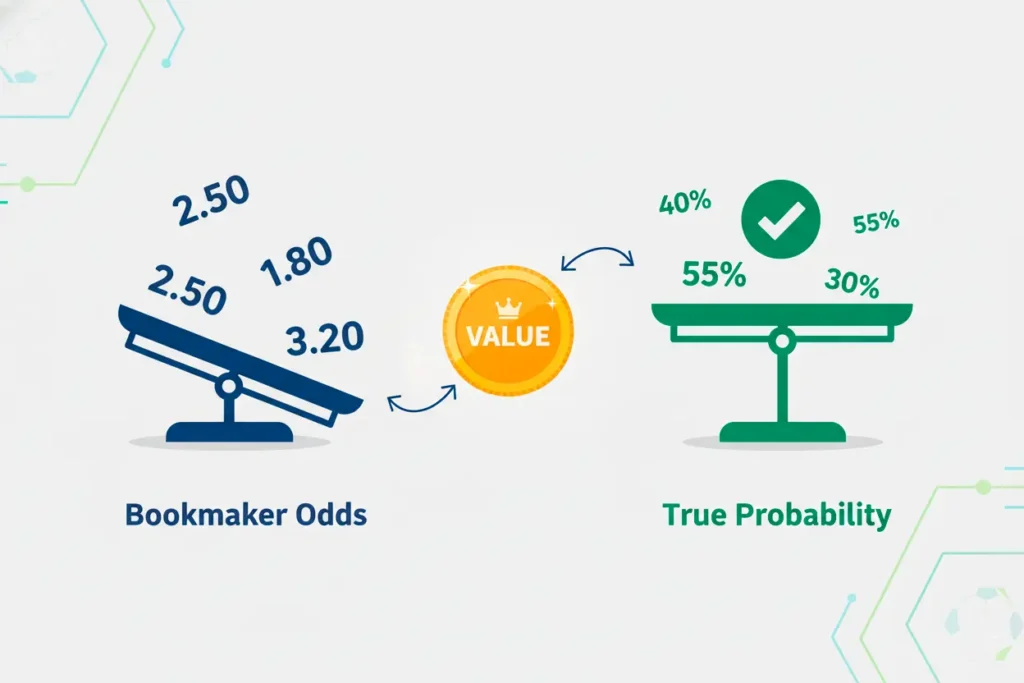
Value betting is the only sustainable path to long-term profitability in sports betting. The concept is elegantly simple but execution requires discipline most bettors never develop. You’re looking for situations where bookmaker odds are higher than the true probability of an outcome. When you consistently bet at odds offering value, you profit over large sample sizes even though individual bets frequently lose.
Understanding value requires divorcing your opinion about what will happen from your assessment of what should happen based on probability. Just because you think Manchester United will beat Brighton doesn’t mean betting on United at 1.4 offers value. If United’s true win probability is 65%, those 1.4 odds represent terrible value—you’re getting 71.4% implied probability for something with 65% actual probability. The opposite team might offer value even though you expect them to lose.
Calculating implied probability from odds is straightforward. For decimal odds, divide one by the odds. Odds of 2.0 equal 50% probability. Odds of 3.0 equal 33.3% probability. Odds of 1.5 equal 66.7% probability. This converts bookmaker prices into probability terms letting you compare against your own probability assessments. The gap between bookmaker implied probability and your assessed probability determines whether value exists.
Developing reliable probability assessments independent of bookmaker odds is where most bettors fail. It requires systematic analysis using whatever information and methodologies you have access to—statistical models, expected goals data, tactical analysis, insider information about team news and motivation. You must estimate match probabilities before looking at odds, otherwise you’re just reacting to bookmaker prices rather than independently evaluating value.
Your probability assessments won’t be perfectly accurate—nobody’s are. The question is whether they’re more accurate than bookmaker odds over large samples. If you can identify situations where you consistently assess probability more accurately than the market, you have edge worth betting. This might mean specializing in specific leagues you know deeply, focusing on particular market types where you’ve developed expertise, or leveraging information sources most bettors don’t use.
Value betting requires patience because variance means short-term results don’t validate or invalidate your approach. You might correctly identify value bets that lose five times consecutively simply through bad luck. Recreational bettors abandon their strategy after a few losses, assuming it doesn’t work. Professional bettors understand that value reveals itself only over hundreds or thousands of bets, not dozens.
Record-keeping becomes essential for value betting because you need tracking actual results versus expected results based on your probability assessments. If you’re betting at average odds of 2.5 across one hundred bets, you expect winning roughly forty times even if variance causes you to win thirty-five times or forty-five times in any specific sample. Over larger samples, actual results should converge toward expected results if your probability assessments are accurate.
The challenging psychological aspect of value betting is that it sometimes requires backing outcomes you don’t actually expect to happen. If you assess a team has 20% win probability but bookmaker odds imply 15% probability, betting on that team offers value even though you expect them to lose 80% of the time. This feels wrong to bettors conditioned to only back things they predict will happen, but it’s mathematically correct strategy.
Bankroll Management: Surviving Inevitable Downswings

Bankroll management determines whether you survive long enough for your edge to materialize or go broke during the inevitable losing streaks that destroy accounts. The best betting strategy in the world fails if you’re risking too much per bet—one bad run of variance and your bankroll evaporates before probability has time to assert itself.
The unit system provides the most practical framework for bankroll management. Divide your total betting bankroll into one hundred equal units. Each unit represents 1% of your total bankroll. Most bets should be one or two units depending on confidence level. Strong value opportunities might justify three units. Marginal spots might get half a unit or pass entirely.
This system naturally scales your bet sizes to your bankroll, ensuring you’re not overexposed on any single outcome. If your bankroll is one thousand pounds, one unit equals ten pounds. If your bankroll grows to two thousand pounds, one unit becomes twenty pounds. The percentage-based approach prevents the common mistake of maintaining static bet sizes regardless of bankroll changes.
Kelly Criterion provides mathematical framework for optimal bet sizing based on your edge and bankroll. The formula calculates ideal bet size by considering both your probability assessment and the odds available. Full Kelly often recommends aggressive sizing that causes uncomfortable volatility, so most experienced bettors use fractional Kelly—betting some fraction like half or quarter of the calculated Kelly stake.
The Kelly Criterion calculation requires accurate probability estimates. If you overestimate your edge even slightly, Kelly recommends oversized bets that increase risk of ruin. This is why conservative bettors prefer simple unit systems rather than Kelly—the unit system protects against overconfidence by capping bet sizes regardless of perceived edge. Kelly works brilliantly when you have genuine edge and accurate probability assessments but punishes overconfidence brutally.
Never bet more than 5% of your bankroll on any single outcome regardless of confidence. This hard ceiling prevents catastrophic losses from unexpected results or mistakes in analysis. Even professional bettors with documented edge rarely bet more than 2-3% on individual matches. The difference between betting 2% and 5% might seem trivial, but it dramatically affects risk of ruin during inevitable losing streaks.
Separate your betting bankroll completely from living expenses and savings. This isn’t gambling advice about only betting what you can afford to lose—though that’s true. It’s practical advice about accurate bankroll tracking and emotional detachment. When your betting money mingles with rent money, you can’t objectively assess performance and you’ll make emotional decisions when losing affects your ability to pay bills.
Track your bankroll balance after every betting session, adjusting unit size as bankroll changes. If your bankroll grows from one thousand to eleven hundred pounds, your unit size increases from ten to eleven pounds. If it drops to nine hundred pounds, unit size decreases to nine pounds. This dynamic adjustment maintains consistent risk exposure as your bankroll fluctuates.
Avoid the temptation to increase unit sizes during winning streaks beyond what your bankroll growth justifies. Three winning bets don’t mean you’ve suddenly become better at betting—it might just be variance swinging positive temporarily. Maintain disciplined unit sizing based on actual bankroll balance rather than recent results or confidence level.
Set stop-loss limits for individual sessions or days to prevent emotional decision-making during downswings. If you lose three units in a session, stop betting regardless of upcoming matches you planned to bet. This prevents the catastrophic spiral where losses trigger emotional betting that causes larger losses that trigger even worse decisions.
Line Shopping and Multi-Account Advantage
Betting the best available odds on every bet might seem trivial but compounds dramatically over hundreds of wagers. The difference between getting 2.0 versus 2.1 on individual bets seems insignificant—just five percent better payout. But that five percent improvement repeated across every bet you place represents the difference between long-term profit and long-term loss for bettors with small edges.
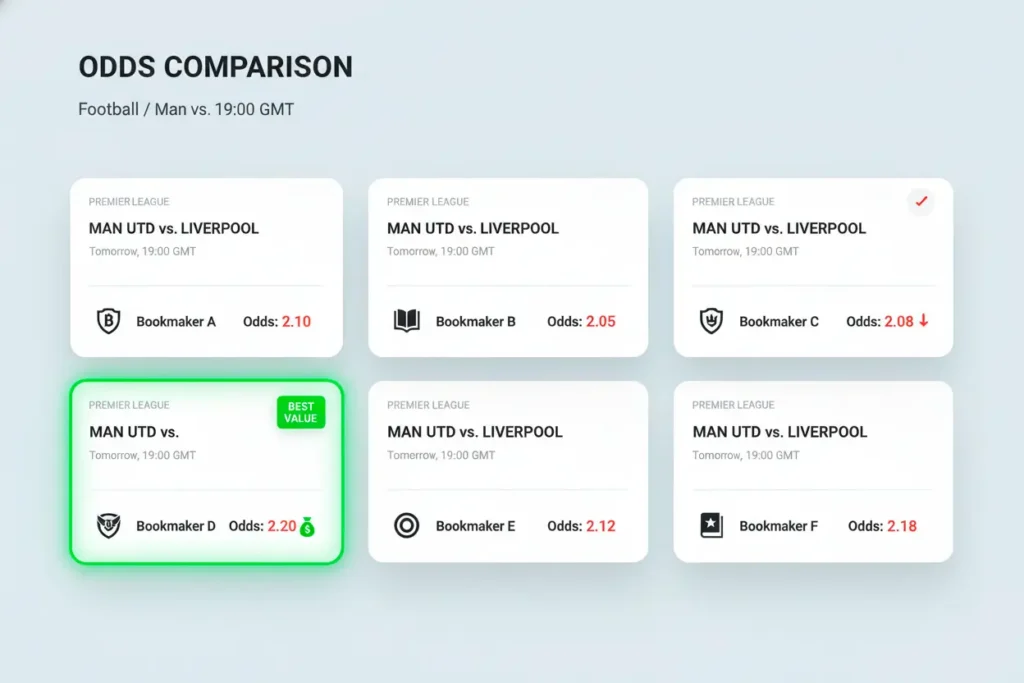
Line shopping means maintaining accounts at multiple bookmakers and always betting whichever offers the best odds for your selection. This requires more effort than betting everything at one bookmaker—you’re comparing odds across five or six sites before placing each bet. But the return on that effort is guaranteed improvement to your bottom line without requiring any skill at predicting match outcomes.
Consider concrete example showing line shopping impact. You want to bet Arsenal to beat Tottenham. Bookmaker A offers 1.95, Bookmaker B offers 2.0, Bookmaker C offers 2.05. Betting one hundred pounds at 2.05 instead of 1.95 pays you ten pounds more when you win. That’s ten percent additional profit for thirty seconds of checking odds across sites. Do this one hundred times across a season, and you’ve made an extra one thousand pounds just by shopping for better prices.
Odds comparison websites aggregate odds from many bookmakers, making line shopping faster than manually checking each site. These services show you instantly which bookmaker offers best price for any given selection. Some also track odds movements over time, helping identify when odds are moving in your favor versus against you.
The multi-account strategy amplifies line shopping benefits but requires careful management. Maintaining accounts at six to ten bookmakers gives you maximum flexibility to always bet the best available odds. However, you must track balances across accounts, manage different deposit and withdrawal methods, and maintain good standing at each bookmaker by avoiding betting patterns that trigger restrictions.
Bookmakers hate winning bettors and will restrict or close accounts showing consistent profit, especially accounts betting only +EV selections at best available odds. This is the fundamental challenge with line shopping—it’s extremely effective but makes your account more likely to get restricted. Mixing in some recreational bets, betting round numbers rather than precise Kelly stakes, and avoiding patterns that scream professional bettor helps maintain account longevity.
Some bettors use betting exchanges as part of their line shopping strategy. Exchanges often offer better odds than traditional bookmakers because you’re betting against other bettors rather than against the house. The exchange charges commission on winnings rather than building margin into odds. For liquid markets on popular matches, exchanges frequently offer superior prices worth the commission cost.
Betting exchanges also provide opportunities to lay bets—betting against outcomes rather than for them. This opens up arbitrage opportunities when you can find better odds backing at one bookmaker and laying at an exchange. It also lets you hedge positions if circumstances change after you place initial bets.
Track which bookmakers consistently offer the best odds in markets you bet frequently. Some bookmakers are consistently sharp on Premier League matches but loose on lower leagues. Others offer competitive odds on Asian handicaps but poor prices on traditional markets. Understanding each bookmaker’s strengths lets you efficiently check the right places first rather than comparing odds across ten sites for every bet.
Specialization: The Path to Sustainable Edge
Specialists beat generalists in sports betting just as they do in every other field requiring expertise. Bettors who try to bet every match across every league spread their attention too thin to develop genuine advantage anywhere. Bettors who focus deeply on specific leagues, teams, or market types develop knowledge edges bookmakers can’t match through algorithms alone.
Specialization works because bookmaker pricing is most vulnerable in areas they pay less attention to. Every bookmaker dedicates resources to pricing Premier League and Champions League matches accurately—these are the highest volume markets with the most professional betting action. But lower league matches, niche markets, or less popular competitions receive less scrutiny, creating opportunities for bettors with specialized knowledge.
Choosing your specialization requires honest assessment of your interests and information access. Don’t specialize in Serie A just because it seems strategically smart if you don’t actually enjoy watching Italian football and learning about the teams. Specialization requires sustained effort over years—you need genuine interest to maintain that commitment.
Geographic proximity provides natural specialization advantage. If you live in Germany and follow Bundesliga closely through local media, you have information access and cultural understanding that bettors in other countries lack. Local media covers training reports, tactical discussions, and team dynamics that don’t reach international betting markets. This information edge, even if modest, compounds over many bets.
Tactical specialization means focusing on specific match situations or market types rather than leagues. Some bettors specialize in matches where team styles create likely scoring patterns. Others focus on Asian handicap markets where their probability assessments outperform bookmaker lines. The key is identifying specific situations where you consistently identify value better than the market.
Lower league specialization offers advantage because bookmaker resources and betting volume concentrate on top leagues. Championship, League One, or regional leagues receive less attention from odds compilers and face less efficient markets. Bettors willing to deeply research these leagues find more pricing inefficiencies than they would in Premier League where every match gets analyzed to death.
Statistical model specialization means building or using models that assess match probabilities more accurately than bookmaker odds in specific contexts. Expected goals models, team rating systems, or tactical matchup models might identify value in particular situations. This requires technical skills beyond typical bettor but can provide sustainable edge if your models genuinely outperform market pricing.
Team specialization means following a handful of teams extremely closely—watching every match, understanding tactical systems, knowing player roles and form in detail. This deep knowledge helps you identify situations where team performance will differ from market expectations based on factors casual observers miss. You might know a key player is carrying an injury affecting performance but still starting, or understand how specific tactical matchups favor outcomes bookmakers haven’t properly priced.
Market specialization focuses on specific bet types rather than specific teams or leagues. Some bettors specialize in corners markets, others in Asian handicaps, others in first half/second half bets. Focusing on specific market types lets you develop pattern recognition and edge in those markets that wouldn’t be possible if spreading attention across all market types.
Specialization doesn’t mean ignoring everything else—it means concentrating your serious betting and analytical effort in areas where you can develop advantage while avoiding areas where you’re just guessing. You might casually bet small amounts on matches outside your specialization for entertainment, but serious bankroll allocation focuses where you have genuine edge.
Record-Keeping: Your Performance Laboratory
Record-keeping separates bettors who improve over time from bettors who repeat the same mistakes indefinitely while wondering why they’re not profitable. Without comprehensive records tracking every bet and the reasoning behind it, you can’t objectively assess what’s working and what’s not. Gut feelings about your betting performance are unreliable—human memory selectively remembers wins while minimizing losses.
Track every bet immediately after placing it, recording at minimum: date, match details, selection, odds, stake size, result, and profit or loss. This basic data lets you calculate overall profitability, identify winning and losing patterns, and assess whether you’re improving over time. Most bettors who claim they’re “about breakeven” discover they’re significantly down when they actually track comprehensive records.
Categorize bets by league, market type, odds range, and confidence level. This metadata reveals where your edge exists and where you’re essentially gambling. You might discover you’re profitable on Championship matches but losing money on Premier League. Or profitable on underdogs above 3.0 but losing on favorites below 1.8. These insights only emerge from categorized record-keeping.
Track your reasoning and analysis behind each bet, not just the mechanical details. Write a brief note explaining why you bet what you bet—what information or analysis made you believe value existed. This forces you to articulate your betting thesis rather than making impulsive decisions. It also creates learning opportunities when reviewing losing bets to understand whether you made good process decisions that got unlucky or whether your analysis was flawed.
Calculate your closing line value—the difference between odds you got when you bet and the closing odds just before kickoff. If you consistently bet at worse odds than closing lines, you’re betting too early or betting on bad information. If you consistently beat closing lines, you’re finding value before the market corrects. Tracking closing line value provides objective measure of betting skill independent of short-term variance.
Monthly and quarterly reviews of your betting records identify trends impossible to see analyzing individual bets. You might be slowly increasing bet sizes without consciously deciding to—a dangerous pattern suggesting emotional decision-making. Or you might notice performance deteriorates during particular months, suggesting external factors affecting your betting discipline.
Track your expected value versus actual results. If you bet one hundred selections at average odds of 2.0, you expect to win approximately fifty times. If you actually won forty times, you’re underperforming expectations—but this might be normal variance over small sample or indicator of flawed probability assessments. Over larger samples, actual results should converge toward expected results if your edge is genuine.
Spreadsheet software provides the most flexible and powerful tool for betting records. Create a template capturing all relevant data fields, then log every bet consistently. Once you have comprehensive data, you can analyze it endless ways—filtering by date ranges, calculating returns by category, graphing bankroll growth over time, identifying trends and patterns.
Some bettors use dedicated betting tracking applications providing automated statistics and graphs. These work well if they capture all data you need, but spreadsheets offer more flexibility for custom analysis. The tool matters less than the habit—consistent record-keeping regardless of whether you use sophisticated software or a simple notebook.
Review your records regularly but not obsessively. Monthly reviews provide sufficient frequency to identify patterns and trends without getting caught up in short-term variance. Checking records daily or after every bet increases temptation to make emotional adjustments based on recent results rather than long-term patterns.
Psychological Traps and How to Avoid Them

Psychological biases destroy more betting bankrolls than poor analysis or bad luck. Even bettors with genuine edge undermine themselves through emotional decision-making, overconfidence, or cognitive biases they don’t recognize. Understanding these traps and implementing systematic defenses against them is as important as any technical betting strategy.
Chasing losses is the classic trap that accelerates bankroll destruction. You lose a few bets and feel the urge to “win it back” by betting more or betting recklessly on matches you haven’t properly analyzed. This compounds problems by putting more money at risk precisely when you’re making emotional rather than rational decisions. The solution is rigid adherence to unit sizing regardless of recent results—you’re never betting more to recover losses.
Overconfidence after winning streaks creates opposite but equally destructive behavior. Three winning bets doesn’t mean you’ve cracked the code and can increase stakes dramatically. Variance swings both directions, and overconfidence leads to oversized bets right before inevitable regression eliminates profits and more. Maintaining consistent approach during winning streaks is as important as during losing streaks.
Confirmation bias causes selective information gathering supporting positions you’ve already decided to take. You want to back a team, so you search for reasons why they’ll win while ignoring contradictory evidence. The solution is structured analysis before looking at odds or deciding which side to bet. Force yourself to list reasons supporting each possible outcome before concluding which offers value.
Attachment to favorite teams destroys objectivity. Most bettors can’t evaluate matches involving their club rationally because emotional investment overrides analytical thinking. The simple solution is not betting matches involving teams you care about emotionally. The missed betting opportunities cost less than the inevitable poor decisions emotion causes.
Availability bias makes recent events feel more important than they actually are. A team won their last three matches, so you assume they’ll continue winning despite underlying metrics suggesting they’re due for regression. Or a goalkeeper made three errors in one match, so you assume he’s terrible despite years of quality performance. Fight recency bias by emphasizing larger sample sizes over recent small samples.
The gambler’s fallacy—believing past results influence future independent events—appears frequently in betting. A coin landing heads five times doesn’t make tails more likely on the sixth flip. A team losing five consecutive matches doesn’t mean they’re “due” to win. Each match is independent, and past results only matter to the extent they provide information about current team quality.
Anchoring on initial odds you see causes improper value assessment when odds move. If you first saw a team at 2.0 and their odds drift to 2.3, you might perceive 2.3 as value compared to earlier price rather than assessing whether 2.3 offers value based on actual probabilities. Evaluate current prices objectively rather than anchoring to earlier numbers.
Alternative Strategies: Arbitrage and Matched Betting
Value betting is the sustainable long-term path, but alternative strategies offer different risk/reward profiles suitable for specific situations or goals. Understanding these alternatives provides options beyond pure value betting, though each has limitations preventing them from being complete solutions.
Arbitrage betting involves placing bets on all possible outcomes across different bookmakers at odds guaranteeing profit regardless of result. If Bookmaker A offers 2.1 on home win and Bookmaker B offers 2.1 on away win or draw, you can bet both outcomes at sizes ensuring profit. These opportunities appear when bookmakers have different opinions or one is slow adjusting to market movements.
The challenge with arbitrage is that opportunities are fleeting and margins are thin. You need significant capital to make meaningful profit since typical arbitrage edges are 1-3%. You also need accounts at many bookmakers to spot opportunities quickly. And bookmakers aggressively restrict accounts showing arbitrage betting patterns. Arbitrage works as supplementary strategy but isn’t sustainable as primary approach because restrictions arrive quickly.
Matched betting exploits bookmaker promotions by placing opposite bets at betting exchanges to guarantee profit. When a bookmaker offers a free bet, you back an outcome with the free bet at the bookmaker and lay the same outcome at an exchange. Regardless of result, you lock in profit equal to approximately 80% of free bet value. This converts promotional offers into guaranteed money.
Matched betting worked brilliantly 5-10 years ago when bookmakers competed aggressively for customers through generous promotions. It’s become less profitable as promotional quality declined and bookmakers got sophisticated about detecting matched bettors. You can still extract value from welcome bonuses as new customer at multiple bookmakers, but ongoing matched betting profitability requires maintaining recreational betting appearances to avoid restrictions.
Value betting on closing lines represents hybrid approach between pure value betting and market timing. Rather than betting when you identify value at current odds, you wait until close to kickoff when odds have largely stabilized at efficient prices. You’re essentially betting the most efficient available market price, trusting market efficiency more than your own probability assessments. This works for bettors uncomfortable estimating independent probabilities but comfortable identifying which side sharp money favors.
Building Your Complete Strategy

Effective betting strategy combines multiple elements tailored to your situation rather than following a single rigid system. Your strategy should align with your knowledge base, time availability, risk tolerance, and goals. Someone betting for entertainment with modest bankroll needs different strategy than someone treating betting as serious profit-seeking endeavor.
Start with fundamental elements that benefit everyone: rigorous bankroll management preventing ruin, comprehensive record-keeping providing objective feedback, and line shopping extracting maximum value from every bet. These universals should be non-negotiable regardless of other strategic choices.
Add specialization and value betting if you’re committed to long-term profitability over immediate results. This requires significant time investment for analysis, match watching, and developing genuine expertise. The payoff is sustainable edge that compounds over years, but the path requires patience through inevitable downswings and discipline to continuously improve.
Consider supplementary strategies like arbitrage or matched betting for accelerating early bankroll growth or exploiting specific opportunities. These shouldn’t be your primary strategy because they’re not sustainable long-term, but they can complement core value betting approach when opportunities arise.
Continuously refine your strategy based on what records reveal about actual performance. If data shows you’re unprofitable in certain markets or leagues, eliminate those bets regardless of how much you enjoy them. If you’re consistently profitable in specific areas, focus more attention there. Let objective results guide strategic evolution rather than stubborn attachment to approaches that aren’t working.
The most important strategic element is patience and long-term thinking. Profitable betting reveals itself over thousands of bets, not dozens or hundreds. Short-term variance causes massive swings that don’t reflect underlying strategy quality. Bettors who stick with sound strategy through downswings succeed. Those who abandon strategy after losses or get overconfident after wins fail. Welcome to strategic betting—now you understand why most people lose while small percentage consistently profit over years of disciplined execution.
