
Draw No Bet and Double Chance Markets Explained
 Available in US
Football’s three-way nature — home win, draw, away win — creates unique challenges for bettors. Backing a team to win means losing your stake if the match draws, even if your chosen side was clearly superior for 89 minutes before conceding a late equaliser. Draw No Bet and Double Chance markets exist specifically to address this frustration, offering ways to reduce risk by protecting against one of the three possible outcomes. Understanding how these markets work, when to use each, and how to calculate whether they offer value gives you flexibility that straight match betting cannot provide.
Both markets essentially let you trade lower potential returns for higher probability of not losing. They’re particularly valuable in situations where you have strong conviction about which team won’t lose, but less certainty about whether they’ll win outright or settle for a draw. Used strategically, they transform marginal opportunities into more confident positions.
Draw No Bet: The Insurance Policy
Draw No Bet (DNB) does exactly what the name suggests: removes the draw from the equation. You back a team to win, but if the match ends in a draw, your stake is returned rather than lost. Only if your chosen team loses do you forfeit your money.
The three possible outcomes for a Draw No Bet selection are: Win — your team wins, you receive your payout at the DNB odds. Push — the match draws, your stake is refunded in full. Lose — your team loses, you lose your stake.
This structure makes DNB functionally equivalent to backing your team at Asian Handicap 0.0 (sometimes called “level ball”). The markets are priced identically because the payout structure is identical — win pays out, draw refunds, loss loses.
DNB odds are always lower than standard 1X2 odds on the same team because you’re buying insurance against the draw. If Liverpool are 2.00 to beat Everton in the match result market, they might be 1.60 Draw No Bet. The difference reflects the probability of a draw — roughly 25-30% — which you’re no longer exposed to.
When to use Draw No Bet:
DNB excels when you strongly believe a team won’t lose but the match has significant draw probability. Mid-table clashes where both teams play conservatively, matches involving defensive specialists, or fixtures with historically high draw rates all suit DNB. You’re essentially saying “I’m confident Team A avoids defeat, but not confident enough to risk losing everything on a 1-0 or 0-0 draw.”
DNB also works well for accumulator protection. If you’re building a four-fold where three legs feel rock solid but one match seems draw-prone, using DNB on that leg keeps your accumulator alive even if the match stalemates. Yes, a drawn match reduces your accumulator payout (that leg is voided), but it’s better than losing the entire bet.
Backing underdogs with DNB provides significant downside protection. If you fancy Brighton to beat Chelsea but acknowledge Chelsea probably win 55% of these matches, Brighton DNB means you only lose if Chelsea actually wins — Brighton’s 25% draw probability becomes a safety net rather than a losing outcome.
Double Chance: Covering Two Outcomes
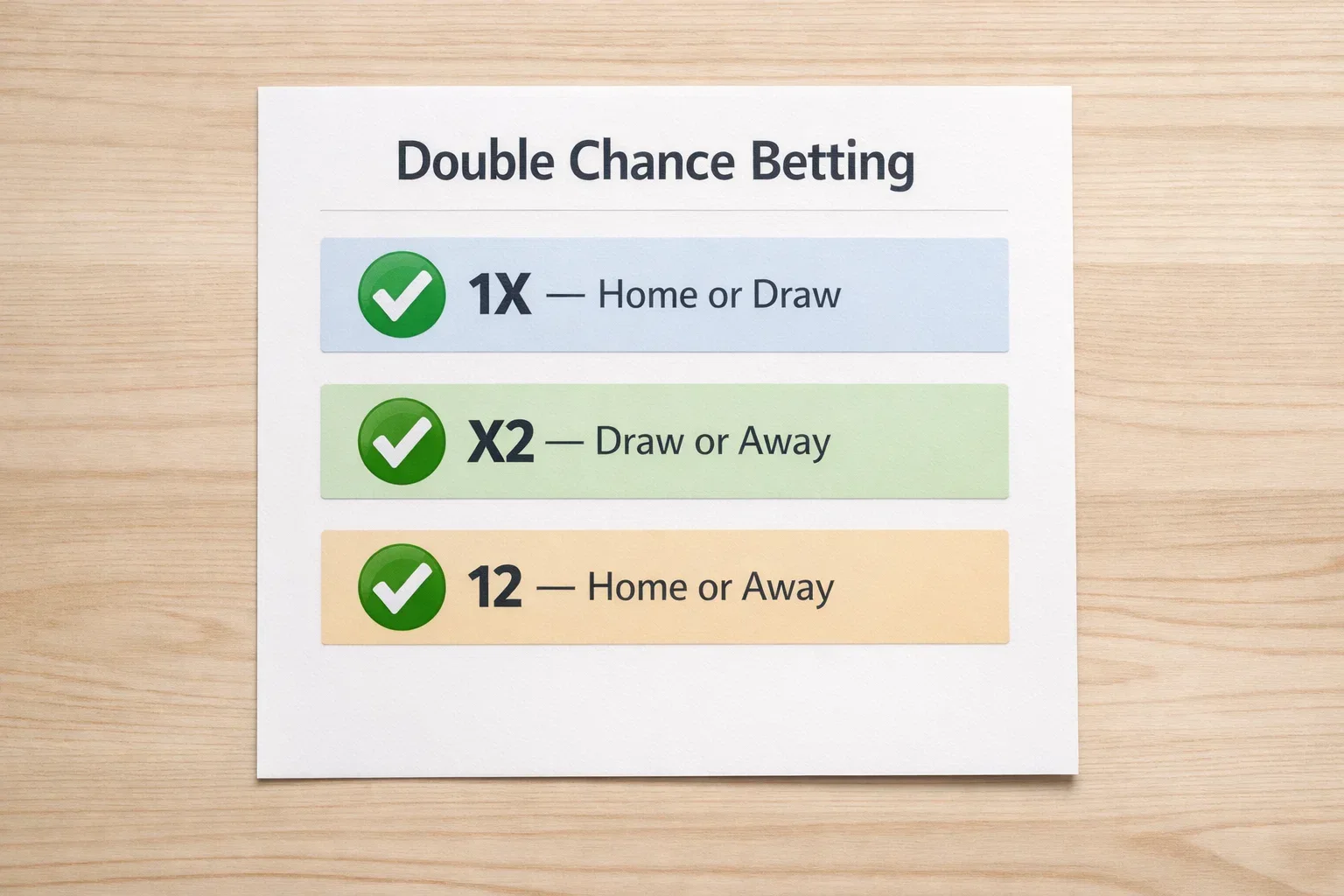
Double Chance takes risk reduction further by letting you cover two of the three possible outcomes with a single bet. Three combinations exist:
1X (Home or Draw): Your bet wins if the home team wins OR the match draws. Only an away win loses your bet.
X2 (Draw or Away): Your bet wins if the match draws OR the away team wins. Only a home win loses your bet.
12 (Home or Away): Your bet wins if either team wins. Only a draw loses your bet.
Double Chance prices are even shorter than DNB because you’re covering more outcomes. If a team is 2.00 in match betting and 1.60 DNB, they might be 1.30-1.40 in Double Chance. You’re now winning on two of three outcomes, so the expected probability of winning is roughly 65-75%, reflected in odds that offer modest returns.
When to use Double Chance:
Double Chance suits situations where you want maximum security and accept minimal returns. Backing a strong home favourite “Home or Draw” (1X) when you fear a shock upset provides insurance against the unexpected. If Manchester City hosting a promoted team seems like a formality, but cup competitions occasionally produce surprises, 1X at 1.15 guarantees you only lose if the underdog actually wins.
The “Away or Draw” (X2) option is valuable for underdogs you believe will “get something” from the match — either stealing a win or grinding out a point. This combination appears frequently in accumulator tips for away sides facing slightly superior home teams.
“Home or Away” (12) bets against the draw specifically. This suits matches where you expect decisive results — perhaps between two attacking teams who rarely draw, or fixtures where motivation guarantees both sides push for wins. The odds are short because draws occur in only 25-30% of matches, but 12 lets you profit regardless of which team emerges victorious.
Comparing the Markets: Which Offers Better Value?
Draw No Bet and Double Chance serve different purposes and suit different confidence levels. Choosing correctly requires understanding what you’re actually paying for with each.
DNB provides better odds when your selection wins because you’re only protected against draws, not defeats. If your team wins, DNB pays out at higher odds than Double Chance would. However, if the match draws, DNB only refunds your stake while Double Chance pays out as a winner.
Consider a match where the home team is priced at: Match Winner: 2.20, Draw No Bet: 1.70, Double Chance (1X): 1.35.
If you stake £100: Home win: DNB returns £170 (£70 profit), Double Chance returns £135 (£35 profit). Draw: DNB returns £100 (stake refund, no profit), Double Chance returns £135 (£35 profit). Away win: Both lose £100.
The choice depends on your probability assessment. If you estimate 50% home win, 25% draw, 25% away win, then: DNB expected value = (0.50 × £70) + (0.25 × £0) + (0.25 × -£100) = £35 + £0 – £25 = +£10. Double Chance expected value = (0.50 × £35) + (0.25 × £35) + (0.25 × -£100) = £17.50 + £8.75 – £25 = +£1.25.
DNB offers better expected value in this scenario because you’re not paying for draw protection you don’t fully need at the given prices. But if draw probability is higher — say 35% — the calculation might favour Double Chance.
Calculating Fair Odds for DNB and Double Chance
Knowing what fair prices should be helps identify value in these markets. The calculations derive from the standard 1X2 odds.
For Draw No Bet, fair odds equal the team’s 1X2 price adjusted for draw probability removal. The formula is:
DNB Fair Odds = 1 / (Win Probability / (1 – Draw Probability))
If a team has 45% win probability and 28% draw probability: Adjusted win probability = 0.45 / (1 – 0.28) = 0.45 / 0.72 = 0.625. Fair DNB odds = 1 / 0.625 = 1.60.
Alternatively, DNB should equal the team’s Asian Handicap 0.0 price. Compare these markets — if DNB is significantly different from AH 0.0, one market is mispriced.
For Double Chance, fair odds combine two outcome probabilities:
Double Chance Fair Odds = 1 / (Combined Outcome Probability)
For Home or Draw (1X) with 45% home win and 28% draw: Combined probability = 0.45 + 0.28 = 0.73. Fair odds = 1 / 0.73 = 1.37.
For Draw or Away (X2) with 28% draw and 27% away win: Combined probability = 0.28 + 0.27 = 0.55. Fair odds = 1 / 0.55 = 1.82.
Comparing your calculated fair odds to bookmaker prices reveals whether value exists. If your fair price is 1.60 and the bookmaker offers 1.75, you’ve found potential value.
Using DNB and Double Chance in Accumulators
These markets integrate smoothly into accumulator betting, with some important nuances to understand.
DNB in accumulators creates variable leg counts. If you build a five-fold using DNB on each selection and three matches end in your team winning while two draw, you receive a three-fold payout (at the three winning selections’ odds multiplied together). The drawn matches are voided rather than counted as losses or wins.
This structure provides significant protection. A traditional five-fold match betting accumulator loses entirely if any selection draws. A five-fold DNB accumulator only loses if any selection loses outright — draws merely reduce the final payout rather than destroying it.
Double Chance in accumulators behaves more simply — each leg either wins (counting toward your multiplied odds) or loses (killing the accumulator). There’s no void provision because you’re covering two outcomes; the third outcome is simply a loss.
Double Chance accumulators have high hit rates but low payouts. A four-fold where each leg is 1.35 Double Chance pays just 3.32x your stake — and even one loss from the 25-30% losing probability per leg ends the bet. The mathematics often don’t justify the complexity.
Strategic combination uses DNB for higher-risk legs and straight match betting for confident selections. A three-fold might include two match winner bets at 1.80 and one DNB at 1.50, balancing potential returns against insurance on the wobbliest leg.
Alternative Approaches: Dutching
Instead of using bookmaker Double Chance markets, you can create equivalent bets by “Dutching” — placing separate bets on two outcomes calculated to return the same profit regardless of which hits.
To Dutch Home and Draw for equal profit: calculate stakes inversely proportional to the odds. If Home is 2.20 and Draw is 3.50: Stake ratio = (1/2.20) : (1/3.50) = 0.455 : 0.286, normalised to roughly 61% on Home, 39% on Draw.
For a £100 total stake: £61 on Home at 2.20 returns £134.20, £39 on Draw at 3.50 returns £136.50. Either result returns approximately £135-136 — equivalent to Double Chance.
Why Dutch instead of using Double Chance directly? Sometimes the combined probability from Dutching separate markets beats the bookmaker’s Double Chance price, especially on betting exchanges where margins are tighter. Compare both approaches before committing.
Practical Applications and Examples
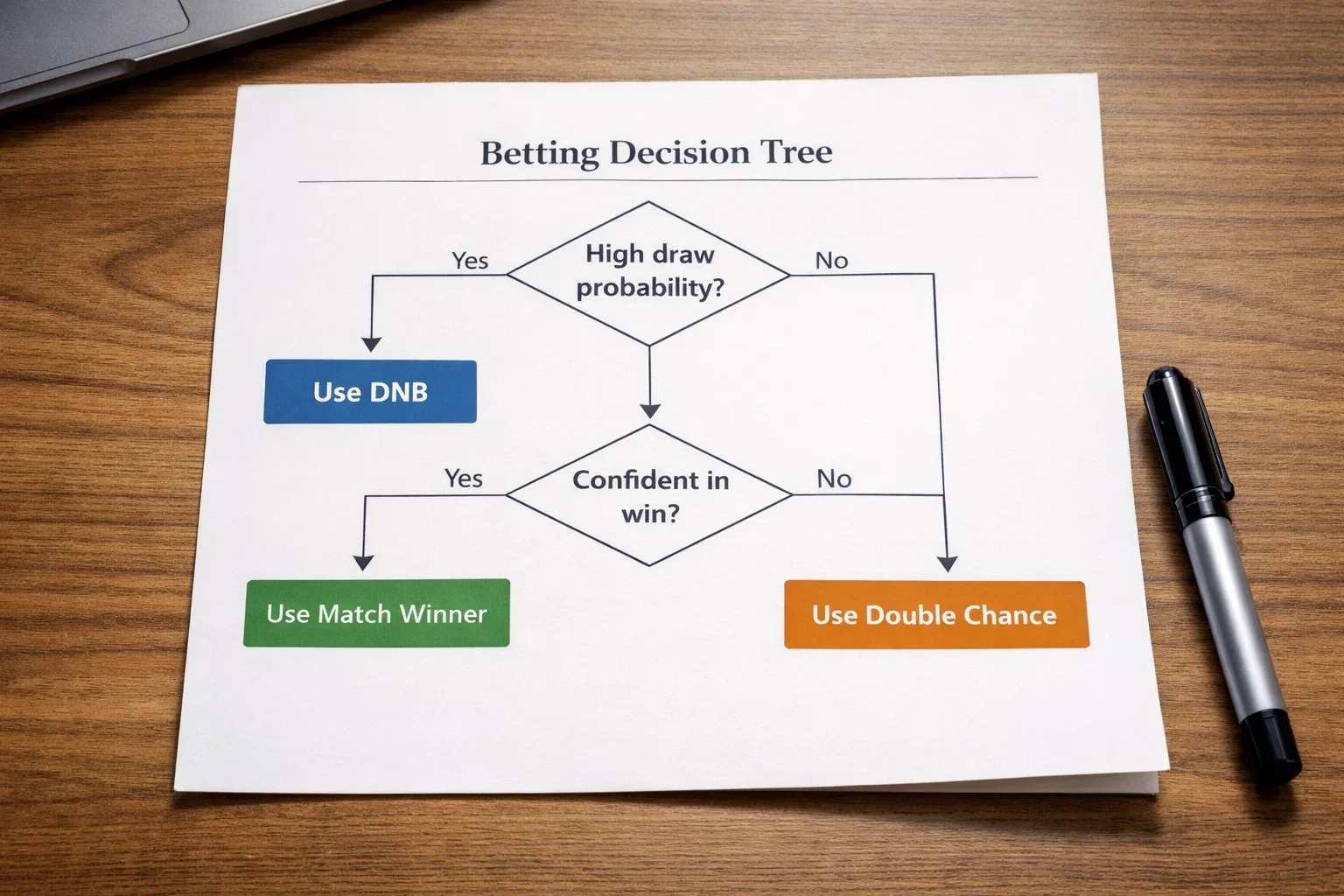
Scenario 1: Confident favourite, wary of upset
Arsenal host newly-promoted side at 1.45 match odds, 1.20 DNB, 1.12 Double Chance (1X). You’re confident Arsenal won’t lose but acknowledge draws happen in maybe 20% of such games.
At 1.45 match odds, Arsenal need to win 69% of the time to break even. At 1.20 DNB, they need to avoid defeat (win + draw = 80%+ typical for such fixtures) for profitability. DNB provides value if you estimate Arsenal’s loss probability below 17%.
Scenario 2: Dangerous underdog away
Wolves visit Liverpool as significant underdogs at 7.00 match odds, 4.50 DNB, 2.75 Double Chance (X2). You believe Wolves are live underdogs who could nick a point.
Double Chance X2 at 2.75 requires 36.4% probability of Wolves winning or drawing. If you estimate Wolves’ combined win/draw probability at 40%, X2 offers value. DNB at 4.50 requires more confidence in an outright Wolves win that may not exist.
Scenario 3: Goal-shy encounter
Two defensive mid-table teams meet in a fixture that historically produces draws. Home win 2.50, Draw 3.20, Away win 3.00, DNB Home 1.75, Double Chance 1X 1.50.
If draw probability is genuinely 35% (higher than market’s 31% implied), DNB becomes attractive because you’re getting refunded on a likely outcome. At 1.75 DNB with 35% draw probability, you’re essentially backing a 45-50% proposition with decent insurance.
Common Mistakes to Avoid
Over-using Double Chance on heavy favourites destroys value. If a team is 90% likely to win, adding draw protection at 1.10 Double Chance odds pays almost nothing while still losing when the 5% upset occurs. At such short prices, just back the match winner or don’t bet.
Ignoring the odds comparison between DNB and Asian Handicap 0.0. These should be identical; if they’re not, take the better price. Many bettors don’t realise the equivalence and leave value on the table.
Building Double Chance accumulators expecting easy money. The short odds compound poorly while the risk of one loss killing everything remains. A five-fold of 1.35 selections needs all five to hit for just 4.4x return — one 30% probability failure ends it.
Forgetting context when selecting markets. Cup matches with replay possibilities (now rare), weather-affected games, or end-of-season dead rubbers all have elevated draw probabilities that make DNB more attractive than standard conditions suggest.
Draw No Bet and Double Chance aren’t magic solutions to beating the bookmaker — they simply reshape the risk-reward profile of your bets. Used thoughtfully when match dynamics favour draw or “avoid defeat” scenarios, they provide valuable flexibility that pure match betting cannot match.
