
Arbitrage Betting in Football: Finding Sure Bets Across Bookmakers
 Available in US
Arbitrage betting — also known as “arbing” or “sure betting” — exploits odds discrepancies between bookmakers to guarantee profit regardless of match outcome. When different bookmakers disagree significantly on event probabilities, their combined odds can create situations where backing all possible outcomes across multiple bookmakers returns more than you stake. It sounds like free money, and mathematically it is — but the practical reality involves significant challenges including account restrictions, time investment, and diminishing opportunities.
The concept is straightforward: bookmakers don’t always agree on probabilities. One might price Manchester City at 1.35 to beat Brentford while another offers 1.45. If their draw and Brentford odds also diverge sufficiently, betting all three outcomes with optimal stakes across different bookmakers can lock in guaranteed profit. Football’s three-way markets (home/draw/away) create more arbitrage opportunities than two-way sports, though the complexity of covering three outcomes requires larger bankrolls and precise stake calculations.
How Arbitrage Works Mathematically
An arbitrage opportunity exists when the combined implied probabilities of all outcomes fall below 100%. Normally, bookmaker margins ensure this sum exceeds 100% — that’s how they profit. But when you cherry-pick the best odds for each outcome from different bookmakers, occasionally the total drops below 100%, creating positive expected value.
The formula for calculating whether an arbitrage exists is simple. Convert each outcome’s decimal odds to implied probability by dividing 1 by the odds. Sum these probabilities. If the total is below 1 (or 100%), an arbitrage opportunity exists.
Example calculation:
Suppose for Liverpool vs Arsenal you find:
- Bookmaker A offers Liverpool at 2.50 (implied probability: 1/2.50 = 40%)
- Bookmaker B offers Draw at 3.80 (implied probability: 1/3.80 = 26.3%)
- Bookmaker C offers Arsenal at 3.20 (implied probability: 1/3.20 = 31.25%)
Combined implied probability: 40% + 26.3% + 31.25% = 97.55%
Since this is below 100%, an arbitrage opportunity exists. The profit margin is approximately 2.45% (100% – 97.55%), meaning a £1,000 total stake would return roughly £24.50 guaranteed profit.
Calculating Stake Distribution
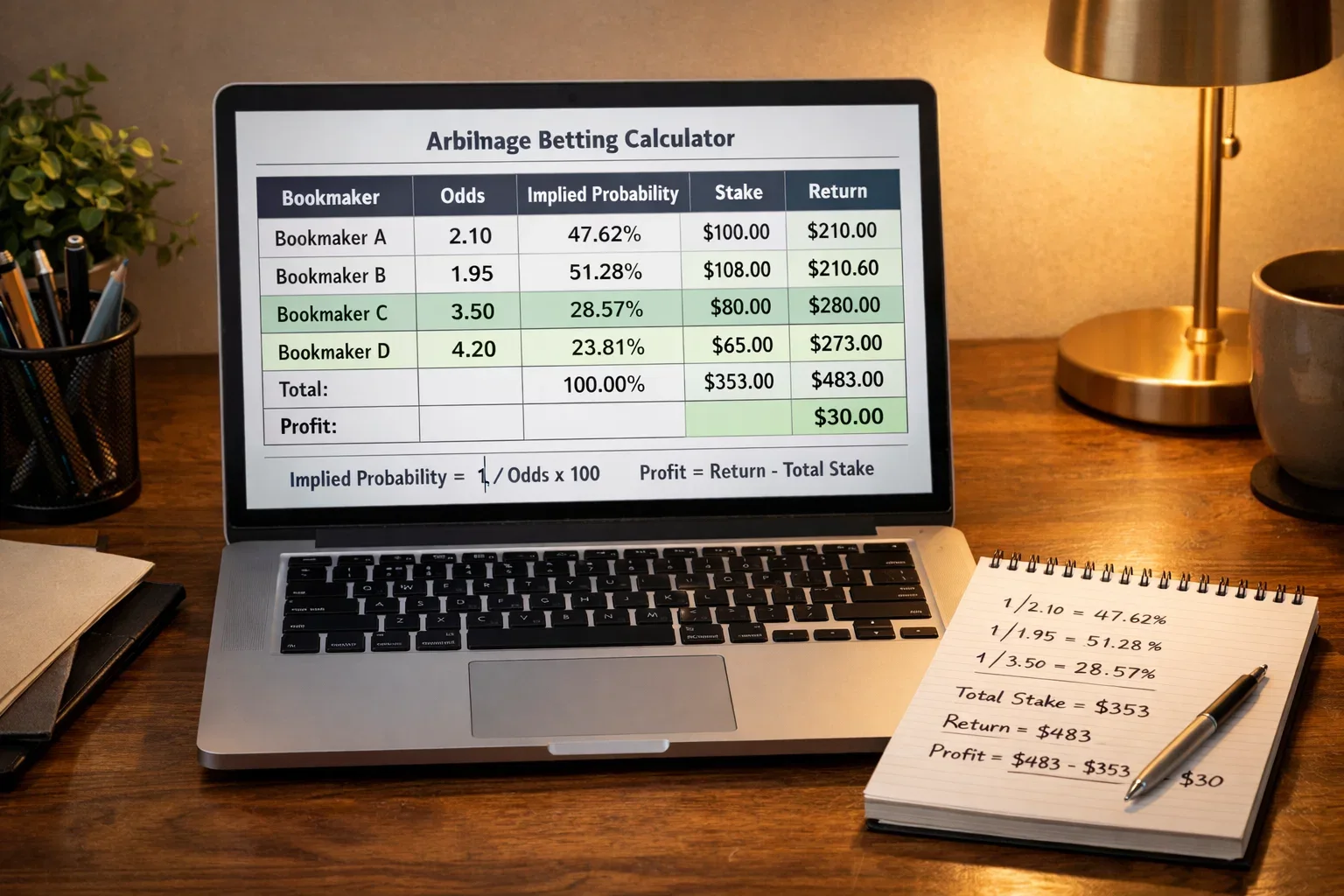
Once you’ve identified an arbitrage opportunity, you must calculate exactly how much to stake on each outcome to guarantee equal returns regardless of result. The formula allocates stakes proportionally to each outcome’s implied probability relative to the total.
Stake formula:
Individual Stake = (Total Investment × Individual Implied Probability) / Total Implied Probability
Using our Liverpool vs Arsenal example with £1,000 total investment:
- Liverpool stake: (£1,000 × 0.40) / 0.9755 = £410.05
- Draw stake: (£1,000 × 0.263) / 0.9755 = £269.60
- Arsenal stake: (£1,000 × 0.3125) / 0.9755 = £320.35
Total staked: £1,000.00
Returns by outcome:
- If Liverpool wins: £410.05 × 2.50 = £1,025.13
- If Draw: £269.60 × 3.80 = £1,024.48
- If Arsenal wins: £320.35 × 3.20 = £1,025.12
Guaranteed profit: approximately £24-25 regardless of result.
Finding Arbitrage Opportunities
Manual arbitrage hunting is theoretically possible but practically inefficient. You’d need to monitor odds across dozens of bookmakers continuously, calculate arbitrage percentages for thousands of daily markets, and act within minutes before odds shift. This is why most serious arbitrage bettors use dedicated software.
Arbitrage scanning software continuously monitors odds across bookmakers, instantly flagging opportunities that meet your criteria. Services like BetBurger, RebelBetting, OddsJam, and BetWasp scan hundreds of bookmakers and alert users to surebets in real-time. Most operate on subscription models costing £50-200 monthly, justified by the profits they enable.
Odds comparison sites like Oddschecker and Oddsportal aggregate bookmaker odds and can help identify potential arbitrages manually, though they’re slower than dedicated scanners and don’t calculate stake distributions automatically.
Key characteristics of football arbitrage opportunities:
Football’s three-way markets create more opportunities than two-way sports but require larger bankrolls since you’re covering three outcomes instead of two. The most common football arbitrages appear in match winner markets, but opportunities also exist in over/under goals, Asian handicaps, and player props.
Most arbitrage opportunities offer 0.5-3% returns. Opportunities above 3% are rare and often indicate errors (which may be voided by bookmakers) rather than genuine market disagreements. The average profitable arb returns around 1-2%, meaning you need substantial stakes and volume to generate meaningful income.
Practical Execution Challenges
The mathematical elegance of arbitrage betting confronts messy real-world complications that reduce profitability and sustainability.
Speed is critical. Arbitrage opportunities typically last seconds to minutes before odds shift. By the time you’ve identified an opportunity, calculated stakes, and placed three separate bets across three different bookmaker websites, the odds may have changed. Software automation helps but doesn’t eliminate this risk.
Stake placement issues arise frequently. You might successfully place two of three bets only to find the third bookmaker has limited your maximum stake or shifted their odds. You’re now exposed on an incomplete arbitrage, potentially facing losses rather than guaranteed profits.
Differing bookmaker rules can void arbitrage attempts. If bookmakers disagree on how to settle a specific outcome (injury timing, abandoned matches, extra time rules), one leg of your arbitrage might settle differently than expected. Understanding each bookmaker’s specific terms is essential but time-consuming.
Maximum stake limits vary dramatically between bookmakers and markets. A bookmaker might accept £10,000 on Premier League match winner but only £100 on Conference League totals. Lower-profile matches often have stricter limits precisely because bookmakers expect sharper action on them.
Currency and payment considerations complicate multi-bookmaker operations. Maintaining funded accounts across numerous bookmakers requires significant capital. Currency conversion fees eat into already-slim arbitrage margins if you’re betting across different currencies.
Account Restrictions: The Biggest Threat
Bookmakers actively identify and restrict arbitrage bettors. Their surveillance systems flag betting patterns consistent with arbing: always taking best available odds, betting both sides of markets, unusual stake amounts (arbitrage calculations often produce odd numbers like £347.82), and consistent winning.
Account limiting typically starts with reduced maximum stakes — you might find your limits dropped from £500 to £5 on certain markets. This often progresses until meaningful betting becomes impossible, though your account technically remains “open.”
Account closure is the ultimate sanction. Some bookmakers close suspected arbitrage accounts entirely, returning your balance but preventing future access. Once limited or closed at a bookmaker, there’s rarely any appeal process that succeeds.
Gubbing timelines vary by bookmaker. Some restrict within days of detecting arbitrage activity; others tolerate it longer. “Sharp” bookmakers like Pinnacle and betting exchanges rarely limit winning players and are arbitrage-friendly, while recreational-focused bookmakers (most UK high street brands) limit aggressively.
Delaying restrictions requires operational discipline. Bet round numbers rather than precise arbitrage calculations (£350 instead of £347.82). Place occasional losing recreational bets. Avoid always taking best odds. Don’t withdraw immediately after wins. These tactics may extend account lifespans but don’t guarantee immunity.
Risk Factors and Mitigation
Despite “guaranteed profit” marketing, arbitrage betting carries real risks.
Palpable errors (obvious pricing mistakes) can be voided by bookmakers even after your bet is placed. If one bookmaker accidentally offers 10.00 on Manchester City instead of 1.10, they’ll almost certainly void bets at those odds. Your “arbitrage” suddenly becomes a losing single bet on the other outcome.
Correlation risk emerges when bookmakers void or settle bets differently. You might have placed your Liverpool, Draw, and Arsenal bets, but one bookmaker voids their leg due to a technicality you weren’t aware of. You’re now holding two exposed bets without the third leg that completed your arbitrage.
Counterparty risk exists with smaller or offshore bookmakers. If a bookmaker refuses to pay or becomes insolvent, your perfect arbitrage calculation means nothing. Stick to regulated, reputable bookmakers even if their odds create fewer opportunities.
Cash flow requirements are substantial. With 1-2% returns per successful arbitrage, you need five-figure stakes to generate meaningful income. Your capital is also fragmented across many bookmaker accounts, reducing liquidity and flexibility.
Realistic Expectations

Professional arbitrage betting was more viable a decade ago when bookmaker surveillance was less sophisticated and online odds comparison was newer. Today’s environment presents significant obstacles.
Income potential depends heavily on starting capital and bookmaker access. Someone with £50,000 spread across 30 bookmaker accounts who identifies two 1.5% arbitrages daily would gross roughly £1,500 monthly — before account restrictions inevitably erode access. Most hobby arbitrage bettors operate at much smaller scales with correspondingly modest returns.
Sustainability is limited. Almost all arbitrage bettors eventually face account restrictions that end their profitability. Treating arbitrage as temporary income rather than career strategy is realistic. Some practitioners rotate through new bookmaker accounts (family members, friends) to extend their runway, though this creates its own complications.
Opportunity cost matters. The hours spent monitoring arbitrage software, managing multiple bookmaker accounts, and placing time-sensitive bets have alternative value. For many, the effective hourly rate of arbitrage betting — after accounting for restrictions that shorten earning periods — falls below minimum wage.
Alternatives and Complements
Arbitrage betting skills transfer to related strategies that may offer better long-term sustainability.
Value betting identifies odds that exceed fair probability without requiring offsetting bets. You accept variance in exchange for higher potential returns and (sometimes) less aggressive account restrictions, since you’re not exhibiting the obvious arbitrage pattern of backing all outcomes.
Matched betting uses bookmaker promotions (free bets, bonuses) alongside arbitrage-style lay bets on exchanges to extract value from sign-up offers. It’s more sustainable than pure arbitrage because bookmakers expect promotional abuse and account through-put is limited anyway.
Exchange trading on Betfair and similar platforms allows backing and laying without bookmaker involvement. While exchanges don’t restrict winning traders, the competition is fiercer — you’re trading against other sophisticated bettors rather than exploiting bookmaker disagreements.
Arbitrage betting remains mathematically sound but practically challenging. For those with significant capital, multiple bookmaker accounts, and willingness to invest time in software-assisted opportunity identification, modest profits are achievable until the inevitable account restrictions accumulate. For most casual bettors, the barriers to entry and sustainability issues make other approaches more practical.
