
First Goalscorer and Anytime Goalscorer Betting Tips
 Available in US
Goalscorer markets transform football betting from predicting team outcomes into backing individual players to find the net. Instead of worrying about final scores or which side wins, you’re focused on one question: will this specific player score? The appeal is straightforward — higher odds than match betting, engagement throughout the entire game, and the satisfaction of correctly identifying who’ll deliver the crucial moment. The challenge is equally clear: you’re predicting individual performance in a team sport where countless variables determine who gets scoring opportunities.
Two primary markets dominate goalscorer betting. First Goalscorer requires your player to score the opening goal of the match — a high-risk, high-reward proposition where timing matters as much as talent. Anytime Goalscorer simply needs your player to score at any point during the 90 minutes, offering better hit rates at correspondingly lower odds. Understanding the nuances of each market, knowing which factors genuinely predict goals, and identifying where bookmakers misprice individual players separates profitable goalscorer betting from expensive guesswork.
First Goalscorer: High Risk, High Reward
First Goalscorer betting asks you to predict not just who scores but when — specifically, that your chosen player scores before anyone else. The market typically offers odds three to four times higher than Anytime Goalscorer on the same player because the probability is correspondingly lower. A striker who scores in 40% of matches might only score first in 10-12% of them.
The mechanics are simple but the rules matter. If the match ends 0-0, all First Goalscorer bets lose — there’s no refund for goalless draws. If your selected player doesn’t feature at all (not even as a substitute before the first goal), your stake is typically refunded. Own goals don’t count; if the first goal is an own goal, settlement moves to whoever scores the second goal. These rules apply to 90 minutes plus stoppage time only — extra time and penalty shootouts don’t count.
First Goalscorer odds usually range from about 5.00 for prolific strikers in attacking teams to 30.00+ for defenders and defensive midfielders. The favourite rarely starts shorter than 5.00 because even the most clinical striker only scores the opening goal in roughly 15-20% of matches where any goal is scored. This creates an inherently speculative market where even successful bettors lose the majority of their bets.
The variance is brutal. A player who scores first once every six matches (fair value at 6.00) will experience long losing runs through pure probability. Ten consecutive losses is entirely normal even when backing value selections. Bankroll management and stake sizing must account for this reality — First Goalscorer is not a market for aggressive staking or chasing losses.
Anytime Goalscorer: The Safer Alternative
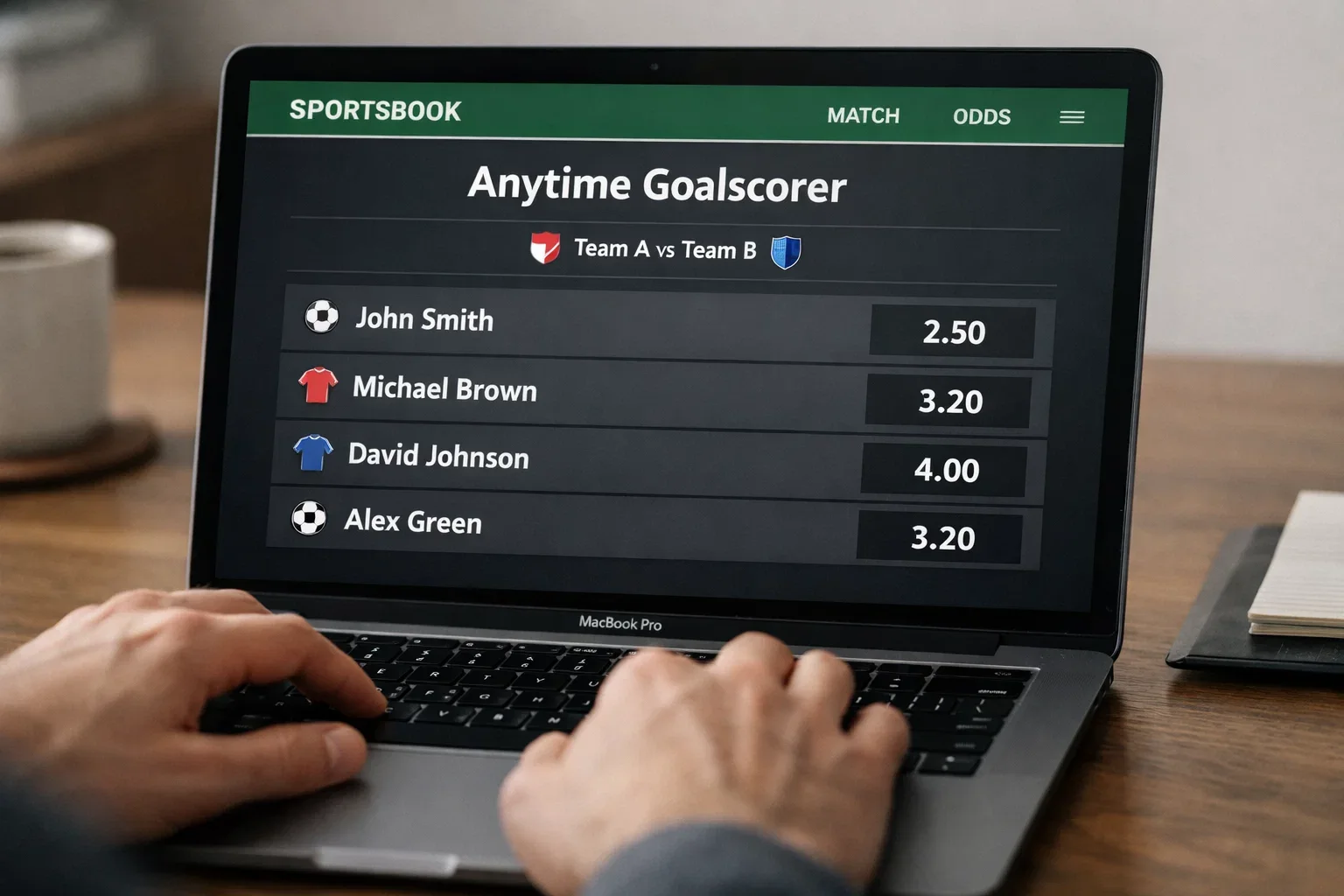
Anytime Goalscorer removes the timing element entirely. Your player just needs to score once during the match — first goal, last goal, or any goal in between. This dramatically increases hit rates compared to First Goalscorer, reflected in odds roughly one-third as high.
If a player is 15.00 to score first, they might be 5.00 to score anytime. If they’re 6.00 first, they’ll be around 2.20-2.50 anytime. The relationship isn’t perfectly linear because First Goalscorer probability depends on goal timing distribution, but roughly dividing First Goalscorer odds by three gives you the Anytime Goalscorer ballpark.
The same rules apply regarding non-participation (stake refunded if player doesn’t feature), own goals (don’t count), and match duration (90 minutes plus stoppage time only). The key difference is that goalless draws don’t automatically lose — your bet loses because your player didn’t score, not because no one scored.
Anytime Goalscorer suits accumulator betting better than First Goalscorer. A three-fold of players at 2.50 each returns 15.63x stake — achievable through a combination of research and reasonable fortune. A three-fold of First Goalscorer selections at 8.00 each returns 512x but hits so rarely that the variance destroys most bankrolls before a winner lands.
Key Factors for Goalscorer Analysis
Successful goalscorer betting requires systematic analysis of factors that genuinely predict individual goal scoring, rather than lazy assumptions about “in-form strikers” or “prolific attackers.”
Minutes played is the foundational metric. A player who starts every match and plays 90 minutes has double the scoring opportunity of someone who starts but gets substituted at 60 minutes or only appears off the bench for 20-minute cameos. Check recent minutes data before backing anyone — a star striker returning from injury might be on limited minutes, dramatically reducing their scoring probability regardless of talent.
Penalty taking duties create significant scoring advantages. The average penalty converts at approximately 75-80%, and teams win penalties in roughly 20-25% of matches. A designated penalty taker essentially gets free shots at goal that don’t depend on creating chances from open play. Bruno Fernandes, Mohamed Salah, and other regular penalty takers consistently outperform their open-play scoring rates because of this bonus. Always identify who takes penalties for each team.
Free kick specialisation matters for direct free kicks within shooting range. Players like James Ward-Prowse built careers partly on dead-ball expertise, and a direct free kick goal doesn’t require getting into open-play scoring positions. However, direct free kick goals are rare enough (perhaps 2-3% conversion rate) that this factor is secondary to penalties.
Playing position obviously affects scoring probability, but less straightforwardly than many assume. Yes, strikers score more than defenders on average. But a deep-lying striker who drops to link play might score less than an attacking midfielder who makes late runs into the box. Examine how players actually position themselves in the attacking phase, not just their nominal position.
Team attacking quality determines the volume of chances created. A middling striker for Manchester City gets more and better scoring opportunities than a star striker at a relegation-threatened side. Consider the supply chain — who creates the chances, and does that creator tend to find your selected player?
Opponent defensive quality affects how many chances convert. Facing a makeshift defence with injuries or suspensions increases goal probability for everyone. Facing a well-organised unit with a quality goalkeeper suppresses conversion rates. This factor matters more for open-play scorers than penalty takers.
Identifying Value in Goalscorer Markets
Value in goalscorer markets emerges when the probability implied by the odds is lower than the true probability based on your analysis. A player at 4.00 implies 25% scoring probability. If you estimate 30% based on their scoring rate, minutes played, and fixture context, you’ve found potential value.
Historical scoring rates provide the baseline. Calculate goals per 90 minutes over a meaningful sample (preferably 20+ matches). A player scoring 0.45 goals per 90 theoretically scores in about 36% of matches they play 90 minutes in — though the actual distribution varies based on whether goals come in clusters or spread evenly.
Current form adjustments can swing probability estimates. A player on a hot streak of four goals in three games might be temporarily overperforming their underlying rate — regression is likely. Conversely, a quality striker blanking for five games despite creating chances is probably due for positive regression. Expected goals (xG) data helps distinguish between form and luck.
Fixture-specific factors require match-by-match evaluation. Does this player historically score against this opponent? Is the opposition missing their best defender? Will the game state (e.g., cup tie versus meaningless league game) affect attacking intent? These factors don’t appear in seasonal averages but affect individual match probability.
Market inefficiencies often exist for players outside the starting XI spotlight. Bookmakers dedicate more attention to pricing headline strikers accurately. Goalscoring midfielders, super-sub specialists, and defenders who score from set pieces may be mispriced because they receive less analytical focus. Finding value on a centre-back at 20.00 who actually scores from corners 8% of the time (fair value 12.50) is more achievable than finding value on Erling Haaland at 2.20.
Common Mistakes in Goalscorer Betting
Backing players who don’t start destroys expected value. Always check team news before placing goalscorer bets. A player on the bench has perhaps 20-30% of normal scoring probability even if they come on, and maybe 30% of matches they don’t appear at all. Your 3.00 shot becomes effectively 8.00-10.00 fair value.
Ignoring penalty taker changes leads to mispriced selections. If a team’s regular penalty taker is injured or out of form and someone else has assumed duties, the market might not adjust quickly. Similarly, backing a non-penalty taker on a team that rarely wins penalties means you’re missing the chance element that inflates others’ rates.
Overweighting recent goals without context causes reactive betting. A defender who scored twice from corners last month isn’t suddenly a goalscoring threat — that’s noise, not signal. Unless something structural changed (new set-piece routine, new taker who finds him), regression toward their usual non-scoring rate is coming.
Chasing losses with First Goalscorer bets accelerates bankroll destruction. After a losing streak on Anytime Goalscorer, the temptation is switching to First Goalscorer for bigger potential returns. This increases variance precisely when you need to reduce it. Stick to your strategy through losing runs rather than gambling on long shots to recover.
Neglecting substitute patterns affects Last Goalscorer betting specifically. Players who typically get substituted around 70 minutes rarely score the last goal — that falls to those still on the pitch in the 85th-90th minute. Fresh legs from late substitutes score disproportionately many last goals compared to starters who played the full match.
Building a Goalscorer Betting Strategy
Develop a systematic approach rather than match-by-match guessing. Start with a clear scope — which leagues and players will you analyse regularly? Comprehensive coverage of one league beats superficial coverage of five.
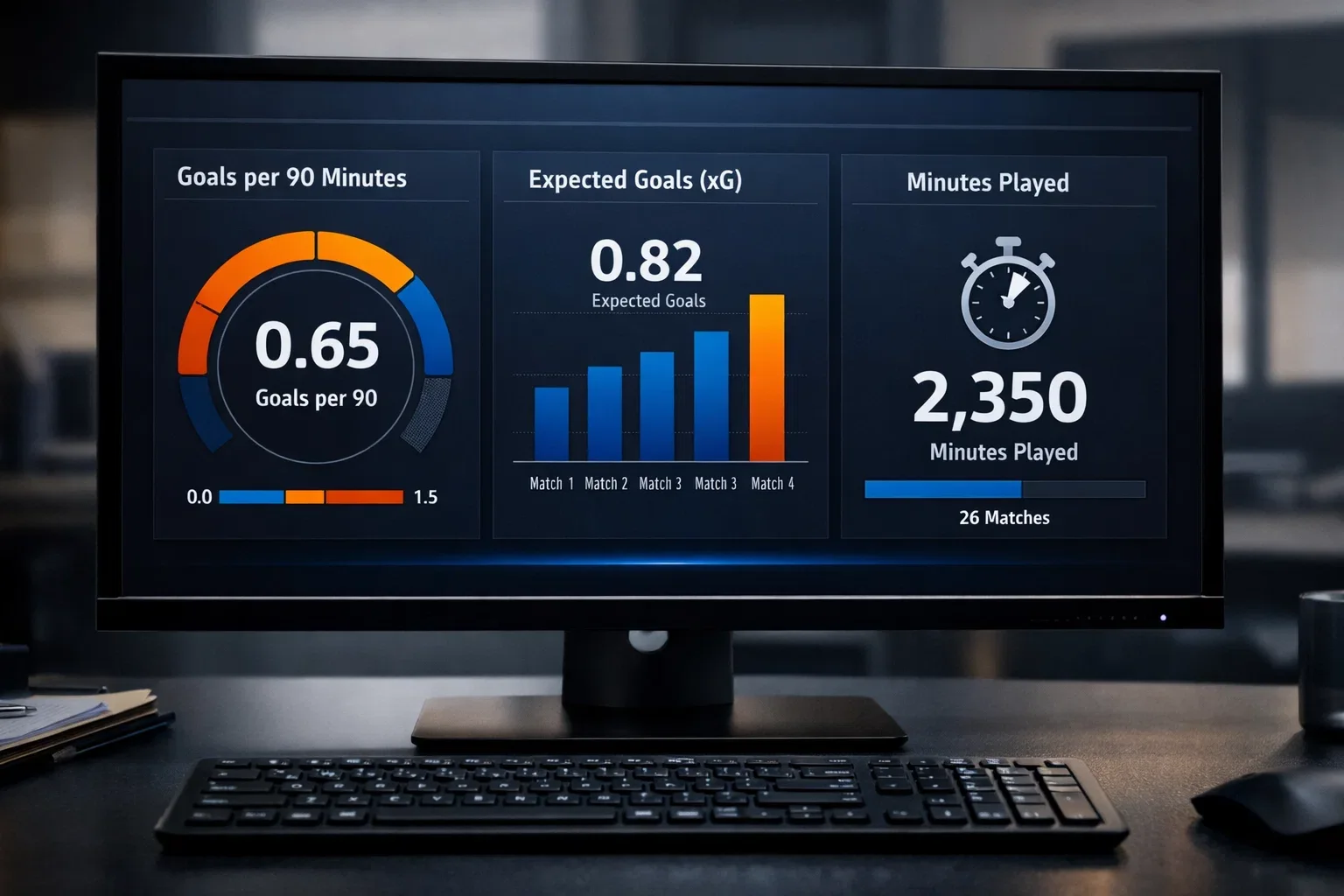
Build a database tracking relevant metrics for players in your scope: goals per 90, expected goals per 90, minutes per start, penalty taking duties, historical scoring against upcoming opponents, and recent form. This enables objective comparison rather than subjective impressions about who “looks likely” to score.
Set minimum value thresholds before betting. If you require 10% edge (your estimated probability exceeds implied probability by 10% of the implied), only bet when that threshold is met. This filtering reduces bet volume but increases expected profitability.
Track results religiously. Record every goalscorer bet: player, match, odds, your estimated probability, stake, and result. Over hundreds of bets, analyse whether your probability estimates are well-calibrated. If you’re estimating 30% but only hitting 22%, your model needs adjustment.
Consider focusing on specific niches within goalscorer markets. Maybe you develop genuine edge in identifying underpriced midfielders who score from set pieces, or super-subs in leagues where you track playing time patterns closely. Specialisation enables deeper knowledge than bookmaker generalists possess.
Combining Goalscorer Bets with Other Markets
Goalscorer selections integrate into several combination markets offering enhanced odds through increased difficulty.
Scorecast combines First Goalscorer with Correct Score — your player must score first AND the match must end with your predicted scoreline. These offer enormous odds (often 50.00-200.00) but hit extremely rarely. The value is difficult to assess because you’re multiplying two low-probability events.
Wincast combines Anytime Goalscorer with Match Result. Your player must score and their team must achieve the result you backed. More achievable than Scorecast but still challenging, typically offering 4x-6x the Anytime Goalscorer odds alone.
Goalscorer accumulators multiply selections across matches. Three Anytime Goalscorer picks at average 2.50 each returns 15.63x; four returns 39x. Hit rates decline exponentially — roughly 25% for a double, 10% for a treble, 4% for a four-fold — but accumulated odds can be attractive for small stakes.
Bet builders allow combining goalscorer selections with team-level markets within the same match. You might back a player to score anytime combined with over 2.5 goals and both teams to score. These combinations allow expressing specific match views but require all elements to hit.
Goalscorer betting rewards those who approach it analytically. The markets appear simple — just pick who scores — but profitable betting requires understanding scoring probability, identifying mispriced players, and managing the variance inherent in backing individual outcomes within a team sport.
