
Football Accumulator Betting: Tips for Building Winning Accas
 Available in US
Football accumulators — combining multiple selections into a single bet with multiplied odds — represent the most popular but mathematically punishing form of football betting. The appeal is obvious: transform a modest stake into substantial returns by linking several “banker” selections together. A five-fold of 1.50 odds selections returns 7.59x your stake; add a few longer prices and returns quickly reach 20x, 50x, or more. The problem is equally obvious: every additional selection reduces your probability of success. Bookmakers love accumulators because the compounding margin across multiple selections tilts mathematics heavily in their favour.
This isn’t to say accumulators are impossible to profit from — just that doing so requires either finding genuine value in each selection (rare) or exploiting promotional offers that shift the mathematics (more achievable). Understanding how accumulator mathematics works, selecting appropriate numbers of legs, and approaching accas with realistic expectations separates hopeful punters from strategic bettors.
How Accumulator Mathematics Works
When you combine selections into an accumulator, the odds multiply together. A double with legs at 2.00 and 2.50 pays 5.00 (2.00 × 2.50). A treble adding a third leg at 1.80 pays 9.00 (5.00 × 1.80). The compounding effect creates the attractive returns that draw punters to accumulators.
However, bookmaker margins also compound. Each selection contains a built-in edge for the bookmaker — typically 3-6% on standard match markets. In a single bet, that margin costs you perhaps 5%. But in a four-fold accumulator, the compounding effect means you’re facing an effective margin of roughly 20%+ on the combined bet.
Consider four selections each at true probability 50% (fair odds 2.00). A fair four-fold would pay 16.00. But bookmakers offer 1.90 on each leg (incorporating their margin), so your four-fold pays only 13.03 (1.90^4). You’re sacrificing nearly 20% of fair value before any bet is placed.
This mathematical reality explains why bookmakers promote accumulators so enthusiastically, offer “acca insurance” (refunding stakes if one leg fails), and provide accumulator bonuses (adding percentage returns to winning accas). These promotions partially offset the compounding margin — but rarely eliminate it entirely.
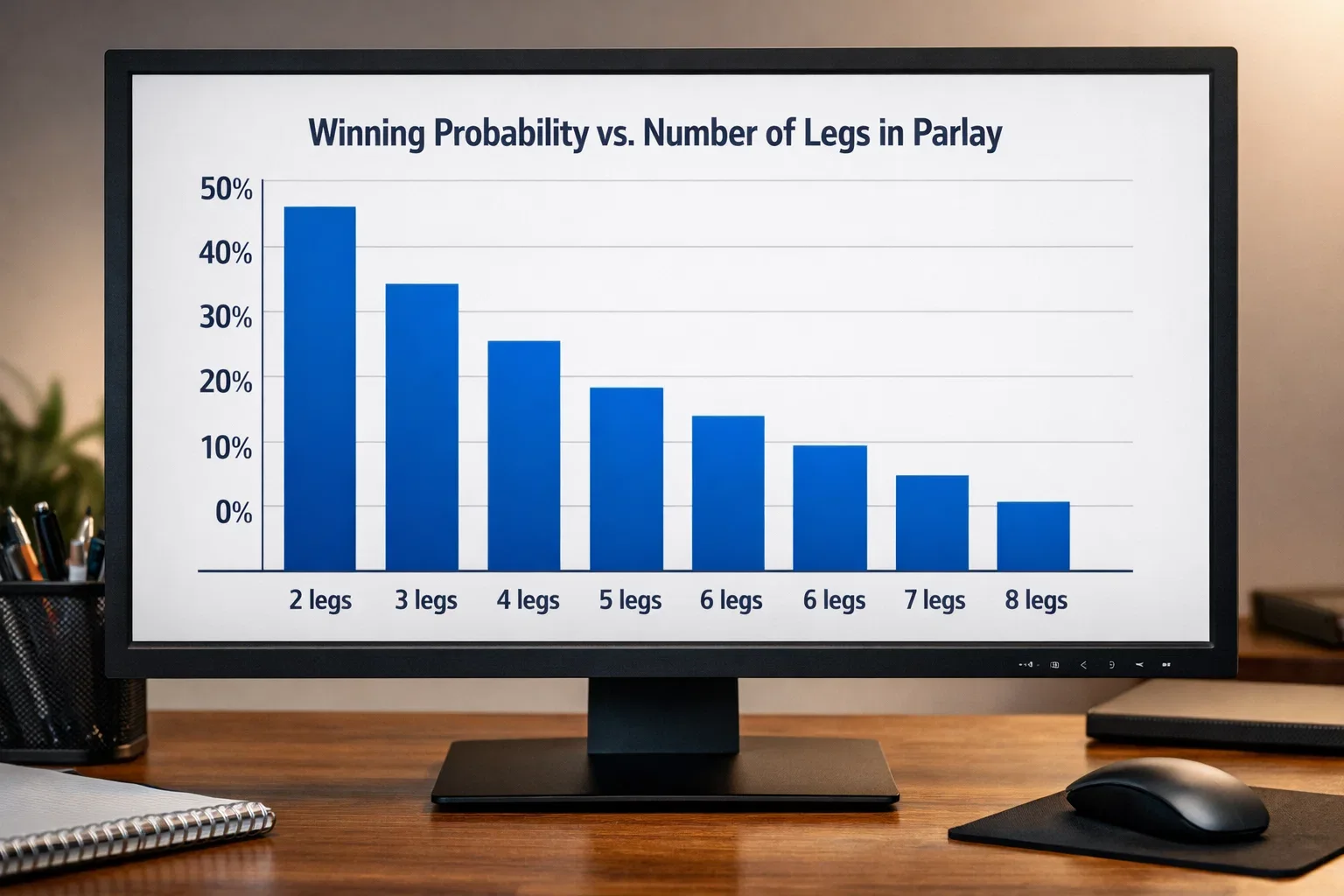
The probability of winning also plummets with additional legs. If each selection has 50% probability of winning, a double has 25% chance of full success; a treble 12.5%; a four-fold 6.25%; a five-fold 3.125%. Even with highly probable selections (say, 70% each), a five-fold wins only 16.8% of the time (0.70^5). Most accumulators lose.
Optimal Number of Selections
There’s no mathematically “correct” number of selections — it depends on your goals, edge, and risk tolerance. However, general principles guide sensible accumulator construction.
Fewer legs means higher strike rate but lower returns. Doubles and trebles hit more often than larger accas, allowing more consistent (though smaller) profits. If you have genuine analytical edge in identifying value, concentrating that edge in smaller multiples produces steadier results.
More legs means higher variance and lower expected value. Each additional leg compounds the bookmaker’s margin while reducing your probability of success. Unless you’re betting solely for entertainment or chasing transformational returns with small stakes, six-folds and beyond are mathematically challenging.
Three to five legs offers reasonable balance for most bettors. This range creates attractive odds (roughly 5x-15x at typical prices) while maintaining achievable strike rates. At these sizes, promotional offers like acca insurance become particularly valuable — getting your stake back when one leg fails significantly improves expected value.
Single-leg failures dominate accumulator outcomes. Research your accumulators historically and you’ll likely find that most lose by exactly one leg. This painful pattern makes insurance offers genuinely valuable rather than just marketing gimmicks.
Building Better Accumulators
Random selection of “bankers” produces predictably poor results. Systematic approaches to accumulator construction improve your odds — though they can’t eliminate the fundamental mathematical challenge.
Select value, not favourites. The temptation is combining heavy favourites (1.20, 1.30 odds) for perceived safety. But these short prices often offer poor value — the probability of winning isn’t proportionally higher than the odds suggest. A 1.25 favourite needs to win 80% of the time to break even; many “bankers” don’t achieve this. Instead, identify value at each price point: sometimes that’s a favourite, sometimes an underdog.
Mix market types to reduce correlation risk. Four match winner selections face similar risks — bad weather affecting multiple games, unusual refereeing patterns, or league-wide surprises. Including different market types (over/under goals, BTTS, Asian handicaps) diversifies your exposure, though correlation still exists.
Consider league and timing carefully. Football is most unpredictable in specific contexts: international breaks disrupt domestic form; fixture congestion affects team selection; end-of-season matches involve skewed motivation. Build accumulators during relatively predictable periods rather than chaotic ones.
Check fixture scheduling. If possible, structure accumulators so that uncertain results settle first. This enables cash-out opportunities if early legs succeed but later selections look risky. Having your most confident selection last — when you can’t cash out — is strategically suboptimal.
Research each leg independently. Don’t add selections to “boost odds” without analysis. Each additional poorly-researched leg reduces overall probability more than the odds increase justifies. Better a well-researched treble than a speculative five-fold.
Exploiting Accumulator Promotions
Bookmaker promotions transform accumulator mathematics more than any analytical improvement you can make. Understanding and exploiting these offers is the closest thing to guaranteed edge in accumulator betting.
Acca insurance refunds your stake (usually as a free bet) if one leg of a qualifying accumulator fails. This converts near-misses into break-even outcomes rather than total losses. If 60% of your losing accas fail by exactly one leg, acca insurance recovers 60% of losses on those bets (minus free bet restrictions). The value is substantial.
Acca boosts add percentage returns to winning accumulators — typically 5-10% for four-folds scaling up to 50-100% for ten-folds. These bonuses directly offset compounding margins. A 10% boost on a four-fold effectively eliminates the extra margin from one of the four selections.
Enhanced odds on specific accumulators (often pre-built by bookmakers) occasionally offer genuine value if the combined enhancement exceeds what you’d calculate as fair odds. However, many promoted accas are designed to attract recreational money rather than offer edge — analyse rather than trust.
Qualifying for promotions often requires minimum odds per leg (typically 1.20-1.50) and minimum number of selections. Structure accumulators to meet these thresholds while maintaining your analytical standards. Don’t add low-value legs just to qualify for insurance.
Multiple bookmaker accounts enable consistent promotional exploitation. Different bookmakers offer different promotions on different weekends. Spreading accumulator betting across accounts captures more promotional value than loyalty to one bookmaker.
Market Selection for Accumulators
Different betting markets suit accumulator structures differently, balancing probability, odds, and correlation.
Match winner (1X2) is the most common accumulator market but includes the draw as a losing outcome. Favourites often offer poor value; underdogs offer long odds but low strike rates. Consider Draw No Bet or Double Chance markets to eliminate the draw risk while maintaining reasonable odds.
Both Teams to Score (BTTS) typically hits around 50% of matches in major leagues, with odds usually near 1.80-1.95. BTTS accumulators have reasonable strike rates and popular promotional support. However, correlation between BTTS outcomes is lower than many assume — high-scoring leagues don’t always produce BTTS more often.
Over/Under Goals markets offer clear probability benchmarks from historical data. Over 2.5 hits roughly 50% in most leagues; over 1.5 hits 70%+; over 3.5 hits 25-30%. Understanding these baselines helps identify value. Goals markets correlate with specific matchups more predictably than match outcomes.
Asian Handicaps eliminate draws and offer tighter margins than 1X2 markets. AH accumulators avoid the frustration of draws killing bets while typically receiving competitive odds. Quarter-line handicaps (0.25, 0.75) provide half-push, half-win/loss outcomes that can salvage partially successful legs.
Mixed market accumulators combining match outcomes, goals, and BTTS from different fixtures reduce correlation while maintaining attractive combined odds. However, ensure you’re not sacrificing leg quality for market diversity.
Bankroll Management for Accumulators

Accumulator betting requires specific bankroll approaches due to its high variance and low strike rate.
Stake small relative to bankroll. If singles warrant 1-2% of bankroll, accumulators warrant 0.5% or less. The probability of losing any individual acca is high; you need sufficient bankroll to survive the inevitable losing runs.
Consider accumulator bankroll separately. Allocate a specific portion of total gambling funds to accumulators, accepting that this portion may be depleted during bad runs. This psychological separation prevents accumulators from draining funds earmarked for higher-probability betting.
Don’t chase accumulator losses with larger accumulators. After a losing weekend, the temptation is adding more legs to “get it back” with one big win. This compounds the mathematical problem — more legs means lower probability and higher effective margin.
Track accumulator performance independently. Record every accumulator: selections, odds, stake, result, and how many legs won. Over time, analyse whether your accumulators are profitable, break-even, or losing. This data reveals whether your selection approach works or needs adjustment.
Use free bets strategically. When promotions provide free bet returns, use them on accumulators with higher expected value than average. Free bets have no stake risk, so slightly more aggressive accumulator construction is justified.
Realistic Expectations
Most accumulator bettors lose money. The mathematics ensures this — compounding margins, low strike rates, and the difficulty of consistently finding value across multiple selections produce negative long-term returns for most punters.
Even skilled bettors who profit on singles often struggle with accumulators. Finding one value bet is challenging; finding four simultaneously is dramatically harder. The edge required to overcome compounding margins is rarely achievable through pure analytical skill.
The realistic path to accumulator profit combines genuine analytical ability with promotional exploitation. By identifying solid value selections (not certainties — just positive expected value) and structuring bets to maximise promotional returns, the combined edge can exceed the compounding margin.
Alternatively, treat accumulators as entertainment rather than investment. A £5 weekly accumulator for potential £100+ returns provides excitement across multiple matches at minimal cost. This approach is psychologically healthier than believing accumulators represent a path to consistent profit.
What accumulators aren’t is “free money” through stacking favourites. The beautiful simplicity that makes them appealing — just pick some winners and multiply your money — obscures the mathematical reality that picking enough winners consistently enough to overcome compounded margins is genuinely difficult. Approach them with eyes open, expectations managed, and strategies designed around promotional value rather than analytical overconfidence.
