
How Football Betting Odds Work: Decimal, Fractional and American Explained
 Available in US
Football betting odds tell you two things at once: how likely something is to happen, and how much money you stand to win if it does. That sounds simple enough, but bookmakers around the world have settled on three completely different ways of expressing the same information. If you’ve ever looked at odds of 2.50 on one site, 6/4 on another, and +150 somewhere else, and wondered whether these were remotely comparable, you’re not alone. They are, in fact, identical — just dressed in different mathematical clothing.
Understanding how to read and convert between these formats isn’t just academic exercise. It’s the foundation for everything else in football betting, from calculating your potential returns to spotting value and comparing prices across different bookmakers. Get comfortable with odds, and you’ll navigate betting markets with confidence. Remain confused by them, and you’ll always be operating at a disadvantage.
The Three Formats: Where They Come From and Who Uses Them
Decimal odds dominate continental Europe, Australia, and most international betting exchanges. They’re also increasingly common on UK betting sites that cater to a global audience. The format is straightforward: the number represents your total return for every unit staked, including your original stake. Odds of 3.00 mean you get three units back for every one you put down — your original stake plus two units of profit.
Fractional odds are the traditional British and Irish format, still widely used at racecourses, in betting shops, and on many UK-facing online bookmakers. They express profit relative to stake: 2/1 (spoken as “two to one”) means you profit two units for every one you stake. The number on the left is your potential profit; the number on the right is what you need to risk to earn it.
American odds, also called moneyline odds, are standard across the United States. They work differently depending on whether the number is positive or negative. Positive odds show how much profit you’d make on a 100-unit stake. Negative odds show how much you need to stake to profit 100 units. The system takes some getting used to, but it quickly communicates whether you’re betting on a favourite or an underdog.
Decimal Odds: The Clearest System
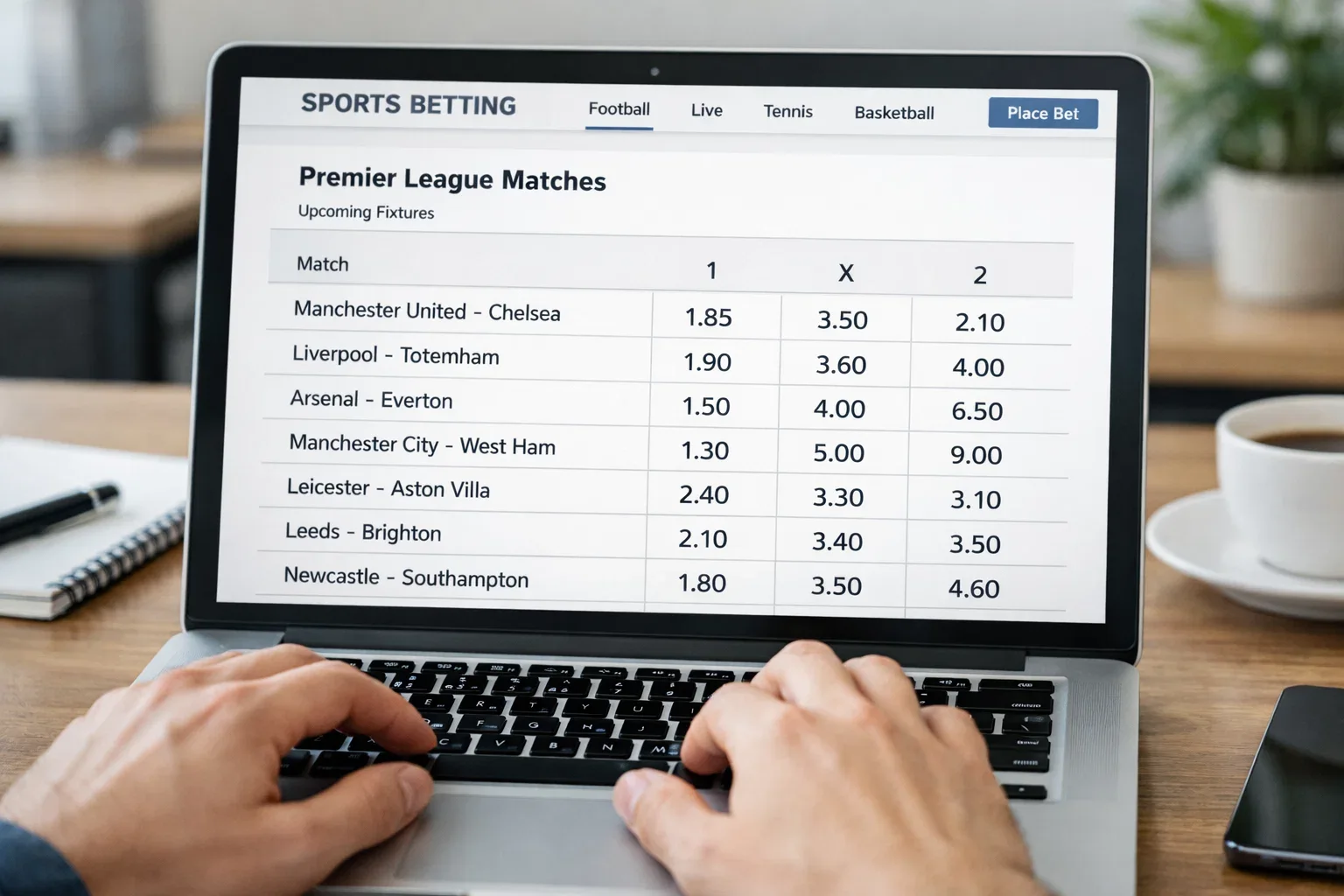
Decimal odds have become the international standard for good reason — they’re the easiest to work with mathematically. Your total return is simply your stake multiplied by the decimal odds. Bet £50 at odds of 2.40, and your return is £50 × 2.40 = £120. That includes your original £50 stake, so your actual profit is £70.
The beauty of decimal odds is that comparing prices across different bets takes no mental effort. Higher numbers always mean bigger potential returns, and therefore either a less likely outcome or better value. If one bookmaker offers 2.10 on Liverpool to win and another offers 2.25, you know instantly that the second price is better without any conversion or calculation.
Calculating implied probability from decimal odds is equally simple. You divide 1 by the decimal odds and multiply by 100 to get a percentage. At odds of 2.00, the implied probability is 1 ÷ 2.00 = 0.50, or 50%. At odds of 4.00, it’s 1 ÷ 4.00 = 0.25, or 25%. This tells you what chance the bookmaker is assigning to that outcome — before their margin is factored in. Any odds above 2.00 represent an outcome the bookmaker considers less than 50% likely. Any odds below 2.00 represent favourites.
The only minor complication is remembering that decimal odds include your stake in the return figure. When someone says they got “3.50 on the draw,” they mean they’ll receive 3.50 units back for every unit staked — not that they’ll profit 3.50 units. Profit at odds of 3.50 is 2.50 units per unit staked.
Fractional Odds: The Traditional Approach
Fractional odds express your potential profit as a ratio. At 5/2 (“five to two”), you profit five units for every two units staked. At 1/4 (“one to four,” sometimes called “four to one on”), you profit one unit for every four units staked. The first number is always profit; the second is always stake.
To calculate your return, you multiply your stake by the fraction and add your original stake. A £20 bet at 7/2 returns (£20 × 7 ÷ 2) + £20 = £70 + £20 = £90. Your profit is £70; your total return is £90. Alternatively, you can convert the fraction to a decimal by dividing the first number by the second and adding 1: 7 ÷ 2 + 1 = 4.50 in decimal odds.
Fractional odds above “evens” (1/1) represent underdogs or less likely outcomes. Odds like 3/1, 5/1, or 10/1 show you stand to profit more than you stake, because the outcome is considered unlikely. Fractional odds below evens — written as 1/2, 1/3, 4/6, and so on — represent favourites. At 1/3, you need to stake three units to profit just one, because the bookmaker considers the outcome highly probable.
One quirk of fractional odds is that they can be expressed in multiple equivalent forms. Odds of 2/1 are mathematically identical to 4/2 or 6/3, just as 1/2 equals 2/4 or 3/6. Bookmakers typically use the simplest form, but you’ll occasionally see unusual fractions like 11/10, 6/5, or 11/8 that don’t reduce further. These offer slightly more precision than rounder fractions allow. Converting implied probability works the same way: divide the second number by the sum of both numbers. At 3/1, implied probability is 1 ÷ (3 + 1) = 25%. At 1/4, it’s 4 ÷ (1 + 4) = 80%.
American Odds: Plus and Minus
American odds split into positive and negative numbers, each with different calculation methods. Positive odds indicate underdogs and show profit on a $100 stake. Odds of +200 mean a $100 bet returns $300 total — your $100 stake plus $200 profit. Odds of +350 mean a $100 bet returns $450 total.
Negative odds indicate favourites and show how much you must stake to profit $100. Odds of -150 mean you need to bet $150 to profit $100 (returning $250 total). Odds of -300 mean staking $300 to profit $100. The larger the negative number, the stronger the favourite and the worse the payout relative to stake.
The baseline of $100 makes scaling straightforward for any actual bet size. At +200, every $10 bet profits $20. At -150, every $15 bet profits $10. You can work out any stake by maintaining these ratios. But if you’re used to decimal or fractional odds, American odds feel backwards at first — bigger positive numbers are good for bettors, but bigger negative numbers mean you’re laying more to win less.
Converting American odds to implied probability requires different formulas for positive and negative numbers. For positive odds, the formula is 100 ÷ (odds + 100). At +200, implied probability is 100 ÷ 300 = 33.3%. For negative odds, the formula is |odds| ÷ (|odds| + 100), where |odds| is the absolute value without the minus sign. At -150, implied probability is 150 ÷ 250 = 60%.
Converting Between Formats
Once you understand what each format represents, converting between them becomes mechanical. Decimal odds are the natural hub for conversions because they’re mathematically simplest.
To convert fractional to decimal, divide the first number by the second and add 1. Odds of 5/2 become 5 ÷ 2 + 1 = 3.50 decimal. Odds of 4/9 become 4 ÷ 9 + 1 = 1.44 decimal. To go the other way, subtract 1 from the decimal odds and express the result as a fraction. Decimal odds of 2.75 become 2.75 – 1 = 1.75, or 7/4 fractional.
Converting American to decimal depends on whether the number is positive or negative. For positive American odds, divide by 100 and add 1. Odds of +250 become 250 ÷ 100 + 1 = 3.50 decimal. For negative American odds, divide 100 by the absolute value and add 1. Odds of -200 become 100 ÷ 200 + 1 = 1.50 decimal.
Going from decimal to American also requires different formulas. If decimal odds are 2.00 or higher (underdogs), subtract 1 and multiply by 100 to get positive American odds. Decimal 3.50 becomes (3.50 – 1) × 100 = +250. If decimal odds are below 2.00 (favourites), divide -100 by the decimal odds minus 1. Decimal 1.50 becomes -100 ÷ (1.50 – 1) = -200.
These formulas matter less in practice than you might think. Most modern betting sites let you toggle between formats with a single click, and odds comparison tools handle conversions automatically. But understanding the relationships helps you think fluently about probability and value regardless of which format you’re looking at.
From Odds to Probability: What the Numbers Really Mean
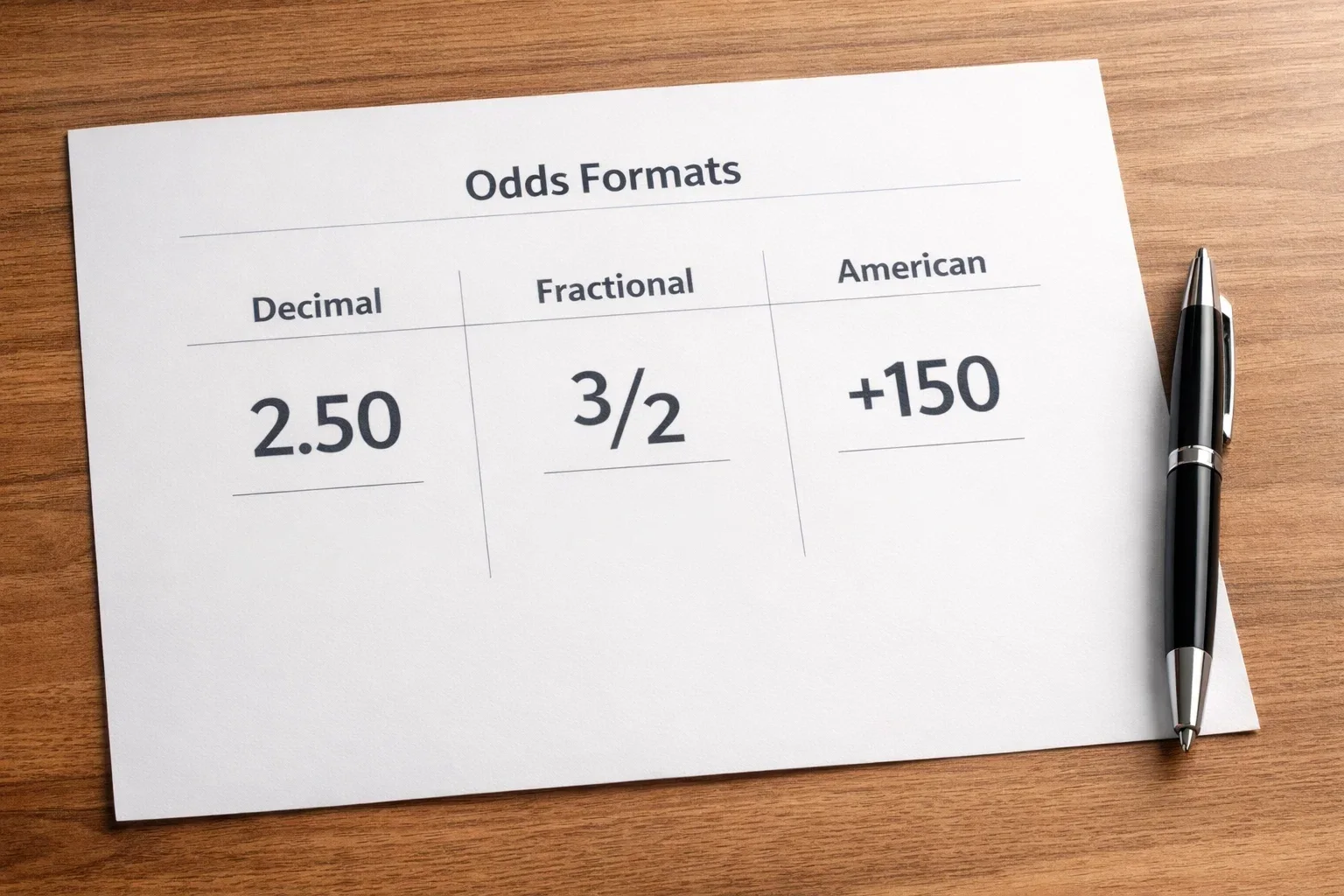
Every betting odd corresponds to an implied probability — the chance of an outcome occurring that the odds would represent in a fair market. A coin flip at true odds would be 2.00 decimal (1/1 fractional, +100 American), implying exactly 50% probability for each side. When bookmakers offer 1.91 on each side instead, they’re pricing both outcomes at 52.4% implied probability, which totals 104.8%. That extra 4.8% is their margin.
Understanding implied probability transforms how you evaluate bets. Instead of thinking “Manchester City at 1.50 seems about right,” you can think “1.50 implies 66.7% probability of City winning. Do I believe they have better than a two-thirds chance?” If your assessment is that City wins 75% of matches like this, the bet offers value. If you think their true probability is closer to 60%, you should avoid it or look for better prices elsewhere.
Calculating implied probability becomes second nature with practice. For decimal odds, just divide 1 by the number. Odds of 1.80 imply 55.5% probability. Odds of 3.00 imply 33.3%. Odds of 5.00 imply 20%. Mental math gets you close enough for quick evaluations: odds around 2.00 mean roughly 50-50, odds around 3.00 mean roughly one-in-three, odds around 4.00 mean one-in-four.
The gap between implied probability and your own probability estimate is where profit lives. Bookmakers set odds based on their models, public betting patterns, and margin requirements. They get it right most of the time, but they’re not omniscient. Finding spots where you genuinely believe the true probability exceeds the implied probability — and being correct about that often enough — is the entire game.
Practical Application: What This Means for Your Betting
Fluency with odds isn’t about impressing anyone with quick mental conversions. It’s about making better decisions faster. When you see Chelsea at 2.10 with one bookmaker and 2.25 with another, you should immediately recognise that the second price is meaningfully better — not just “higher” but offering approximately 7% better returns. Over hundreds of bets, those differences compound dramatically.
Odds literacy also protects you from common mistakes. Bettors who don’t understand probability sometimes chase long odds without recognising how unlikely those outcomes really are. Odds of 15.00 (14/1, +1400) imply just 6.7% probability — roughly one chance in fifteen. Those bets feel exciting when they land, but they need to land more than once in fifteen attempts just to break even. If you’re backing them because “anything can happen in football,” you’re ignoring mathematics that will catch up with you.
The most practical skill is rapid conversion to implied probability. Before placing any bet, get in the habit of asking: “What probability is this price implying, and do I think the true probability is higher?” That simple question separates strategic betting from hoping for lucky outcomes. You won’t always be right, but over time, consistently identifying positive expected value situations is the only sustainable path to profit.
