
Understanding Overround and Bookmaker Margins in Football Betting
 Available in US
Bookmakers are not charitable institutions. They exist to make money, and they do so by building a mathematical advantage into every market they offer. This advantage goes by several names — overround, margin, vigorish, vig, juice — but the concept is the same: the odds you’re offered are always slightly worse than fair probability would dictate. Understanding how this works, how to calculate it, and why it matters is fundamental to becoming a more informed bettor. Ignore the margin, and you’re essentially playing a game where the rules are stacked against you without knowing by how much.
The good news is that bookmaker margins aren’t hidden or mysterious. With basic arithmetic, you can calculate exactly how much edge the bookmaker has built into any market. Armed with that knowledge, you can compare bookmakers, identify which ones offer better value, and make more informed decisions about where and when to place your bets.
What Exactly Is Overround?
In a perfectly fair betting market, the implied probabilities of all possible outcomes would add up to exactly 100%. A coin toss has two outcomes, each with 50% probability, totalling 100%. A football match has three main outcomes — home win, draw, away win — and their true probabilities also sum to 100%. But bookmakers don’t offer true probabilities. They shorten the odds on every outcome just enough to guarantee themselves a profit regardless of what happens.
When you calculate the implied probability from the odds offered on each outcome and add them together, you’ll get a number higher than 100%. That excess above 100% is the overround. If the sum of implied probabilities is 105%, the overround is 5%. If it’s 108%, the overround is 8%. The higher the number, the worse the deal for bettors and the better the deal for the bookmaker.
Consider a simple example with even odds. A fair coin toss would be priced at 2.00 on both sides — heads at 2.00 and tails at 2.00. Each outcome has an implied probability of 50%, totalling exactly 100%. But a bookmaker offering 1.91 on both heads and tails is building in margin. The implied probability at odds of 1.91 is 52.36% (calculated as 1 ÷ 1.91). Add both sides together: 52.36% + 52.36% = 104.72%. The overround is 4.72%, and that’s the bookmaker’s expected profit margin on this market.
Calculating Overround in Football Markets
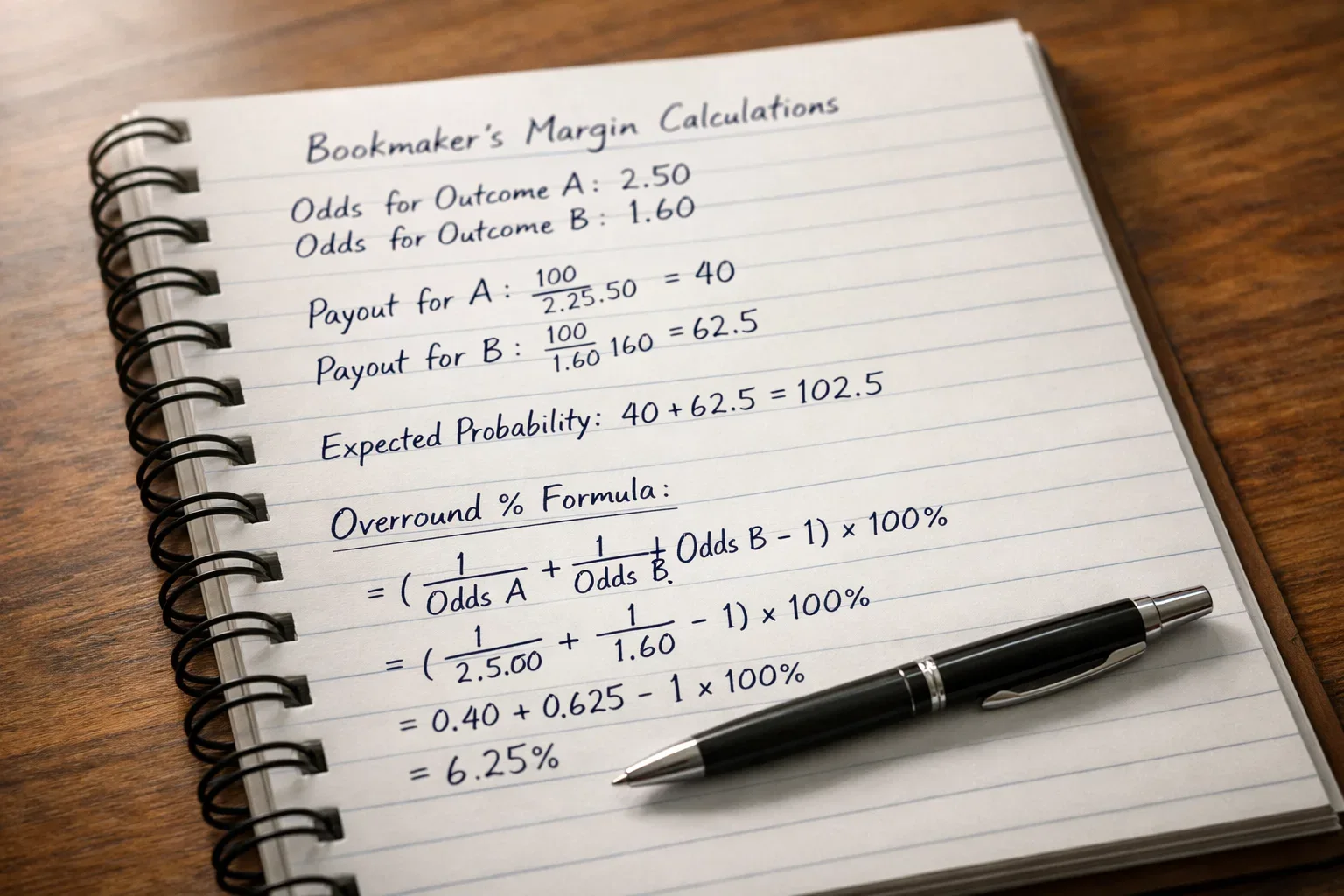
Football’s 1X2 market — home win, draw, away win — is the most common market for analysing bookmaker margins. The calculation requires converting each set of odds to implied probability and summing them up.
The formula for implied probability from decimal odds is: Implied Probability = 1 ÷ Decimal Odds. Once you have all three probabilities, add them together. Anything above 100% is the overround.
Let’s work through a real example. Suppose a bookmaker offers the following odds on Manchester City versus Chelsea: City to win at 1.65, draw at 4.00, Chelsea to win at 5.50. Converting each to implied probability: City win = 1 ÷ 1.65 = 60.6%, Draw = 1 ÷ 4.00 = 25.0%, Chelsea win = 1 ÷ 5.50 = 18.2%. The sum is 60.6% + 25.0% + 18.2% = 103.8%. The overround on this market is 3.8%.
A 3.8% margin might not sound like much, but it compounds over time. If you bet consistently on markets with this margin, and the bookmaker’s odds accurately reflect true probabilities, you’d expect to lose roughly 3.7% of your total stake over the long run (calculated as 1 – 100/103.8 = 0.037). That’s the price of playing the game — unless you can find genuine value by identifying where the bookmaker’s odds underestimate the true probability of an outcome.
Why Margins Vary Between Bookmakers
Not all bookmakers charge the same margin, and these differences matter enormously for long-term profitability. Sharp bookmakers like Pinnacle typically operate with margins of 2-3% on major football leagues, accepting lower profit per bet in exchange for higher volume and attracting professional bettors. Recreational bookmakers may run margins of 6-10% on the same fixtures, knowing their casual customer base is less price-sensitive and more focused on promotions and user experience.
The type of market also affects margin size. Mainstream 1X2 markets on Premier League or Champions League matches tend to have the tightest margins because competition between bookmakers is fiercest for these high-profile events. Move to over/under goals or both teams to score markets, and margins typically widen. Venture into correct score, first goalscorer, or other exotic markets, and you’ll often find overrounds exceeding 20% or even 30%. The bookmaker knows fewer bettors are comparing prices on these niche markets, so they can get away with charging more.
League popularity plays a similar role. Premier League margins are tight because millions of people bet on these games, and bookmakers compete aggressively for their business. Lower league or obscure foreign league matches carry larger margins because there’s less competition and less sophisticated money flowing into these markets. Bookmakers also face higher uncertainty in pricing these games, so they protect themselves with wider margins.
The Compounding Problem with Accumulators
If there’s one thing bookmakers love, it’s accumulator bets. And there’s a mathematical reason for that enthusiasm beyond the long odds against all legs winning. When you combine multiple selections into an accumulator, the overround compounds with each added leg.
Consider a four-fold accumulator where each individual market has a 5% overround. The combined overround isn’t 20% (4 × 5%). Instead, it’s calculated by multiplying the overround factors: 1.05 × 1.05 × 1.05 × 1.05 = 1.216, or a 21.6% combined overround. A ten-fold accumulator at the same individual margins would compound to 1.05^10 = 1.629, or a staggering 62.9% overround. The bookmaker’s edge grows exponentially with each selection you add.
This compounding effect explains why bookmakers promote accumulators so enthusiastically with “acca insurance” and bonus offers. They’re already making massive margins on these bets; throwing back a small percentage as promotional value still leaves them with a far better deal than they’d get on single bets. The person betting ten-fold accumulators every weekend is the bookmaker’s ideal customer — not because they never win, but because even when they do win, the overall structure of their betting guarantees the bookmaker profits heavily in the long run.
Using Margin Calculations to Find Better Value
Understanding overround isn’t just academic — it’s a practical tool for becoming a sharper bettor. The first application is straightforward: compare margins across bookmakers for the same fixture. If one bookmaker offers 103% on a match while another offers 107%, you should obviously bet with the first one, all else being equal. The 4% difference in margin represents real money over time.
Line shopping — checking prices across multiple bookmakers before placing any bet — becomes more meaningful when you understand what you’re looking for. Sometimes the best price is obvious: one bookmaker simply offers higher odds on your selection. But sometimes the picture is more nuanced. A bookmaker might offer slightly lower odds on your specific selection but have a much tighter overall market. In competitive markets, odds are usually correlated, so tighter margins often translate to better prices somewhere in the book.
You can also use overround analysis to identify markets worth avoiding entirely. Correct score markets with 25%+ overrounds are essentially designed to extract money from recreational bettors attracted to long odds without understanding how poor those odds really are. A market with 30% overround means the bookmaker expects to keep roughly £30 of every £100 wagered — that’s not a game you can expect to beat without exceptional edge.
Removing the Margin: Calculating True Odds
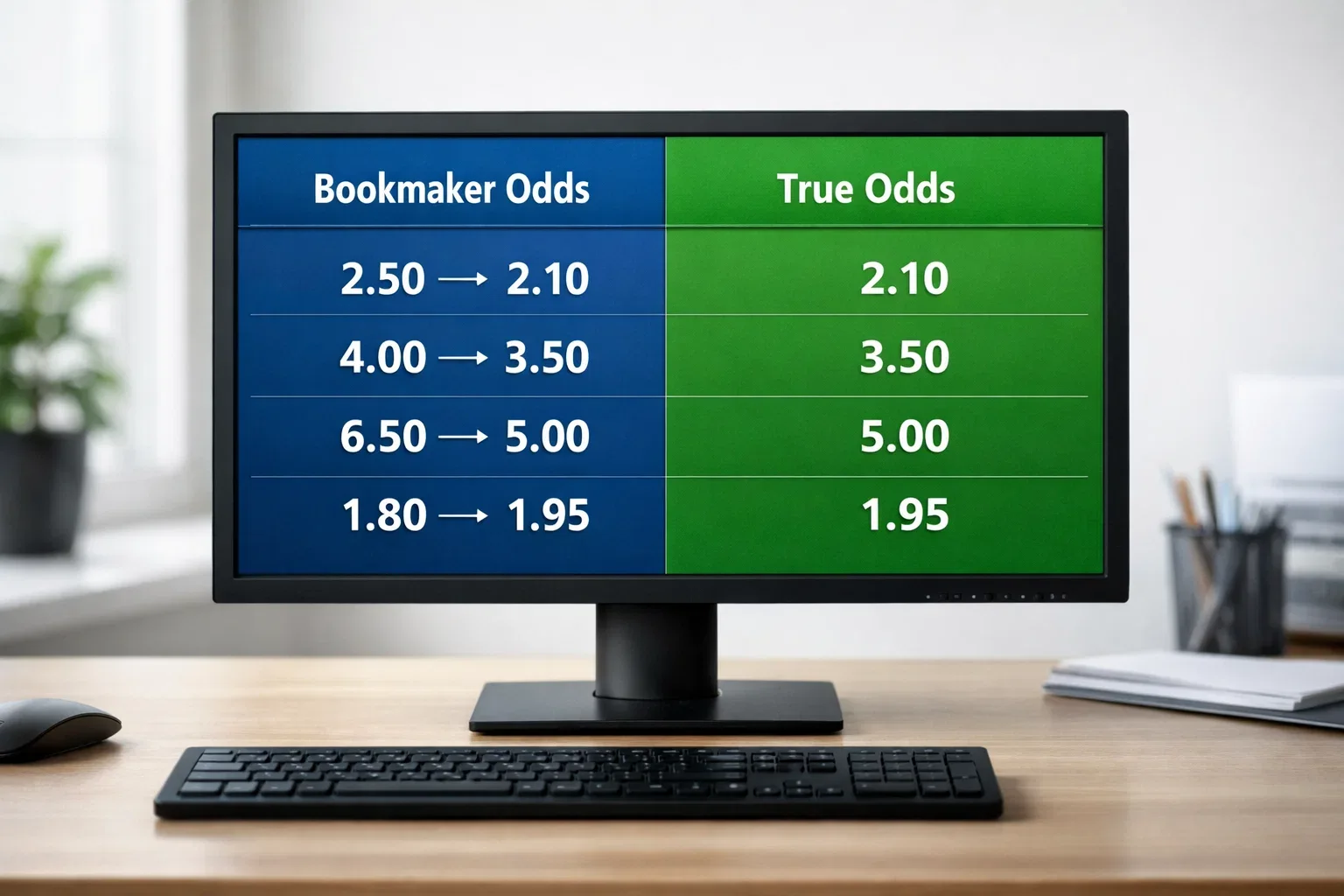
Once you know the overround, you can estimate what the “true” odds should be — the odds the bookmaker would offer in a perfectly fair market with zero margin. This helps you assess whether a particular price represents value compared to your own probability estimate.
The simplest method is proportional distribution: divide each implied probability by the overround percentage to get normalised probabilities that sum to 100%. Using our earlier example with 103.8% overround: City’s true probability = 60.6% ÷ 1.038 = 58.4%, Draw’s true probability = 25.0% ÷ 1.038 = 24.1%, Chelsea’s true probability = 18.2% ÷ 1.038 = 17.5%. These now sum to 100%.
To convert back to odds, take the inverse: True City odds = 1 ÷ 0.584 = 1.71, True draw odds = 1 ÷ 0.241 = 4.15, True Chelsea odds = 1 ÷ 0.175 = 5.71. These “true” odds represent what a fair market would look like. When a bookmaker actually offers odds better than these calculated true odds, you may have found value — assuming the original market was reasonably efficient.
This method has limitations. It assumes the bookmaker applies margin evenly across all outcomes, which isn’t always true. Research consistently shows bookmakers tend to shade odds more heavily on longshots than favourites — a phenomenon called the favourite-longshot bias. The 5.50 price on Chelsea in our example may incorporate more margin than the 1.65 on City. More sophisticated margin removal techniques account for this, but for practical purposes, the proportional method provides useful approximation.
What Margins Mean for Long-Term Results
Let’s put concrete numbers on what margins cost you. Suppose you bet £100 on 100 different football matches over a season, each in markets with 5% average overround. If the bookmaker’s odds perfectly reflect true probabilities, your expected loss is approximately £4.76 per £100 wagered, or about £476 over 100 bets totalling £10,000 in stakes.
Reducing average margin from 5% to 3% through better bookmaker selection would lower expected losses to about £285 on the same £10,000 staked. The £191 difference is pure savings just from shopping around and understanding margin — no improvement in selection ability required.
Of course, the goal isn’t just to minimise losses but to find situations where your edge exceeds the margin. If you genuinely identify value bets where true probability exceeds implied probability by more than the margin, you can profit despite the bookmaker’s edge. But the margin is always working against you, which is why serious bettors obsess about finding the best prices. Giving away unnecessary margin is like spotting your opponent points before the game starts.
Practical Takeaways for Smarter Betting
First, calculate margin on markets before betting, or use an online overround calculator. Knowing you’re betting into a 4% margin market versus a 12% margin market changes how you think about the bet. Second, hold accounts with multiple bookmakers and always compare prices before placing bets. The bookmaker offering the best odds on your selection is usually the one with the tightest margin, though not always. Third, be especially wary of accumulator promotions designed to make you feel clever while actually exploiting the compounding margin effect.
Fourth, recognise that exotic markets like correct score, first goalscorer, and halftime/fulltime generally carry much higher margins than standard 1X2 or over/under markets. These aren’t inherently bad bets, but you need proportionally larger edge to overcome the proportionally larger margin. Fifth, consider betting exchanges like Betfair for single bets, where there’s no overround — just commission on winning bets. The effective margin on exchanges is typically 1-2%, far lower than most bookmakers.
Understanding overround won’t make you a winning bettor by itself. But ignoring it guarantees you’re operating at a permanent disadvantage. The bookmaker’s margin is the house edge you’re playing against, and just like in a casino, you need to understand the rules before you can hope to beat them.
