
Value Betting in Football: How to Find Profitable Bets
 Available in US
Value betting is the only sustainable path to long-term profit in football betting. The concept is deceptively simple: bet when the probability of an outcome occurring exceeds the probability implied by the bookmaker’s odds. A team priced at 3.00 implies 33% probability. If your analysis suggests they actually win 40% of the time, you’ve found value — and betting value consistently produces profits over time, regardless of individual outcomes. This isn’t about picking winners; it’s about identifying when odds are wrong and exploiting that error systematically.
Most bettors focus on predicting match outcomes, treating betting as a prediction contest. Value bettors think differently. They recognise that correctly predicting a 25% probability event makes you right about once every four attempts — a losing proposition if the odds only pay 2.50 (40% implied). But incorrectly predicting a 35% probability event at odds of 4.00 (25% implied) still generates profit over hundreds of bets. The question isn’t “will this happen?” but “are the odds high enough to justify betting?”
Understanding Expected Value
Expected value (EV) quantifies whether a bet is profitable in the long run. Positive expected value (+EV) means the bet generates profit over sufficient repetitions; negative expected value (-EV) means it loses money. The formula is straightforward:
EV = (Probability of Winning × Potential Profit) – (Probability of Losing × Stake)
Suppose you estimate Chelsea have 45% probability of beating Liverpool, and the bookmaker offers 2.60 on Chelsea. Your potential profit at £100 stake is £160. Your expected value is:
(0.45 × £160) – (0.55 × £100) = £72 – £55 = +£17 per bet
Over 100 such bets at these parameters, you’d expect to profit approximately £1,700. Individual bets will win or lose unpredictably, but the mathematical edge compounds over volume.
Conversely, if your probability estimate is only 35% but you bet anyway because Chelsea “look good”:
(0.35 × £160) – (0.65 × £100) = £56 – £65 = -£9 per bet
This bet loses money long-term even though Chelsea might win this specific match. Understanding EV separates recreational bettors (who celebrate wins) from value bettors (who celebrate positive expected value regardless of outcome).
Estimating True Probabilities
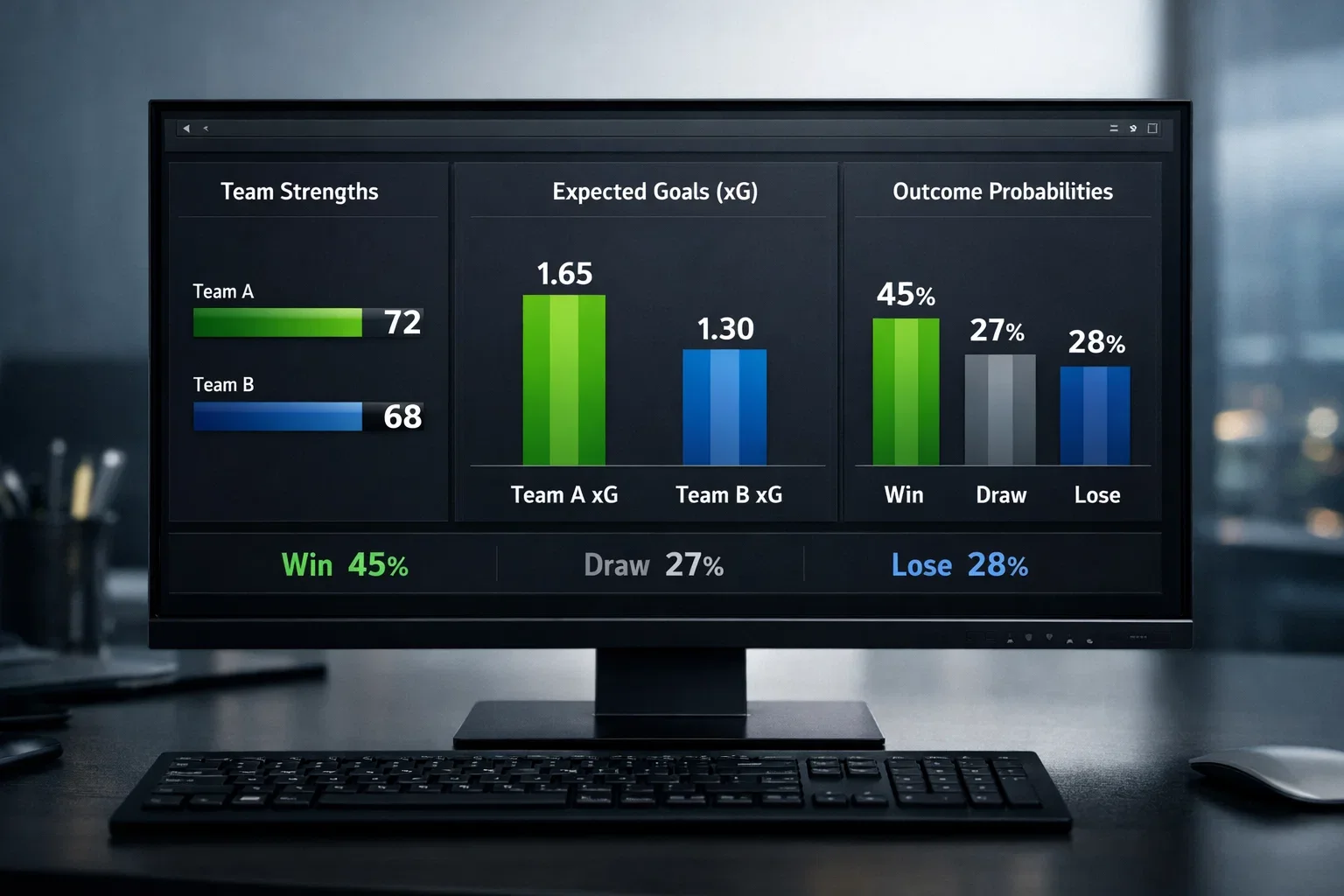
Value betting requires accurate probability estimation — not just knowing something is possible, but quantifying how likely it is. Several approaches exist, from simple models to sophisticated data science.
Historical base rates provide starting points. In most top leagues, home teams win approximately 45% of matches, draws occur 27%, and away wins happen 28%. Adjusting from these baselines based on team quality gives rough probability estimates without complex modelling.
Power ratings and Elo systems assign numerical strength values to teams, updating after each match. The rating difference between teams maps to expected match outcomes. Free Elo ratings exist for major leagues; more sophisticated bettors build proprietary rating systems incorporating more variables.
Expected goals (xG) models estimate goal-scoring probability from match statistics. Teams consistently outperforming or underperforming their xG are candidates for regression — creating value opportunities when bookmakers price based on actual goals rather than underlying chance creation.
Poisson distribution models calculate scoreline probabilities from expected goals, enabling probability estimates for match outcomes, goal totals, and Asian handicaps. Building a Poisson model in Excel requires only basic formulas and public data.
Machine learning approaches can incorporate dozens of variables (form, injuries, travel distance, rest days, head-to-head records) to generate probability estimates. These require programming knowledge and substantial historical data but can capture patterns simpler models miss.
The approach matters less than the discipline. Any systematic method that generates probability estimates you can compare against bookmaker odds enables value identification. Gut feeling doesn’t count — “I reckon they’ve got about a 60% chance” without underlying analysis is just guessing.
Using Pinnacle as the Benchmark
Pinnacle is the world’s sharpest football bookmaker, accepting winning bettors, offering tight margins, and adjusting lines based on sophisticated bettor action rather than limiting accounts. Their closing odds — the final prices available before matches start — represent the market’s best estimate of true probability, incorporating all available information and money-backed opinions.
This makes Pinnacle closing lines a powerful benchmark. If Pinnacle closes at 2.00 on a selection you backed at 2.30 elsewhere, you obtained Closing Line Value (CLV). You bet at better odds than the sharpest market ultimately determined were fair. Research consistently shows that bettors who beat Pinnacle closing lines are profitable; those who don’t are not.
Using Pinnacle for value detection is straightforward: compare Pinnacle’s current prices to odds available at other bookmakers. If Pinnacle offers 1.85 on a selection while Bet365 offers 1.95, the Bet365 price potentially offers value — the sharp market implies higher probability than Bet365’s odds suggest.
This approach works because recreational bookmakers (Bet365, William Hill, Paddy Power, etc.) price partly based on where they expect public money to flow, not purely on probability. They might shorten odds on popular teams to limit liability while offering generous prices on unfancied sides. Sharp-to-soft comparison identifies these discrepancies.
The limitation is that you’re not developing genuine analytical edge — you’re identifying bookmaker pricing errors relative to market consensus. This approach works until bookmakers limit your accounts for winning consistently, which happens faster than many expect.
Building Your Own Probability Model
Developing independent probability estimates, rather than relying solely on sharp bookmaker comparison, creates sustainable edge that doesn’t depend on bookmaker tolerance.
Start simple. Calculate each team’s attacking and defensive strength ratings from goals scored and conceded, adjusted for opponent quality. Use these to estimate expected goals for each team in upcoming fixtures. Apply Poisson distribution to convert expected goals into match outcome probabilities.
Validate your model against historical results. A well-calibrated model predicts 50% events that actually happen 50% of the time, 70% events that happen 70% of the time, and so on. If your model says something will happen 60% of the time but it actually happens 45% of the time, your model is miscalibrated and needs adjustment.
Incorporate factors your model initially ignores: home advantage variations between teams, form fluctuations, injury impacts, manager changes, fixture congestion. Each additional variable potentially improves accuracy but also increases complexity and overfitting risk.
Compare your model’s outputs against bookmaker odds across hundreds of matches before risking real money. If your model consistently identifies “value” that doesn’t produce actual profit when tracked, either your model is wrong or your value threshold is too low.
Tracking and Measuring Performance
Without rigorous record-keeping, you cannot distinguish skill from luck or identify which aspects of your approach work versus fail.
Record every bet with full details: date, match, selection, market, odds taken, stake, estimated probability, and result. Calculate running metrics: total stakes, total returns, profit/loss, ROI (return on investment as percentage of stakes), and yield (profit per unit staked).
Track Closing Line Value specifically. For each bet, record the Pinnacle closing odds alongside your bet odds. Calculate CLV percentage: (Your Odds / Closing Odds – 1) × 100. Positive CLV indicates you beat the closing line; negative indicates you paid worse than fair value.
Over a sufficient sample (500+ bets minimum for statistical significance), analyse performance by market type, league, odds range, and other variables. You may discover strong edge in Asian handicap markets but negative returns in over/under goals — indicating where to focus future betting.
Review regularly. Monthly analysis of what’s working and what isn’t enables strategy refinement. Annual reviews should examine whether your overall approach remains profitable or whether edge has been eroded by market efficiency improvements.
Managing Variance and Bankroll

Even with genuine edge, variance creates losing runs that test discipline and bankroll. A bettor with 3% true ROI will experience months of losses through pure probability. Understanding and planning for this variance is essential.
Calculate the probability of various drawdown scenarios given your edge and average odds. A bettor flat-staking 2% of bankroll per bet with 3% edge at average odds of 2.00 has roughly 5% probability of experiencing a 30% bankroll drawdown before doubling their bankroll. Knowing these probabilities prevents panic-selling profitable strategies during inevitable bad runs.
Use fixed-percentage staking (betting a constant percentage of current bankroll) rather than fixed-unit staking (betting the same amount regardless of bankroll changes). Fixed-percentage reduces stake sizes during losing runs, preventing ruin, while increasing stakes during winning runs, compounding profits.
Kelly Criterion provides mathematically optimal stake sizing based on edge and odds. Full Kelly is too aggressive for most bettors (leading to significant drawdowns); half-Kelly or quarter-Kelly provides substantial profit capture with manageable variance.
Never chase losses. Increasing stakes after losses amplifies variance without increasing edge. A value bet at 2% of bankroll isn’t suddenly a better value bet at 5% of bankroll just because you lost the previous three bets.
Practical Value Betting Workflow
Develop a systematic daily or weekly routine for identifying and placing value bets.
Pre-match analysis (2-3 days before fixtures): Generate probability estimates for upcoming matches using your model. Compare to opening bookmaker odds. Note potential value opportunities requiring monitoring.
Odds monitoring (ongoing): Track how odds move as match approaches. Early value may disappear if odds shorten; late value may emerge if odds drift. Use odds comparison tools or software to monitor across multiple bookmakers efficiently.
Line shopping (at bet placement): Before placing any bet, check odds across all available bookmakers. The same selection might be 2.10 at one book and 2.30 at another — always take the best available price. Even small odds differences compound significantly over time.
Bet placement (when value is confirmed): Place bets when your probability estimate creates positive expected value at current odds after accounting for margin. Document everything immediately.
Post-match review: After results, update records, analyse whether outcomes are tracking expectations, and identify any patterns suggesting model calibration issues.
Common Mistakes and How to Avoid Them
Overconfidence in probability estimates leads to false value identification. If you estimate 55% probability but the true probability is 48%, betting at 1.90 (52.6% implied) destroys bankroll while feeling like value. Always question whether your estimates are genuinely more accurate than the market’s.
Insufficient sample sizes make results meaningless. Fifty bets cannot distinguish between 3% edge and random luck. You need hundreds or thousands of bets before drawing confident conclusions about your strategy’s profitability.
Ignoring market information leaves money on the table. When sharp money moves a line from 2.30 to 2.00, that movement contains information. Your 2.30 bet might have been value initially, but if the market consensus disagrees so strongly, consider why.
Betting too many markets spreads analysis thin. Focusing on one league and two or three market types enables deeper expertise than superficially covering everything. Edge comes from knowing something the market doesn’t — that requires specialisation.
Account restrictions end many value betting careers. Bookmakers limit winning accounts, sometimes after surprisingly small profits. Maintain accounts at multiple bookmakers, spread betting activity, and avoid patterns (like always taking the best odds) that flag you as a sharp.
Value betting is simple in concept but demanding in execution. It requires probability modelling skills, emotional discipline during variance, meticulous record-keeping, and patience to let edge compound over time. Those who master these elements find football betting can indeed be profitable — not through lucky picks, but through systematic exploitation of market inefficiencies.
